
1st Grade Math Worksheets, Lessons and Tests (Free PDF)
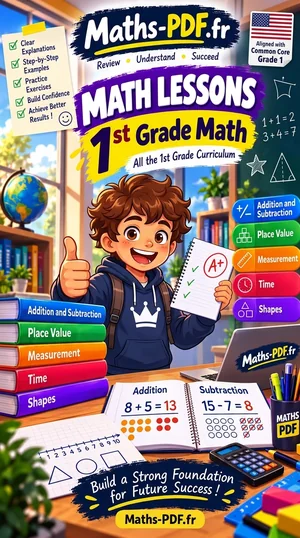
These grade 1 math worksheets follow the Common Core State Standards chapter by chapter: each chapter has a lesson, a worksheet of at least 20 worksheet problems with solutions, a timed test with its answer key and an online quiz, all with a free PDF.
Key takeaway: 1st grade math builds number sense to 120: adding and subtracting within 20, word problems, place value with tens and ones, comparing two-digit numbers, measuring lengths with units, telling time to the half hour, and sorting shapes by their attributes.
Grade 1 math worksheets: all chapters
1. Counting and Numbers to 20
Count objects up to 20 · Understand a ten frame · Find one more and one less · Count on from any number
2. Counting to 120
Count on from any number · Read and write numbers past 99 · Count a big group
3. Tens and Ones
Understand a ten · Understand 10, 20, 30, and the other tens · Read the blocks
6. Subtraction Within 20
Understand subtraction · Count back · Subtract through ten · Understand a fact family
7. The Equal Sign and Word Problems
Tell if an equation is true or false · Find the unknown number · Add three numbers · Solve a word problem
8. Adding and Subtracting Tens Within 100
Add ones to a two-digit number · Add tens to a number · Find 10 more or 10 less · Subtract tens
9. Measuring Length
Understand length · Compare and order objects by length · Measure length with units
10. Telling Time to the Hour and Half Hour
Understand telling time · Read a time on the hour · Read a time on the half hour
11. Organizing and Reading Data
Understand data · Understand a picture graph · Understand a bar graph · Find how many more or how many fewer
12. 2D and 3D Shapes
Understand an attribute of a shape · Understand 3D shapes · Name a shape
What students learn in 1st grade math
First grade is the year when counting turns into real number sense. Children learn that 14 is one ten and four ones, so they can add and subtract within 20 using strategies instead of counting on their fingers every time.
Next, they compare two-digit numbers, measure objects with a repeated unit, read clocks to the half hour and sort shapes by their attributes. As a result, a strong 1st grader can explain how they got an answer, not only give it.
- Operations: adding and subtracting within 20, making ten, and solving one-step word problems.
- Number and place value: counting to 120, tens and ones, and comparing numbers with <, > and =.
- Measurement and data: ordering lengths, telling time to the half hour, and reading simple charts.
- Geometry: naming 2D and 3D shapes, and splitting circles and rectangles into halves and fourths.
A year plan with these grade 1 math worksheets
Start with addition and subtraction facts, because every later chapter uses them. Then, spend the middle of the year on place value, so two-digit numbers make sense before measurement and time. Finally, keep shapes for the spring, when children enjoy hands-on work. In addition, ten minutes of the quick practice a few times a week keeps facts fresh.
How to use these grade 1 math worksheets
Pick a chapter, read its one-page lesson, then solve the worksheet on paper and check every answer with the solutions page. Take the ten-question quiz to see what is still unclear, and finish with the timed test. Every page can be printed from its PDF button, and the quick practice at the bottom of each page gives ten new questions at every visit.
1st Grade math: common questions
What should a 1st grader know in math?
By the end of 1st grade, children add and subtract within 20, understand tens and ones, count to 120, compare two-digit numbers and tell time to the half hour.
How long are the 1st grade tests?
Each 1st grade test is short, about 30 minutes, with simple instructions and pictures a young child can follow.
Can parents use these worksheets at home?
Yes. Every lesson and worksheet prints on US Letter paper, and every worksheet has its solutions on a separate page.
Are the pages free?
Yes. All lessons, worksheets, tests, solutions and quizzes are free to read and to download as PDF.
How many addition facts should a 1st grader know by heart?
By the end of the year, most children add and subtract within 10 fluently and within 20 with a strategy such as making ten. For example, 8 + 5 becomes 8 + 2 + 3 = 13.
How long should a 1st grade math session last?
Short sessions work best. Fifteen to twenty minutes of focused work, such as one lesson page or half a worksheet, keeps attention high. Then, stop while the child is still successful.
