1st Grade Addition Within 20 Test with Answer Key (Free PDF)

This 1st grade addition within 20 test covers addition within 20 (Common Core 1.OA.A.1, 1.OA.B.3, 1.OA.C.6, 1.OA.C.5), with a free PDF to print.
Key takeaway: This test helps Grade 1 teachers and parents check whether students can add within 20 with understanding.
- Topic: Addition Within 20 (1st grade)
- Content: 8 questions with point values, about 45 minutes
- Standards: 1.OA.A.1, 1.OA.B.3, 1.OA.C.6, 1.OA.C.5
- Answers: On a separate page, so you can try every worksheet problem first
- Format: Free printable PDF, US Letter, black and white
This test helps Grade 1 teachers and parents check whether students can add within 20 with understanding. It covers counting on, doubles, switching the order, three-number sums, and comparing sums.
The test has 8 questions worth 20 points. First, students write an addition sentence from counters and solve quick facts. Then they read a number line hop, rewrite a sum, add three numbers, and compare sums. Finally, they solve a bead story and fill a ten frame. Plan for 30 minutes, and read questions aloud if a student needs support.
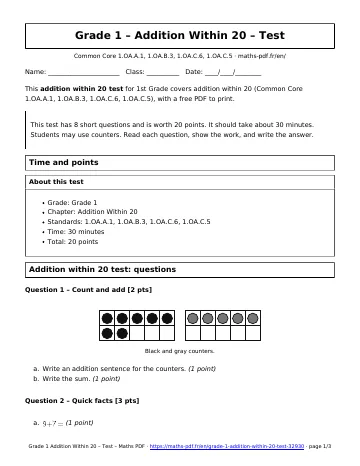
This test has 8 short questions and is worth 20 points. It should take about 30 minutes. Students may use counters. Read each question, show the work, and write the answer.
Key takeaway: This Grade 1 test on Addition Within 20 works as a class assessment or a timed review at home: time and points, 1st grade addition within 20 test: questions and test-taking strategy. The detailed answer key with scoring is on a separate page; free PDF.
Time and points
- Grade: Grade 1
- Chapter: Addition Within 20
- Standards: 1.OA.A.1, 1.OA.B.3, 1.OA.C.6, 1.OA.C.5
- Time: 30 minutes
- Total: 20 points
1st grade addition within 20 test: questions
1 – Count and add [2 pts]
- Write an addition sentence for the counters. (1 point)
- Also, write the sum. (1 point)
2 – Quick facts [3 pts]
- \(9 + 7 =\) (1 point)
- \(5 + 0 =\) (1 point)
- \(6 + 6 =\) (1 point)
3 – Hop on the number line [2 pts]
- Write the addition sentence for the hop. (1 point)
- Where does the hop end? (1 point)
4 – Flip the addends [2 pts]
- Rewrite \(6 + 9\) with the addends swapped. (1 point)
- Write the sum of both sentences. (1 point)
5 – Three numbers [3 pts]
- Find \(3 + 9 + 7\). (2 points)
- Find \(8 + 5 + 5\). (1 point)
6 – Compare [2 pts]
First, write <, > or = in each circle.
- \(7 + 6\) and \(8 + 4\) (1 point)
- \(9 + 3\) and \(6 + 6\) (1 point)
7 – Bead story [3 pts]
Aisha has 8 red beads and 6 blue beads. How many beads does she have in all? Write an addition sentence and the answer.
8 – Fill the frame [3 pts]
- How many counters move to fill the first frame? (1 point)
- Write \(10 +\) and the leftover. (1 point)
- Find the sum of \(8 + 7\). (1 point)

Key facts behind this 1st grade addition within 20 test
- The sum is the total. In 5 + 3 = 8, the sum is 8.
- Counting on: start at the bigger number and count up the smaller one.
- Make a ten: 8 + 5 = 10 + 3 = 13.
- Doubles help: 6 + 6 = 12, so 6 + 7 = 13.
- Order does not matter, and adding 0 leaves a number the same.
Common mistakes with this 1st grade addition within 20 test
- Students may think adding zero makes a number disappear. For example, 7 + 0 stays 7. Remind them that adding zero means nothing is added.
- With three numbers, children add the first two and forget the third. First, circle all three numbers. Then look for a pair that makes ten.
- Also, when comparing sums, students look at the first addends only. Instead, find each sum first, then compare them. For example, compare 5 + 6 with 4 + 8 by finding both totals.
Test-taking strategy
- Start with the quick facts. Finishing easy items first builds confidence, and it leaves more time for the story problem.
- Next, on the ten frame question, count how many empty boxes there are. That number tells how many counters must move to fill the frame.
- Also, parents can practice at home by asking one fact at a time on a walk or a car ride. Mixed doubles and make a ten facts work well.
Download the 1st grade addition within 20 test as a PDF with the button below and keep it with your notes.
1st grade addition within 20 test: frequently asked questions
What should a first grader do when stuck on an addition fact?
Use a strategy. Then, start at the bigger number and count on, or look for a double. For example, for 6 + 7, think 6 + 6 is 12, then add one more. Drawing small dots is also allowed in most classrooms.
How can parents help a child prepare for this test?
Practice ten minutes a day for a week with doubles, make a ten, and counting on. Next, use real objects like coins or snack pieces. Also, avoid long drills, and end each session with an easy win.
Why does the test include a ten frame question?
The ten frame shows how make a ten works. For example, with 9 + 4, the frame holds 9 counters and has one empty box. Moving one counter from the 4 fills the ten. Then 3 are left over.
All Grade 1 chapters: Grade 1 math.