1st Grade Addition Within 20 Lesson: Notes and Examples (Free PDF)


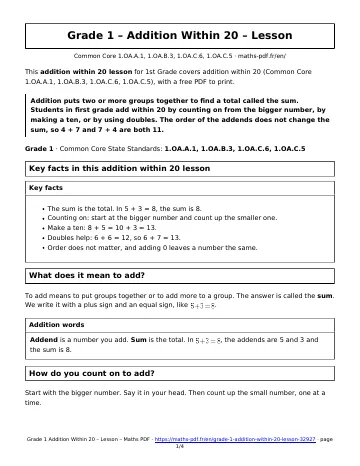
This 1st grade addition within 20 lesson covers addition within 20 (Common Core 1.OA.A.1, 1.OA.B.3, 1.OA.C.6, 1.OA.C.5), with a free PDF to print.
Key takeaway: This lesson helps Grade 1 students add two numbers with a sum up to 20 using strategies instead of only counting.
- Topic: Addition Within 20 (1st grade)
- Content: One-page lesson with a definition, a worked example and key facts
- Standards: 1.OA.A.1, 1.OA.B.3, 1.OA.C.6, 1.OA.C.5
- Answers: Explanations included
- Format: Free printable PDF, US Letter, black and white
Key takeaway: A clear Grade 1 lesson on Addition Within 20, with definitions, rules and worked examples: what does it mean to add, how do you count on to add and how do you make a ten. Read it before the practice worksheet; free to print or download as a PDF.
Addition puts two or more groups together to find a total called the sum. Students in first grade add within 20 by counting on from the bigger number, by making a ten, or by using doubles. The order of the addends does not change the sum, so 4 + 7 and 7 + 4 are both 11.
This lesson helps Grade 1 students add two numbers with a sum up to 20 using strategies instead of only counting. Children learn counting on, doubles, near doubles, and making a ten.
The lesson begins with the meaning of a sum and a simple count of two groups. It then teaches counting on from the bigger number, adding zero, and switching the order of the addends. The last part covers making a ten for facts like 8 + 5 and adding three numbers. Plan about ten minutes, with counters or ten frames on the table.
Grade 1 · Common Core State Standards: 1.OA.A.1, 1.OA.B.3, 1.OA.C.6, 1.OA.C.5
Key facts in this 1st grade addition within 20 lesson
- The sum is the total. In 5 + 3 = 8, the sum is 8.
- Counting on: start at the bigger number and count up the smaller one.
- Make a ten: 8 + 5 = 10 + 3 = 13.
- Doubles help: 6 + 6 = 12, so 6 + 7 = 13.
- Order does not matter, and adding 0 leaves a number the same.
What does it mean to add?
To add means to put groups together or to add more to a group. The answer is called the sum. We write it with a plus sign and an equal sign, like \(5 + 3 = 8\).
How do you count on to add?
Start with the bigger number. Say it in your head. Then count up the small number, one at a time.
Counting on 1 gives the next number. Counting on 2 gives the number two steps up.
How do you make a ten?
Ten is an easy number to work with. Fill a ten frame first, then add what is left.
- Look at the bigger number. How many more make 10?
- Take that many from the other number.
- Add 10 and the leftover.
Example: \(8 + 5\). Two more make 10 from 8. Take 2 from 5, and 3 is left. \(10 + 3 = 13\).
What are doubles?
A doubles fact adds a number to itself. Doubles are easy to remember. Then you can use them for near doubles. If \(6 + 6 = 12\), then \(6 + 7\) is one more, so it is 13.
Does the order matter?
No. You can add in any order and the sum stays the same. Adding zero changes nothing. With three numbers, look for two that make 10 first.
1st grade addition within 20 lesson: questions and answers
What is the sum in addition?
The sum is the answer to an addition problem. It tells how many there are in all. In 6 + 2 = 8, the sum is 8.
Why start counting on from the bigger number?
You have fewer steps to count. For 2 + 9, start at 9 and count on 2 to get 11. That is faster than starting at 2.
What does make a ten mean?
It means you move some counters so that one ten frame is full. Then you add the leftover ones. For 9 + 4, move 1 to make 10, and 3 are left, so the sum is 13.
Can I switch the numbers when I add?
Yes. The sum stays the same in any order. So 3 + 8 = 8 + 3 = 11. This is a big help when one order is easier.
How is counting on 2 like adding 2?
Both give the same answer. To add 2 to 15, say 16, 17. You land on 17, so 15 + 2 = 17.
Common mistakes with this 1st grade addition within 20 lesson
- Children count on but include the starting number, so 6 + 2 becomes 9. Say the start number once, then count two more: seven, eight. The answer is the last number said.
- Some students start at the smaller number, as in 2 + 9, and count nine times. Switch the order and start at 9. Then only two counts are needed.
- Also, when making a ten for 9 + 4, students move the wrong number of counters. Then, look at the ten frame: 9 needs one more to fill it. Next, take 1 from the 4, leaving 10 + 3.
How to study this chapter
- Learn the doubles up to 10 + 10 as a set. Once 7 + 7 is known, 7 + 8 is just one more, and 6 + 7 is one less than 7 + 7.
- Next, use a ten frame at home with small toys or coins. Fill the frame first, then count what is left over. This makes the make a ten strategy visible.
- Also, teachers can ask students to explain two ways to solve one fact, like 8 + 6. Comparing doubles and make a ten builds flexible thinking.
Download the 1st grade addition within 20 lesson as a PDF with the button below and keep it with your notes.
More questions about 1st grade addition within 20 lesson
What are the best addition strategies for first grade?
The best strategies are counting on, doubles, near doubles, and make a ten. Counting on works well when one number is small. Doubles and near doubles help with facts like 6 + 7. Making a ten works for facts such as 9 + 5, which becomes 10 + 4.
How many addition facts should a first grader know by heart?
Most first grade standards ask students to add and subtract fluently within 10 and to use strategies within 20. Fast recall of all facts within 20 is a longer goal that continues into second grade. Strategy practice comes first, and speed follows.
How do you add three numbers like 6 + 4 + 5?
Look for two numbers that make ten, then add the third. In 6 + 4 + 5, the 6 and 4 make 10, and 10 + 5 is 15. You can add numbers in any order, so pick the pair that is easiest to combine first.
All Grade 1 chapters: Grade 1 math.
More 1st Grade math
Lessons
See all





Worksheets
See all Counting and Numbers to 20 Worksheets with Answers
- Counting to 120 Worksheets with Answers
- Comparing Two-Digit Numbers Worksheets with Answers
- Telling Time to the Hour and Half Hour Worksheets with Answers
- Adding and Subtracting Tens Within 100 Worksheets with Answers
- Tens and Ones Worksheets with Answers





Tests
See all





Quizzes
See all- Adding and Subtracting Tens Within 100 Quiz: 10 Questions with Answers
- Subtraction Within 20 Quiz: 10 Questions with Answers
- Counting and Numbers to 20 Quiz: 10 Questions with Answers
- Addition Within 20 Quiz: 10 Questions with Answers
- 2D and 3D Shapes Quiz: 10 Questions with Answers
- Comparing Two-Digit Numbers Quiz: 10 Questions with Answers