1st Grade Comparing Two-Digit Numbers Worksheets with Answers (Free PDF)
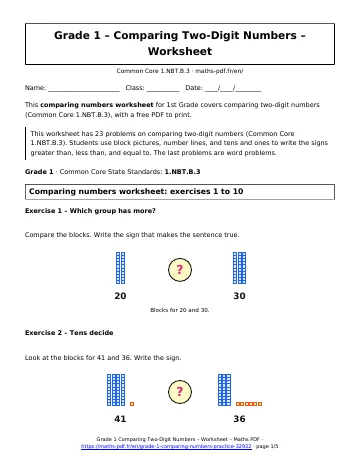
This 1st grade comparing numbers worksheet covers comparing two-digit numbers (Common Core 1.NBT.B.3), with a free PDF to print.
Key takeaway: This worksheet helps Grade 1 students practice comparing two-digit numbers and ordering them.
- Topic: Comparing Two-Digit Numbers (1st grade)
- Content: 23 worksheet problems, from easy to challenging
- Standards: 1.NBT.B.3
- Answers: On a separate page, so you can try every worksheet problem first
- Format: Free printable PDF, US Letter, black and white
This worksheet helps Grade 1 students practice comparing two-digit numbers and ordering them. First, children use base-ten blocks. Then they move toward mental comparison and short word problems.
The 23 problems start with blocks, then write signs for pairs of numbers. Next, they circle greater and lesser numbers, use a number line, and order lists. Finally, they decide true or false, solve stories about stickers and tickets, and explain a mistake. Allow 25 to 30 minutes. Blocks or a number line on the desk are welcome helpers.
Key takeaway: This Grade 1 worksheet on Comparing Two-Digit Numbers gives 23 problems, from warm-up questions to harder applications. The answer key is on a separate page; free printable PDF.
Grade 1 · Common Core State Standards: 1.NBT.B.3
1st grade comparing numbers worksheet: worksheet problems 1 to 10
1 – Which group has more?
First, compare the blocks. Write the sign that makes the sentence true.
2 – Tens decide
Next, look at the blocks for 41 and 36. Write the sign.
3 – Compare 45 and 54
Replace the ? with >, <, or =.
\(45 \quad ? \quad 54\)
4 – Same number
Replace the ? with >, <, or =.
\(67 \quad ? \quad 67\)
5 – Switch the digits
Replace the ? with >, <, or =.
\(82 \quad ? \quad 28\)
6 – Big ones, small tens
Replace the ? with >, <, or =.
\(39 \quad ? \quad 41\)
7 – Zero ones
Replace the ? with >, <, or =.
\(90 \quad ? \quad 19\)
8 – Same tens
Replace the ? with >, <, or =.
\(53 \quad ? \quad 58\)
9 – Circle the greater
Now, circle the greater number: \(76\) or \(67\).
10 – Circle the lesser
Also, circle the lesser number: \(34\) or \(43\).
Worksheet problems 11 and up
11 – Number line
First, look at the number line. Which number is greater, 43 or 47? Write a comparison with a sign.
12 – Missing digit
Next, name a digit that can replace the ? to make the comparison true: \(7? < 72\).
13 – Order three numbers
Then, write the numbers from least to greatest: \(58\), \(85\), \(49\).
14 – Order from greatest
Now, write the numbers from greatest to least: \(31\), \(13\), \(37\).
15 – Compare the ones
Also, both numbers have 6 tens: \(62\) and \(68\). Which has more ones? Write the comparison.
16 – True or false (a)
First, is this true or false? \(71 > 69\)
17 – True or false (b)
Next, is this true or false? \(45 < 38\)
18 – Sticker books
Maya has 63 stickers. Jamal has 36 stickers. Who has more stickers? Write a comparison.
19 – Little League tickets
Now, the Hawks sold 48 tickets. The Owls sold 51 tickets. Which team sold fewer tickets?
20 – Pages read
Priya read 29 pages. Ethan read 29 pages. Who read more pages?
21 – Jars of beads
First, three jars have 72, 27, and 70 beads. Which jar has the most beads? Which has the fewest?
Worksheet problem 22 and after
22 – Tens and ones story
Sofia has 5 tens and 4 ones. Liam has 4 tens and 9 ones. Write both numbers. Then write a comparison.
23 – Fix the mistake
Diego says \(19 > 21\) because 9 is more than 1. Explain his mistake.

Key facts behind this 1st grade comparing numbers worksheet
- Compare the tens digits first.
- Next, if the tens match, compare the ones digits.
- The signs are greater than, less than, and equal to.
- Then, the open mouth of the sign points to the greater number.
- On a number line, the number farther right is greater.
Common mistakes with this 1st grade comparing numbers worksheet
- Children often compare only the ones digits. For example, 38 and 41 look different because 8 is big. Instead, compare the tens first, because 3 tens is less than 4 tens.
- When digits are switched, students think the numbers are equal. For example, 16 and 61 use the same digits. However, the places differ, so the numbers are not equal.
- Numbers that end in zero can confuse students. For example, 70 and 17 look odd because 17 has a 7 too. Count tens, because 7 tens is far more than 1 ten.
Tips before you start the worksheet problems
- First, circle the tens digits in every pair before writing a sign. Then the habit of looking left saves most errors.
- Read each finished sentence aloud, such as forty is greater than thirty-two. Also, listen for whether it sounds true.
- Also, teachers can use the mistake problem for discussion. Having a student explain why a classmate is wrong builds language and reasoning together.
Download the 1st grade comparing numbers worksheet as a PDF with the button below and keep it with your notes.
1st grade comparing numbers worksheet: frequently asked questions
What should a child do when two numbers have the same tens digit?
Compare the ones digits. For example, 72 and 75 both have 7 tens, so look at the ones. 5 ones is more than 2 ones, so 75 is greater. If the ones also match, the numbers are equal.
How do I help a child who mixes up the signs?
Use blocks and say the comparison in words before writing the sign. Then draw the sign as a mouth that opens toward the greater number. Then, practice with just five pairs a day, and check each one aloud.
What does a missing digit problem teach?
It teaches that comparing needs place value. For example, in 5? greater than 52, the tens match, so the ones digit must be greater than 2. Several digits can work, which is new for many first graders.
All Grade 1 chapters: Grade 1 math.
More 1st Grade math
Lessons
See all


Worksheets
See all



Tests
See all


Quizzes
See all Comparing Two-Digit Numbers Quiz: 10 Questions with Answers
- Organizing and Reading Data Quiz: 10 Questions with Answers
- 2D and 3D Shapes Quiz: 10 Questions with Answers
- Halves and Fourths Quiz: 10 Questions with Answers
- Counting to 120 Quiz: 10 Questions with Answers
- Addition Within 20 Quiz: 10 Questions with Answers