1st Grade Tens and Ones Lesson: Notes and Examples (Free PDF)


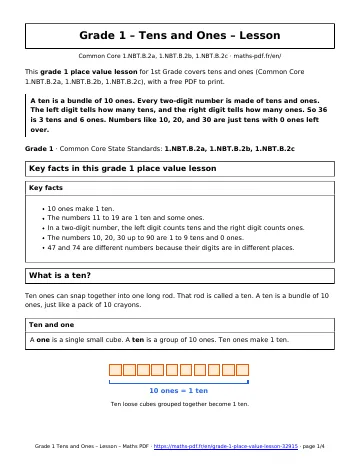
This 1st grade place value lesson covers tens and ones (Common Core 1.NBT.B.2a, 1.NBT.B.2b, 1.NBT.B.2c), with a free PDF to print.
Key takeaway: This lesson helps Grade 1 students understand tens and ones in two-digit numbers.
- Topic: Tens and Ones (1st grade)
- Content: One-page lesson with a definition, a worked example and key facts
- Standards: 1.NBT.B.2a, 1.NBT.B.2b, 1.NBT.B.2c
- Answers: Explanations included
- Format: Free printable PDF, US Letter, black and white
Key takeaway: A clear Grade 1 lesson on Tens and Ones, with definitions, rules and worked examples: what is a ten, how are the numbers 11 to 19 built and how do tens and ones make a two-digit number. Read it before the practice worksheet; free to print or download as a PDF.
A ten is a bundle of 10 ones. Every two-digit number is made of tens and ones. The left digit tells how many tens, and the right digit tells how many ones. So 36 is 3 tens and 6 ones. Numbers like 10, 20, and 30 are just tens with 0 ones left over.
This lesson helps Grade 1 students understand tens and ones in two-digit numbers. Children learn that ten ones make one ten and that each digit in a number has a place and a value.
The lesson begins with bundling ten cubes into one rod. It shows that the teen numbers are 1 ten and some ones, and that a number like 58 is 5 tens and 8 ones. It also explains why 40 has a zero and why 47 and 74 are different numbers. Plan about ten minutes, with base-ten blocks or drawings of rods and dots.
Grade 1 · Common Core State Standards: 1.NBT.B.2a, 1.NBT.B.2b, 1.NBT.B.2c
Key facts in this 1st grade place value lesson
- 10 ones make 1 ten.
- The numbers 11 to 19 are 1 ten and some ones.
- Next, in a two-digit number, the left digit counts tens and the right digit counts ones.
- The numbers 10, 20, 30 up to 90 are 1 to 9 tens and 0 ones.
- 47 and 74 are different numbers because their digits are in different places.
What is a ten?
Ten ones can snap together into one long rod. That rod is called a ten. A ten is a bundle of 10 ones, just like a pack of 10 crayons.
How are the numbers 11 to 19 built?
Every number from 11 to 19 is 1 ten and some extra ones. Look at 14. A full ten frame shows the ten. Four more dots sit in the next frame.
So \(14\) means 1 ten and 4 ones. In the same way, \(17\) is 1 ten and 7 ones.
How do tens and ones make a two-digit number?
A two-digit number has two digits. The digit on the left tells how many tens. The digit on the right tells how many ones.
| Number | Tens | Ones |
|---|---|---|
| \(35\) | 3 | 5 |
| \(62\) | 6 | 2 |
| \(40\) | 4 | 0 |
What are 10, 20, 30, and the other tens?
The numbers 10, 20, 30, up to 90 have tens and no extra ones. So 3 tens is \(30\) and 6 tens is \(60\). The zero is a place keeper. It says there are 0 ones.
How do you read the blocks?
- Count the long rods. That number is the tens digit.
- Count the small cubes. That number is the ones digit.
- Write the tens digit first, then the ones digit.
Example. Sofia has 4 rods and 7 cubes. The tens digit is 4. The ones digit is 7. She writes \(47\).
Be careful with the order. \(47\) is 4 tens and 7 ones, but \(74\) is 7 tens and 4 ones. They are different numbers.
1st grade place value lesson: questions and answers
What is a ten in first grade math?
A ten is a group of 10 ones. You can see it as 10 loose cubes or as one long rod. Counting by tens is faster than counting every cube.
What do the two digits in a number like 58 mean?
The 5 is in the tens place, so it means 5 tens. The 8 is in the ones place, so it means 8 ones. Together 58 is 5 tens and 8 ones.
Why does the number 40 have a zero?
The zero shows that there are 0 ones. Without it, 4 would look like just 4 ones. The 4 tens and the 0 ones together make 40.
How are the teen numbers built?
Each number from 11 to 19 is 1 ten and some ones. For example, 16 is 1 ten and 6 ones. A ten frame that is full plus a few extra dots shows it well.
What is the fastest way to count base-ten blocks?
Count the rods by tens, then add the loose cubes. If you see 5 rods and 2 cubes, you say 10, 20, 30, 40, 50, then 51, 52. The number is 52.
Common mistakes with this 1st grade place value lesson
- Students read 58 as 5 and 8 instead of 5 tens and 8 ones. Then, say the value of each digit aloud: fifty is 5 tens, and eight is 8 ones.
- Children think 47 and 74 are the same because the digits match. Next, build both with blocks. 47 has 4 rods and 7 cubes, while 74 has 7 rods and 4 cubes.
- Also, when writing 6 tens, students write 6 and leave out the zero. Six tens and no ones is 60. The zero holds the ones place.
How to study this chapter
- Count blocks by tens first, then ones. With 4 rods and 3 cubes, say 10, 20, 30, 40, 41, 42, 43. This is faster than counting every cube.
- Next, use bundles of straws or craft sticks with rubber bands. Making your own tens helps children see why ten ones become one ten.
- Also, parents can ask for the tens and ones in house numbers, ages, and page numbers. Everyday numbers make place value real.
Download the 1st grade place value lesson as a PDF with the button below and keep it with your notes.
More questions about 1st grade place value lesson
What does the zero in a number like 40 mean?
The zero shows that there are no ones. The 4 means 4 tens, and the 0 holds the ones place so the 4 stays in the tens place. Without the zero, the number would look like 4, which is only 4 ones.
What is the difference between the digit and the value of a digit?
The digit is the symbol, and the value is how much it is worth. In 58, the digit 5 has a value of 50 because it is in the tens place. The digit 8 has a value of 8 because it is in the ones place.
How do you break apart a number like 73 into tens and ones?
Look at each digit. The 7 means 7 tens, or 70, and the 3 means 3 ones. So 73 is 7 tens and 3 ones, or 70 + 3. Drawing seven rods and three dots shows the same thing with a picture.
All Grade 1 chapters: Grade 1 math.
More 1st Grade math
Lessons
See all Telling Time to the Hour and Half Hour Lesson: Notes and Examples
- Halves and Fourths Lesson: Notes and Examples
- Organizing and Reading Data Lesson: Notes and Examples
- Addition Within 20 Lesson: Notes and Examples
- Subtraction Within 20 Lesson: Notes and Examples
- Counting and Numbers to 20 Lesson: Notes and Examples




Worksheets
See all



Tests
See all


Quizzes
See all- The Equal Sign and Word Problems Quiz: 10 Questions with Answers
- Measuring Length Quiz: 10 Questions with Answers
- Counting and Numbers to 20 Quiz: 10 Questions with Answers
- 2D and 3D Shapes Quiz: 10 Questions with Answers
- Adding and Subtracting Tens Within 100 Quiz: 10 Questions with Answers
- Subtraction Within 20 Quiz: 10 Questions with Answers