1st Grade Counting to 120 Lesson: Notes and Examples (Free PDF)

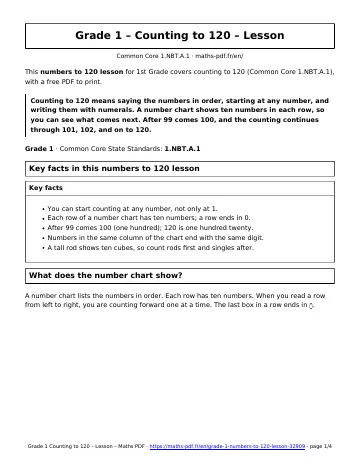
This 1st grade counting to 120 lesson covers counting to 120 (Common Core 1.NBT.A.1), with a free PDF to print.
Key takeaway: This lesson helps Grade 1 students count, read, and write numbers up to 120.
- Topic: Counting to 120 (1st grade)
- Content: One-page lesson with a definition, a worked example and key facts
- Standards: 1.NBT.A.1
- Answers: Explanations included
- Format: Free printable PDF, US Letter, black and white
Key takeaway: A clear Grade 1 lesson on Counting to 120, with definitions, rules and worked examples: what does the number chart show, how do you count on from any number and how do you read and write numbers past 99. Read it before the practice worksheet; free to print or download as a PDF.
Counting to 120 means saying the numbers in order, starting at any number, and writing them with numerals. A number chart shows ten numbers in each row, so you can see what comes next. After 99 comes 100, and the counting continues through 101, 102, and on to 120.
This lesson helps Grade 1 students count, read, and write numbers up to 120. Children learn to start counting at any number, cross the tricky step from 99 to 100, and use a number chart to see patterns.
The lesson shows how each row of a chart has ten numbers and how a column always ends in the same digit. It explains how to write numbers such as one hundred twelve and how to count rods of ten and single cubes. Plan about ten minutes, with a number chart from 1 to 120 on the table.
Grade 1 · Common Core State Standards: 1.NBT.A.1
Key facts in this 1st grade counting to 120 lesson
- You can start counting at any number, not only at 1.
- Next, each row of a number chart has ten numbers; a row ends in 0.
- After 99 comes 100 (one hundred); 120 is one hundred twenty.
- Numbers in the same column of the chart end with the same digit.
- A tall rod shows ten cubes, so count rods first and singles after.
What does the number chart show?
A number chart lists the numbers in order. Each row has ten numbers. When you read a row from left to right, you are counting forward one at a time. The last box in a row ends in \(0\).
How do you count on from any number?
- Say the number where you start.
- Say the next number in the row. If you reach the end of a row, go to the first box of the next row.
- Stop at the number you need.
Example: Start at \(58\) and count to \(62\). Say \(58\), \(59\), \(60\), \(61\), \(62\). The row ends at \(60\), so \(61\) is the first box in the next row.
How do you read and write numbers past 99?
After \(99\) comes \(100\), which is read one hundred. Then the counting keeps going: \(101\) is one hundred one, and \(110\) is one hundred ten. The last number to know in Grade 1 is \(120\), one hundred twenty.
| Numeral | Word |
|---|---|
| \(45\) | forty-five |
| \(76\) | seventy-six |
| \(99\) | ninety-nine |
| \(100\) | one hundred |
| \(105\) | Also, one hundred five |
| \(112\) | one hundred twelve |
| \(120\) | one hundred twenty |
How can you count a big group?
Group things in tens. A tall rod stands for ten cubes. Count the rods one ten at a time, then add the single cubes by counting on. Here, say \(10\), \(20\), \(30\), then \(31\), \(32\), \(33\), \(34\).
Look for patterns. All the numbers in one column of the chart end in the same digit: \(3\), \(13\), \(23\), \(33\), \(43\).
1st grade counting to 120 lesson: questions and answers
Can I start counting at a number other than 1?
Yes. Pick any starting number, such as 73, and say the numbers that come next: 74, 75, 76. The order never changes.
What number comes after 99?
The number after 99 is 100, read as one hundred. It is the first three-digit number. Then comes 101.
How do you write one hundred twelve?
Write 1 for the hundred, then the number 12 after it. That makes 112.
What pattern do you see in one column of the chart?
All numbers in one column end with the same digit. In the column with 5, you find 5, 15, 25, 35, and more.
What is the biggest number to count to in Grade 1?
First graders count to 120. The number 120 is read one hundred twenty. You can count on from any smaller number until you reach it.
Common mistakes with this 1st grade counting to 120 lesson
- Students say ninety-nine and then ninety-ten. After 99, every digit rolls over and the next number is 100. Then, say it with the chart: one hundred comes right after ninety-nine.
- When writing one hundred six, children write 1006 or 1060. The number has 1 hundred, 0 tens, and 6 ones, so write 106. Next, say the parts before writing the digits.
- Also, counting rods and cubes, students count every rod as one. Each tall rod is ten cubes. Count the rods by tens first, then add the single cubes at the end.
How to study this chapter
- Point to each number on a 120 chart while counting aloud. Start at different spots, such as 87, so counting does not always begin at 1.
- Next, look at one column of the chart, like 6, 16, 26, 36. Every number ends in 6, which helps children predict the next number without counting.
- Also, parents can count steps, stairs, or toys past 100 together. Counting real things to 120 makes the larger numbers feel familiar.
Download the 1st grade counting to 120 lesson as a PDF with the button below and keep it with your notes.
More questions about 1st grade counting to 120 lesson
Why do first graders count to 120 instead of 100?
The Grade 1 standard asks students to count to 120 so they can see how the pattern continues after 100. Numbers like 101 and 118 show that hundreds, tens, and ones work the same way. It prepares them for three-digit numbers in Grade 2.
How do you count on from a number that is not 1?
Say the starting number first, then say the next numbers in order. To count on from 47, say 47, 48, 49, 50. Do not start over at 1. The skill helps with adding later, since 47 + 3 means counting on three from 47.
How do you read a number chart from 1 to 120?
Read each row from left to right, then move down to the next row. Each row has ten numbers, and each step down adds ten. Numbers in one column end with the same digit, so 7, 17, 27, and 37 are all in the same column.
All Grade 1 chapters: Grade 1 math.
More 1st Grade math
Lessons
See all Addition Within 20 Lesson: Notes and Examples
- Telling Time to the Hour and Half Hour Lesson: Notes and Examples
- Subtraction Within 20 Lesson: Notes and Examples
- Tens and Ones Lesson: Notes and Examples
- Comparing Two-Digit Numbers Lesson: Notes and Examples
- Adding and Subtracting Tens Within 100 Lesson: Notes and Examples





Worksheets
See all


Tests
See all




Quizzes
See all- Telling Time to the Hour and Half Hour Quiz: 10 Questions with Answers
- Measuring Length Quiz: 10 Questions with Answers
- Tens and Ones Quiz: 10 Questions with Answers
- Counting and Numbers to 20 Quiz: 10 Questions with Answers
- Adding and Subtracting Tens Within 100 Quiz: 10 Questions with Answers
- Counting to 120 Quiz: 10 Questions with Answers