1st Grade Tens and Ones Test with Answer Key (Free PDF)

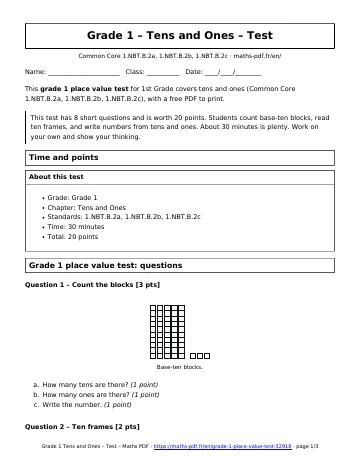
This 1st grade place value test covers tens and ones (Common Core 1.NBT.B.2a, 1.NBT.B.2b, 1.NBT.B.2c), with a free PDF to print.
Key takeaway: This test helps Grade 1 teachers and parents check whether students understand tens and ones.
- Topic: Tens and Ones (1st grade)
- Content: 8 questions with point values, about 45 minutes
- Standards: 1.NBT.B.2a, 1.NBT.B.2b, 1.NBT.B.2c
- Answers: On a separate page, so you can try every worksheet problem first
- Format: Free printable PDF, US Letter, black and white
This test helps Grade 1 teachers and parents check whether students understand tens and ones. It covers base-ten blocks, ten frames, writing numbers, breaking numbers apart, digit meaning, counting by tens, and a bag story.
The test has 8 questions worth 20 points. First, students count tens and ones and read ten frames. Then they write numbers from tens and ones and say what a digit stands for. Finally, they count rods only, solve a cookie bag problem, and check a classmate’s number. Allow 30 minutes for the whole test.
Key takeaway: This Grade 1 test on Tens and Ones works as a class assessment or a timed review at home: time and points, 1st grade place value test: questions and test-taking strategy. The detailed answer key with scoring is on a separate page; free PDF.
Time and points
- Grade: Grade 1
- Chapter: Tens and Ones
- Standards: 1.NBT.B.2a, 1.NBT.B.2b, 1.NBT.B.2c
- Time: 30 minutes
- Total: 20 points
1st grade place value test: questions
1 – Count the blocks [3 pts]
- How many tens are there? (1 point)
- How many ones are there? (1 point)
- Write the number. (1 point)
2 – Ten frames [2 pts]
Next, write the number shown. Then fill in the blanks: it is ___ ten and ___ ones. (2 points)
3 – Write the number [3 pts]
- 3 tens and 9 ones (1 point)
- 8 tens and 0 ones (1 point)
- 1 ten and 2 ones (1 point)
4 – Tens and ones [2 pts]
- \(74\) is ___ tens and ___ ones. (1 point)
- \(90\) is ___ tens and ___ ones. (1 point)
5 – What the digit means [3 pts]
- What does the digit 6 stand for? (1 point)
- What does the digit 8 stand for? (1 point)
- Which digit of \(85\) is in the tens place? (1 point)
6 – Count by tens [2 pts]
First, write the number shown. Then write how many ones it has. (2 points)
7 – Cookie bags [3 pts]
Sofia packs cookies at a bake sale. She fills 6 bags with 10 cookies each. She also has 5 loose cookies.
- How many cookies does she have? (2 points)
- Write the number as tens and ones. (1 point)
8 – Check Noah [2 pts]
- Circle the number with 2 tens and 5 ones: \(52\) \(25\) (1 point)
- Noah says 40 has 4 ones. Is he right? Explain. (1 point)

Key facts behind this 1st grade place value test
- 10 ones make 1 ten.
- The numbers 11 to 19 are 1 ten and some ones.
- Next, in a two-digit number, the left digit counts tens and the right digit counts ones.
- The numbers 10, 20, 30 up to 90 are 1 to 9 tens and 0 ones.
- 47 and 74 are different numbers because their digits are in different places.
Common mistakes with this 1st grade place value test
- When writing a number from tens and ones, students switch the digits. For example, 2 tens and 6 ones is 26, not 62. The tens digit comes first.
- When breaking apart a multiple of ten, students write the wrong ones. For example, 50 is 5 tens and 0 ones, not 5 tens and 5 ones.
- Also, when asked what a digit stands for, children give only the digit. However, in 43, the 4 stands for 4 tens, which is 40.
Test-taking strategy
- Circle the tens and underline the ones before writing a number. This marks each digit’s place and lowers the chance of switching.
- Next, on a bag story, count the full bags by tens first. Then add the loose items, and write both steps.
- Also, parents can review with coins. Dimes are tens and pennies are ones, so a few dimes and pennies make a number of cents.
Download the 1st grade place value test as a PDF with the button below and keep it with your notes.
1st grade place value test: frequently asked questions
How should a student show work on a bag problem?
Write the number of full bags as tens and the loose items as ones. For example, 3 bags of 10 and 5 loose items make 3 tens and 5 ones, or 35. A quick picture of rods and dots also counts as work.
What if a child is not sure which digit is the tens digit?
The tens digit is on the left and the ones digit is on the right. A good memory trick is that the biggest group comes first when we read. For example, in 58, the 5 is tens.
How can children check their answers about tens and ones?
Draw a quick picture of rods and dots and count them again. Then compare the picture to the number. For example, if you wrote 27, the picture should have 2 rods and 7 dots.
All Grade 1 chapters: Grade 1 math.
More 1st Grade math
Lessons
See all Addition Within 20 Lesson: Notes and Examples
- The Equal Sign and Word Problems Lesson: Notes and Examples
- Adding and Subtracting Tens Within 100 Lesson: Notes and Examples
- Counting and Numbers to 20 Lesson: Notes and Examples
- Telling Time to the Hour and Half Hour Lesson: Notes and Examples
- Counting to 120 Lesson: Notes and Examples


Worksheets
See all


Tests
See all


Quizzes
See all- Comparing Two-Digit Numbers Quiz: 10 Questions with Answers
- Measuring Length Quiz: 10 Questions with Answers
- Organizing and Reading Data Quiz: 10 Questions with Answers
- Counting and Numbers to 20 Quiz: 10 Questions with Answers
- 2D and 3D Shapes Quiz: 10 Questions with Answers
- Counting to 120 Quiz: 10 Questions with Answers