1st Grade The Equal Sign and Word Problems Worksheets with Answers (Free PDF)
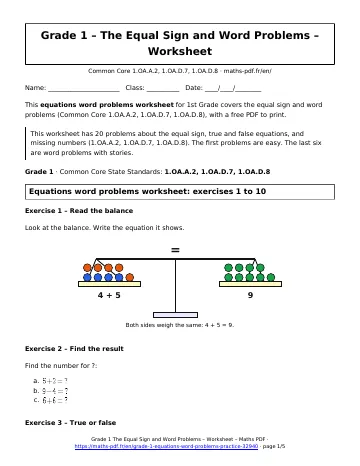
This 1st grade word problems worksheet covers the equal sign and word problems (Common Core 1.OA.A.2, 1.OA.D.7, 1.OA.D.8), with a free PDF to print.
Key takeaway: This worksheet helps Grade 1 students practice the equal sign, missing numbers, and word problems.
- Topic: The Equal Sign and Word Problems (1st grade)
- Content: 20 worksheet problems, from easy to challenging
- Standards: 1.OA.A.2, 1.OA.D.7, 1.OA.D.8
- Answers: On a separate page, so you can try every worksheet problem first
- Format: Free printable PDF, US Letter, black and white
This worksheet helps Grade 1 students practice the equal sign, missing numbers, and word problems. First, children read a balance and test whether equations are true or false. Then they find unknowns in every position.
The 20 problems use a ten frame and a number line. Next, children add three numbers by making ten. Finally, they solve stories about balloons, stickers, grapes, ducks, and points, and decide who is right in a short argument. Plan about 25 minutes. Blocks or a ten frame on the desk are welcome helpers.
Key takeaway: This Grade 1 worksheet on The Equal Sign and Word Problems gives 20 problems, from warm-up questions to harder applications. The answer key is on a separate page; free printable PDF.
Grade 1 · Common Core State Standards: 1.OA.A.2, 1.OA.D.7, 1.OA.D.8
1st grade word problems worksheet: worksheet problems 1 to 10
1 – Read the balance
2 – Find the result
- \(5 + 2 = ?\)
- \(9 – 4 = ?\)
- \(6 + 6 = ?\)
3 – True or false
- \(8 = 8\)
- \(5 + 3 = 8\)
- \(6 = 7\)
4 – Check each sentence
- \(4 + 3 = 7\)
- \(9 – 2 = 6\)
- \(10 = 5 + 5\)
- \(8 + 1 = 10\)
5 – Compare two sides
6 – Make it true
- \(7 = 2 + ?\)
- \(? = 9 – 4\)
- \(3 + 4 = 5 + ?\)
7 – Ten frame
8 – Missing first number
- \(? + 4 = 9\)
- \(? + 6 = 13\)
- \(? + 8 = 15\)
9 – Missing in a take away
- \(12 – ? = 7\)
- \(15 – ? = 9\)
- \(10 – ? = 3\)
10 – Missing start number
- \(? – 3 = 6\)
- \(? – 5 = 8\)
- \(? – 4 = 10\)
Worksheet problems 11 and up
11 – Answer on the left
- \(12 = ? + 5\)
- \(14 = 9 + ?\)
- \(11 = 15 – ?\)
12 – Number line hop
13 – Add three numbers
- \(3 + 4 + 2 = ?\)
- \(5 + 5 + 6 = ?\)
- \(2 + 7 + 3 = ?\)
14 – Make ten first
15 – Balloons at the party
16 – Noah's stickers
17 – Grapes after lunch
18 – Ducks in the pond
19 – Diego's points
Worksheet problem 20 and after
20 – Who is right?

Key facts behind this 1st grade word problems worksheet
- The equal sign = means is the same amount as.
- Next, an equation is true when both sides have the same value.
- The unknown ? can be the first number, the second number, or the answer.
- Then, to add three numbers, look for two that make 10 and add them first.
- A word problem becomes an equation with ? for the missing number.
Common mistakes with this 1st grade word problems worksheet
- Children compare only what they see on each side. Instead, find the value of each side first. For example, check 4 + 3 and 9 – 2 before deciding if they match.
- In missing start problems, children subtract when they should add. For example, in ? – 2 = 7, the start is bigger. Next, add 7 and 2 to find it.
- Also, in take-away stories, students subtract in the wrong direction. First, find which amount is the start. Then decide whether some were added or removed.
Tips before you start the worksheet problems
- Circle the question mark and ask which part of the story it stands for. Naming the unknown first prevents the wrong operation.
- Next, draw a quick picture for each story. For example, draw the start, a box for the change, and a circle around the total.
- Parents and teachers can ask a child to say each true equation in words, such as 12 is the same as 7 plus 5.
Download the 1st grade word problems worksheet as a PDF with the button below and keep it with your notes.
1st grade word problems worksheet: frequently asked questions
How can a ten frame help find a missing number?
The ten frame shows how many more are needed to make 10. For example, 6 counters fill 6 boxes and 4 are empty. So 6 + 4 = 10. The same picture helps with facts like 8 + ? = 10.
What does it mean when an equation is false?
A false equation has different values on the two sides. For example, 6 = 7 is false. Children can fix it by changing a number or by adding to the smaller side until both sides match.
How should a child check a missing number answer?
Put the answer back into the equation and see if both sides match. For example, if you think the missing number in 14 – ? = 9 is 5, check 14 – 5 = 9. This takes only a few seconds.
All Grade 1 chapters: Grade 1 math.
More 1st Grade math
Lessons
See all Halves and Fourths Lesson: Notes and Examples
- Tens and Ones Lesson: Notes and Examples
- Telling Time to the Hour and Half Hour Lesson: Notes and Examples
- Addition Within 20 Lesson: Notes and Examples
- Adding and Subtracting Tens Within 100 Lesson: Notes and Examples
- Measuring Length Lesson: Notes and Examples





Worksheets
See all



Tests
See all



Quizzes
See all- Measuring Length Quiz: 10 Questions with Answers
- Halves and Fourths Quiz: 10 Questions with Answers
- Comparing Two-Digit Numbers Quiz: 10 Questions with Answers
- Tens and Ones Quiz: 10 Questions with Answers
- Organizing and Reading Data Quiz: 10 Questions with Answers
- Subtraction Within 20 Quiz: 10 Questions with Answers