1st Grade Comparing Two-Digit Numbers Test with Answer Key (Free PDF)
This 1st grade comparing numbers test covers comparing two-digit numbers (Common Core 1.NBT.B.3), with a free PDF to print.
Key takeaway: This test helps Grade 1 teachers and parents check whether students can compare and order two-digit numbers.
- Topic: Comparing Two-Digit Numbers (1st grade)
- Content: 8 questions with point values, about 45 minutes
- Standards: 1.NBT.B.3
- Answers: On a separate page, so you can try every worksheet problem first
- Format: Free printable PDF, US Letter, black and white
This test helps Grade 1 teachers and parents check whether students can compare and order two-digit numbers. It focuses on place value, the comparison signs, and number line reasoning.
The test has 8 questions worth 20 points. First, students read blocks and write signs. Then they circle the greater number, order numbers, use a number line, and find a missing digit. Finally, they solve a collection problem and check a classmate’s claim. Plan 30 minutes for the whole test. A short review of tens first, ones second helps before starting.
Key takeaway: This Grade 1 test on Comparing Two-Digit Numbers works as a class assessment or a timed review at home: time and points, 1st grade comparing numbers test: questions and test-taking strategy. The detailed answer key with scoring is on a separate page; free PDF.
Time and points
- Grade: Grade 1
- Chapter: Comparing Two-Digit Numbers
- Standards: 1.NBT.B.3
- Time: 30 minutes
- Total: 20 points
1st grade comparing numbers test: questions
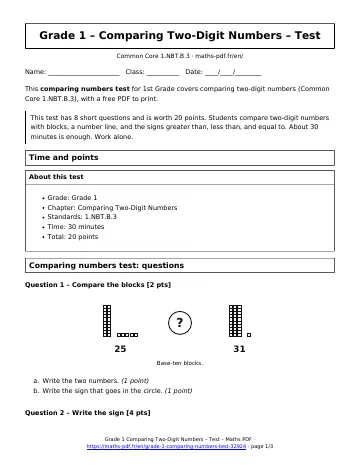
1 – Compare the blocks [2 pts]
- Write the two numbers. (1 point)
- Write the sign that goes in the circle. (1 point)
2 – Write the sign [4 pts]
- \(47 \quad ? \quad 74\) (1 point)
- \(60 \quad ? \quad 60\) (1 point)
- \(88 \quad ? \quad 79\) (1 point)
- \(35 \quad ? \quad 38\) (1 point)
3 – Circle the greater [2 pts]
- Circle the greater number: \(91\) \(19\) (1 point)
- Circle the greater number: \(48\) \(43\) (1 point)
4 – Order the numbers [2 pts]
Now, write these numbers from least to greatest: \(46\), \(64\), \(41\). (2 points)
5 – Number line [2 pts]
Also, write a comparison with a sign for the two points. (2 points)
6 – Missing digit [2 pts]
- Write a digit to replace the ?: \(3? > 36\) (1 point)
- Write a digit to replace the ?: \(8? < 82\) (1 point)
7 – Can collection [3 pts]
Jamal’s class collected 57 cans. Mei’s class collected 75 cans.
- Which class collected more cans? (1 point)
- Write a comparison with a sign. (2 points)
8 – Check Ava [3 pts]
Ava says \(49 > 52\) because 9 is more than 2. Is she right? Explain. (3 points)

Key facts behind this 1st grade comparing numbers test
- Compare the tens digits first.
- Next, if the tens match, compare the ones digits.
- The signs are greater than, less than, and equal to.
- Then, the open mouth of the sign points to the greater number.
- On a number line, the number farther right is greater.
Common mistakes with this 1st grade comparing numbers test
- Students sometimes write the sign backward. Next, check that the open side faces the greater number. For example, in 63 and 36, the open side faces 63.
- When ordering, children use only the ones digit. Instead, compare the tens digits first. Then use the ones digits to break ties.
- When checking a claim, students agree because one digit looks big. For example, someone may say 29 is more than 31 because of the 9. Look at the tens instead.
Test-taking strategy
- Underline the tens digits in each pair before writing a sign. This one habit prevents most mistakes on a comparison test.
- For the number line question, remember that the number farther to the right is greater. Then check the two points before you write the sentence.
- Also, parents can review with two dice. Roll twice to make a two-digit number, roll again for another, and say which one is greater.
Download the 1st grade comparing numbers test as a PDF with the button below and keep it with your notes.
1st grade comparing numbers test: frequently asked questions
How can students check a comparison on a test?
Read the sentence aloud in words. For example, 74 is greater than 47 sounds right because 7 tens is more than 4 tens. If a sentence sounds wrong, look at the tens again. You can also draw quick rods.
What should a child do on a question about someone else’s claim?
Decide if the claim is true, then explain why using place value. Writing one short sentence with the word tens earns the explanation points. For example, 3 tens is less than 5 tens.
How many comparison problems should a first grader practice each day?
Five to eight pairs for about five minutes is a good daily amount. Also, mix pairs with different tens, pairs with the same tens, and pairs with switched digits. Short, regular practice beats a long weekend session.
All Grade 1 chapters: Grade 1 math.
More 1st Grade math
Lessons
See all Organizing and Reading Data Lesson: Notes and Examples
- The Equal Sign and Word Problems Lesson: Notes and Examples
- Addition Within 20 Lesson: Notes and Examples
- Telling Time to the Hour and Half Hour Lesson: Notes and Examples
- Adding and Subtracting Tens Within 100 Lesson: Notes and Examples
- Comparing Two-Digit Numbers Lesson: Notes and Examples



Worksheets
See all


Tests
See all


Quizzes
See all- The Equal Sign and Word Problems Quiz: 10 Questions with Answers
- Adding and Subtracting Tens Within 100 Quiz: 10 Questions with Answers
- Measuring Length Quiz: 10 Questions with Answers
- Counting and Numbers to 20 Quiz: 10 Questions with Answers
- Counting to 120 Quiz: 10 Questions with Answers
- Subtraction Within 20 Quiz: 10 Questions with Answers