
6th Grade Math Worksheets, Lessons and Tests (Free PDF)
These grade 6 math worksheets follow the Common Core State Standards chapter by chapter: each chapter has a lesson, a worksheet of at least 20 worksheet problems with solutions, a timed test with its answer key and an online quiz, all with a free PDF.
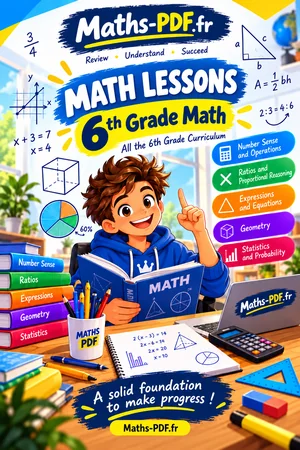
Key takeaway: 6th grade math introduces ratios, rates and percents, division of fractions by fractions, negative numbers and absolute value, the four-quadrant coordinate plane, expressions and one-step equations with variables, area, surface area and volume, and statistical thinking with dot plots, histograms and box plots.
Grade 6 math worksheets: all chapters
1. Ratios and Ratio Language
Understand a ratio · Write and read a ratio · Understand equivalent ratios · Solve a ratio problem with a tape diagram
2. Unit Rates and Rate Language
Understand a rate and a unit rate · Find a unit rate · Use a unit rate to solve problems · Find the better buy
3. Ratio Tables and Graphs of Ratios
Understand a ratio table · Find missing values · Graph a ratio · Compare two ratios with tables
4. Percent as a Rate per 100
Find a percent of a quantity · Find the whole when you know the part
5. Converting Measurement Units with Ratios
To convert measurement units, use a ratio between the two units.
6. Dividing Fractions by Fractions
To divide by a fraction, multiply by its reciprocal: a/b divided by c/d equals a/b times d/c.
7. Multi-Digit and Decimal Operations
Divide multi-digit numbers · Add and subtract decimals · Multiply decimals · Divide by a decimal
8. Greatest Common Factor and Least Common Multiple
Understand factors and multiples · Find the GCF · Find the LCM
9. Integers and Rational Numbers on the Number Line
Understand positive and negative numbers · Use integers to describe real situations · Understand opposites · Graph rational numbers on a number line
10. Ordering Rational Numbers and Absolute Value
Compare rational numbers · Order fractions and decimals · Understand absolute value
11. The Coordinate Plane and Polygons
Understand a reflection · Find distance on the plane · Draw polygons on the plane
12. Exponents and Order of Operations
Understand an exponent · Understand the order of operations · Evaluate an expression with a variable
13. Writing and Reading Algebraic Expressions
Write expressions from words · Understand terms, coefficients, and factors · Read an expression as one thing
14. Equivalent Expressions and the Distributive Property
Understand equivalent expressions · Use the distributive property · Combine like terms · Test whether two expressions are equivalent
15. Solving One-Step Equations
Understand an equation and a solution · Solve equations with addition and subtraction · Solve equations with multiplication and division · Write an equation for a story
16. Inequalities on the Number Line
Understand an inequality · Graph an inequality · Write an inequality from words · Use inequalities in real situations
17. Independent and Dependent Variables
Understand independent and dependent variables · Connect a table, a graph, and an equation · Understand different about y = x + 2
18. Area of Triangles and Polygons
Find the area of a rectangle and a parallelogram · Find the area of a triangle · Find the area of a trapezoid · Find the area of other polygons
19. Volume of Prisms with Fractional Edges
Understand volume · Find volume with fractional edges · Solve volume problems
20. Nets and Surface Area
Understand a net · Find the surface area of a prism · Find the surface area of a pyramid · Handle a triangular prism
21. Statistical Questions and Data Displays
Understand a statistical question · Show data on a dot plot · Read a histogram · Describe a distribution
What students learn in 6th grade math
Sixth grade is the bridge from arithmetic to algebra. Students reason with ratios and rates, divide fractions by fractions, and extend the number line to negative numbers.
In addition, they write and solve one-step equations, use variables in expressions, find areas of triangles and polygons, and start statistics with mean, median and spread. As a result, the year introduces most ideas used in pre-algebra.
- Ratios and proportional relationships: ratio tables, unit rates, percents, and unit conversions.
- The number system: dividing fractions, multi-digit decimals, GCF and LCM, and rational numbers on a number line.
- Expressions and equations: exponents, variables, equivalent expressions, one-step equations, and inequalities.
- Geometry and statistics: area, surface area, volume with fractional edges, and data distributions.
A year plan with these grade 6 math worksheets
Open the year with ratios and rates, because they appear in every later chapter. Then, cover fraction division and negative numbers. After that, spend a long block on expressions and equations, which prepare 7th grade. Finally, finish with geometry and statistics.
How to use these grade 6 math worksheets
Pick a chapter, read its one-page lesson, then solve the worksheet on paper and check every answer with the solutions page. Take the ten-question quiz to see what is still unclear, and finish with the timed test. Every page can be printed from its PDF button, and the quick practice at the bottom of each page gives ten new questions at every visit.
6th Grade math: common questions
What is the hardest topic in 6th grade math?
Ratios and rates are new for most students: comparing two quantities with a table, a double number line or a tape diagram, then finding unit rates and percents.
Do 6th graders learn algebra?
Yes. Students write and evaluate expressions with variables, use properties to write equivalent expressions, and solve one-step equations and inequalities such as x + 7 = 19 or 4x = 36.
How many chapters are in 6th grade math here?
Twenty-two chapters cover the five Common Core domains, each with a lesson, a worksheet of at least 20 worksheet problems, solutions, a test, test solutions and a quiz.
Can I print the worksheets?
Yes. Every page has a free PDF in US Letter format that prints well in black and white.
What is the most important topic in 6th grade math?
Ratios and rates matter most, because they lead to proportions, percents, slope and linear functions. Expressions and one-step equations come a close second, since they start algebra.
How do you divide fractions in 6th grade?
Multiply the first fraction by the reciprocal of the second. For example, 3/4 ÷ 1/2 = 3/4 × 2/1 = 6/4 = 3/2. Then, check with a model: there are one and a half halves in three fourths.
