6th Grade Equivalent Expressions and the Distributive Property Test with Answer Key (Free PDF)
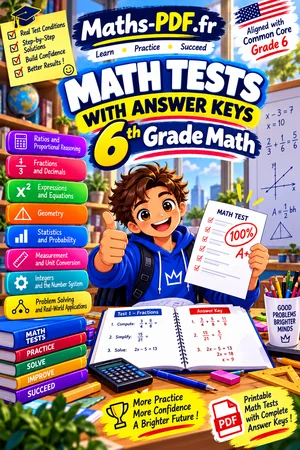
This 6th grade equivalent expressions test covers equivalent expressions and the distributive property (Common Core 6.EE.A.3, 6.EE.A.4), with a free PDF to print.
Key takeaway: This test helps Grade 6 students show that they can write equivalent expressions with the distributive property, factoring, and like terms.
- Topic: Equivalent Expressions and the Distributive Property (6th grade)
- Content: 9 questions with point values, about 45 minutes
- Standards: 6.EE.A.3, 6.EE.A.4
- Answers: On a separate page, so you can try every worksheet problem first
- Format: Free printable PDF, US Letter, black and white
This test helps Grade 6 students show that they can write equivalent expressions with the distributive property, factoring, and like terms. It fits a 45-minute class period and is worth 20 points.
The test has 9 questions. Question 1 distributes over a sum and a difference, question 2 factors out the GCF, and question 3 combines like terms. Also, question 4 uses an area model and question 5 asks whether two expressions are equivalent and why. Question 6 is a spot-the-error problem, and question 7 simplifies a short expression. Questions 8 and 9 are worth 3 points each and cover fencing and a multi-step simplification with a check.
Key takeaway: A printable Grade 6 test on Equivalent Expressions and the Distributive Property, built like a unit assessment: time and points, 6th grade equivalent expressions test: questions and test-taking strategy. The detailed answer key with scoring is on a separate page; free PDF.
Time and points
- Grade: Grade 6
- Chapter: Equivalent Expressions and the Distributive Property
- Standards: 6.EE.A.3, 6.EE.A.4
- Time: 45 minutes
- Total: 20 points
6th grade equivalent expressions test: questions
1 – Distributive property [2 pts]
- Write \(7(x + 2)\) without parentheses.
- Also, write \(4(3a – 5)\) without parentheses.
2 – Factor [2 pts]
- Also, write \(18 + 24y\) as a product of the GCF and a sum.
- Write \(9m – 6\) as a product of the GCF and a difference.
3 – Combine like terms [2 pts]
4 – Area model [2 pts]
Now, write two equivalent expressions for the area of the rectangle shown.
5 – Equivalent or not [2 pts]
6 – Spot the error [2 pts]
First, a student writes 5(x + 3) = 5x + 3. Explain the mistake and write the correct expression.
7 – Simplify [2 pts]
8 – Fencing [3 pts]
Then, a garden is a rectangle with length x + 4 feet and width 3 feet. Write two equivalent expressions for the perimeter. Then find the perimeter when x is 6.
9 – Multi-step simplify [3 pts]

Key facts behind this 6th grade equivalent expressions test
- Equivalent expressions have the same value for every value of the variable.
- Distributive property: a(b + c) = ab + ac.
- Like terms have the same variable part and can be combined.
- Then, factor out the GCF to reverse the distributive property.
- Substitute values to test whether two expressions are equivalent.
Common mistakes with this 6th grade equivalent expressions test
- Multiplying only the first term when distributing. Instead, draw an arrow to every term inside the parentheses.
- Factoring out a smaller factor than the greatest one. Find the greatest common factor of all the terms first.
- Combining like terms before distributing in a multi-step problem. Distribute each product first, then group the variable terms and the constants.
Test-taking strategy
- First, use a check number on the longer questions. Then, substitute \(x = 2\) into the original and final expressions to confirm they match.
- Also start with the quick questions. They give a base of points, and you then have time for the multi-step ones.
- Parents can ask the student to explain, in a sentence, why two expressions are equivalent. For example, using the words multiply each term.
Download the 6th grade equivalent expressions test as a PDF with the button below and keep it with your notes.
6th grade equivalent expressions test: frequently asked questions
How do I explain that two expressions are equivalent?
State the property that connects them and show one step. For example, \(5(x + 2)\) and \(5x + 10\) are equivalent because the distributive property multiplies 5 by x and by 2. A test value, such as \(x = 3\), also supports your explanation.
What should I write for a fencing perimeter question?
Add all the side lengths, then combine like terms. For a rectangle with length \(x + 4\) and width 2, the perimeter is \(2(x + 4) + 2(2)\), which simplifies to \(2x + 12\). Then, state the units if the question gives them.
How do I find a spot-the-error answer?
Compare each step with the property that should have been used. Then, say which step is wrong, give the correct step, and write the right answer. For example, state that 4 must multiply both x and 6 in \(4(x + 6)\).
All Grade 6 chapters: Grade 6 math.
Free printable PDF
6th Grade Equivalent Expressions and the Distributive Property Test with Answer Key
Download PDF
More 6th Grade math
Lessons
See all Independent and Dependent Variables Lesson: Notes and Examples
- Ordering Rational Numbers and Absolute Value Lesson: Notes and Examples
- Inequalities on the Number Line Lesson: Notes and Examples
- Equivalent Expressions and the Distributive Property Lesson: Notes and Examples
- Ratio Tables and Graphs of Ratios Lesson: Notes and Examples
- Dividing Fractions by Fractions Lesson: Notes and Examples


Worksheets
See all- Converting Measurement Units with Ratios Worksheets with Answers
- Ratios and Ratio Language Worksheets with Answers
- Exponents and Order of Operations Worksheets with Answers
- Volume of Prisms with Fractional Edges Worksheets with Answers
- Solving One-Step Equations Worksheets with Answers
- The Coordinate Plane and Polygons Worksheets with Answers




Tests
See all- Ordering Rational Numbers and Absolute Value Test with Answer Key
- Statistical Questions and Data Displays Test with Answer Key
- Ratios and Ratio Language Test with Answer Key
- Volume of Prisms with Fractional Edges Test with Answer Key
- Greatest Common Factor and Least Common Multiple Test with Answer Key
- Unit Rates and Rate Language Test with Answer Key






Quizzes
See all- Converting Measurement Units with Ratios Quiz: 10 Questions with Answers
- Independent and Dependent Variables Quiz: 10 Questions with Answers
- Greatest Common Factor and Least Common Multiple Quiz: 10 Questions with Answers
- Dividing Fractions by Fractions Quiz: 10 Questions with Answers
- Area of Triangles and Polygons Quiz: 10 Questions with Answers
- Writing and Reading Algebraic Expressions Quiz: 10 Questions with Answers