6th Grade Solving One-Step Equations Lesson: Notes and Examples (Free PDF)
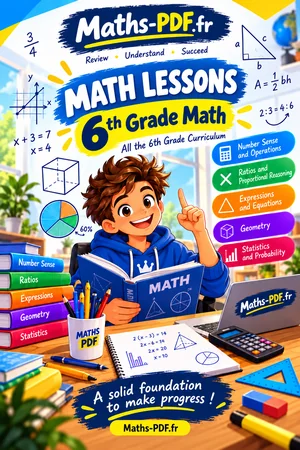
This 6th grade one step equations lesson covers solving one-step equations (Common Core 6.EE.B.5, 6.EE.B.6, 6.EE.B.7), with a free PDF to print.
Key takeaway: This lesson helps Grade 6 students solve one-step equations by undoing the operation that was done to the variable.
- Topic: Solving One-Step Equations (6th grade)
- Content: One-page lesson with a definition, a worked example and key facts
- Standards: 6.EE.B.5, 6.EE.B.6, 6.EE.B.7
- Answers: Explanations included
- Format: Free printable PDF, US Letter, black and white
Key takeaway: This Grade 6 lesson on Solving One-Step Equations explains the key ideas step by step with worked examples: how do you write an equation for a story. Read it before the practice worksheet; free to print or download as a PDF.
To solve a one-step equation, use the inverse operation on both sides. Subtract to undo addition, add to undo subtraction, divide to undo multiplication, and multiply to undo division. For x + 5 = 12, subtract 5 to get x = 7. A solution is the value that makes the equation true, so check it by substitution.
This lesson helps Grade 6 students solve one-step equations by undoing the operation that was done to the variable. An equation is a balanced scale, so whatever you do to one side must also be done to the other side.
The lesson begins with testing whether a number is a solution, then uses tape diagrams to show addition and multiplication equations. Also, it moves on to solving with inverse operations for whole numbers, decimals, and fractions, and ends with writing equations from short stories. Plan about 20 minutes. After each solution, substitute the answer back into the equation to make sure the two sides match.
Grade 6 · Common Core State Standards: 6.EE.B.5, 6.EE.B.6, 6.EE.B.7
Key facts in this 6th grade one step equations lesson
- A solution makes an equation true; check by substituting.
- Do the same operation to both sides to keep the equation balanced.
- Use the inverse operation: add and subtract, multiply and divide.
- Tape diagrams show addition and multiplication equations.
- Write an equation from a story by naming the unknown with a variable.
What is an equation and a solution?
An equation says two expressions are equal, like \(x + 3 = 8\). A solution is a value of the variable that makes the equation true. To test a value, substitute it. Since \(5 + 3 = 8\), the number 5 is a solution.
How do you solve equations with addition and subtraction?
For \(x + 5 = 12\), subtract 5 from both sides to get \(x = 7\). A tape diagram shows the whole 12 split into the parts x and 5.
How do you solve equations with multiplication and division?
For \(3x = 18\), divide both sides by 3 to get \(x = 6\). For \(\frac{x}{5} = 4\), multiply both sides by 5 to get \(x = 20\).
Always check your solution by substituting it into the original equation, not into a step you rewrote. If you solved \(x – 6 = 14\) and got \(x = 20\), check \(20 – 6 = 14\). A correct check proves your work and catches slips such as adding when you should have subtracted. When the equation has a decimal or a fraction, the steps do not change. Only the arithmetic is different, so use what you know about decimals and fractions.
How do you write an equation for a story?
- Choose a variable for the unknown quantity and say what it means.
- Write an equation that matches the story.
- Solve it using the inverse operation.
- Check the answer in the original story.
Example: After spending $14, Maya has $23. Let \(x\) be her starting money. Then \(x – 14 = 23\), so \(x = 23 + 14 = 37\). She started with $37. Equations can also have decimals and fractions, such as \(x + 3.5 = 8.2\), which gives \(x = 4.7\).
6th grade one step equations lesson: questions and answers
What does it mean to solve an equation?
Solving an equation means finding the value of the variable that makes the equation true. For x + 5 = 12, the solution is 7.
How do you check a solution?
Substitute the value for the variable and see whether both sides are equal. For x = 7 in x + 5 = 12, 7 + 5 = 12 is true.
What is an inverse operation?
An inverse operation undoes another operation. Subtraction undoes addition, and division undoes multiplication.
Why do you do the same thing to both sides?
An equation is like a balanced scale. If you change one side, you must change the other so the sides stay equal.
How do you solve an equation with a fraction coefficient?
Multiply both sides by the reciprocal of the fraction. For (2/3)x = 8, multiply by 3/2 to get x = 12.
Common mistakes with this 6th grade one step equations lesson
- Doing the operation on only one side. If you subtract 7 from the left side of \(x + 7 = 12\), you must also subtract 7 from the right side to keep the balance.
- Using the same operation instead of the inverse. To solve \(x – 6 = 14\), add 6 to both sides, not subtract 6 again.
- Dividing the wrong way in \(\frac{2}{3}x = 8\). Instead, multiply both sides by the reciprocal, \(\frac{3}{2}\), to get \(x = 12\).
How to study this chapter
- Always check by substituting your solution back into the original equation. If both sides give the same number, the answer is right.
- Say what the equation says in words before you solve. Hearing a number plus 12 equals 30 helps you choose subtraction as the inverse.
- Parents can use a balance picture, such as a kitchen scale, to show why both sides must change by the same amount.
Download the 6th grade one step equations lesson as a PDF with the button below and keep it with your notes.
More questions about 6th grade one step equations lesson
How do you know which operation to use to solve an equation?
Look at what is being done to the variable and do the opposite. If a number is added to the variable, subtract it from both sides. If the variable is multiplied by a number, divide both sides by that number.
Can a solution to an equation be a decimal or a fraction?
Yes. Also, a solution can be any number that makes the equation true, including a decimal or a fraction. For \(x + 3.5 = 8.2\), subtracting 3.5 from both sides gives \(x = 4.7\). Check by adding back: \(4.7 + 3.5 = 8.2\), so the answer works and needs no rounding.
What does the variable stand for in a word problem?
The variable stands for the unknown quantity the question asks about. Then, choose a letter that helps you remember it, such as p for price. Then write an equation from the story and solve it, and state the answer in a sentence with units.
All Grade 6 chapters: Grade 6 math.

More 6th Grade math
Lessons
See all Unit Rates and Rate Language Lesson: Notes and Examples
- The Coordinate Plane and Polygons Lesson: Notes and Examples
- Nets and Surface Area Lesson: Notes and Examples
- Exponents and Order of Operations Lesson: Notes and Examples
- Percent as a Rate per 100 Lesson: Notes and Examples
- Mean, Median, Spread and Box Plots Lesson: Notes and Examples





Worksheets
See all- Percent as a Rate per 100 Worksheets with Answers
- Greatest Common Factor and Least Common Multiple Worksheets with Answers
- Statistical Questions and Data Displays Worksheets with Answers
- Dividing Fractions by Fractions Worksheets with Answers
- Area of Triangles and Polygons Worksheets with Answers
- Integers and Rational Numbers on the Number Line Worksheets with Answers



Tests
See all- Multi-Digit and Decimal Operations Test with Answer Key
- Percent as a Rate per 100 Test with Answer Key
- Dividing Fractions by Fractions Test with Answer Key
- The Coordinate Plane and Polygons Test with Answer Key
- Solving One-Step Equations Test with Answer Key
- Ordering Rational Numbers and Absolute Value Test with Answer Key




Quizzes
See all- Percent as a Rate per 100 Quiz: 10 Questions with Answers
- Equivalent Expressions and the Distributive Property Quiz: 10 Questions with Answers
- Ordering Rational Numbers and Absolute Value Quiz: 10 Questions with Answers
- Unit Rates and Rate Language Quiz: 10 Questions with Answers
- Independent and Dependent Variables Quiz: 10 Questions with Answers
- Ratio Tables and Graphs of Ratios Quiz: 10 Questions with Answers