1st Grade Comparing Two-Digit Numbers Lesson: Notes and Examples (Free PDF)
This 1st grade comparing numbers lesson covers comparing two-digit numbers (Common Core 1.NBT.B.3), with a free PDF to print.
Key takeaway: This lesson helps Grade 1 students compare two-digit numbers using tens and ones.
- Topic: Comparing Two-Digit Numbers (1st grade)
- Content: One-page lesson with a definition, a worked example and key facts
- Standards: 1.NBT.B.3
- Answers: Explanations included
- Format: Free printable PDF, US Letter, black and white
Key takeaway: A clear Grade 1 lesson on Comparing Two-Digit Numbers, with definitions, rules and worked examples: how do you compare two numbers, what if the tens are the same and how can a number line help. Read it before the practice worksheet; free to print or download as a PDF.
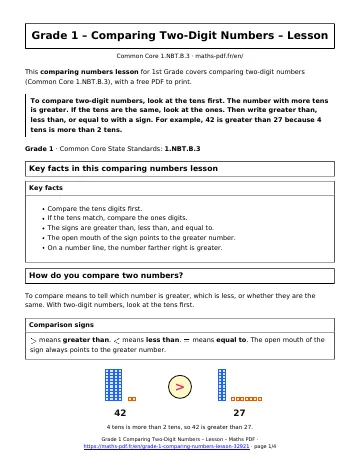
To compare two-digit numbers, look at the tens first. The number with more tens is greater. If the tens are the same, look at the ones. Then write greater than, less than, or equal to with a sign. For example, 42 is greater than 27 because 4 tens is more than 2 tens.
This lesson helps Grade 1 students compare two-digit numbers using tens and ones. Children learn which digit to look at first and how to write the greater than, less than, and equal signs correctly.
The lesson begins with base-ten blocks, where more rods means a greater number. It then shows the rule of comparing tens first and ones second. It also covers the open mouth of the sign, number line position, and ordering three numbers. Plan about ten minutes, with blocks or a number line nearby.
Grade 1 · Common Core State Standards: 1.NBT.B.3
Key facts in this 1st grade comparing numbers lesson
- Compare the tens digits first.
- Next, if the tens match, compare the ones digits.
- The signs are greater than, less than, and equal to.
- Then, the open mouth of the sign points to the greater number.
- On a number line, the number farther right is greater.
How do you compare two numbers?
To compare means to tell which number is greater, which is less, or whether they are the same. With two-digit numbers, look at the tens first.
Here \(42 > 27\) because 42 has 4 tens and 27 has only 2 tens.
What if the tens are the same?
When both numbers have the same number of tens, look at the ones. The number with more ones is greater.
So \(53 < 58\). If both the tens and the ones match, the numbers are equal, like \(64 = 64\).
How can a number line help?
Numbers get bigger as you move to the right on a number line. The number farther to the right is greater.
This shows \(72 < 77\) and \(77 > 72\).
How do I pick the right sign?
| Step | What to do |
|---|---|
| 1 | Compare the tens digits. |
| 2 | If they are different, the bigger tens digit wins. |
| 3 | If they are the same, compare the ones digits. |
| 4 | Write \(>\), \(< \), or \(=\). |
Example. Compare 39 and 41. The tens digits are 3 and 4. Since 3 is less than 4, \(39 < 41\). The 9 ones in 39 do not matter, because 4 tens beat 3 tens.
Remember: tens first, ones second. Say it out loud each time you compare. A number with more tens is always greater than a number with fewer tens, even when its ones digit is small. For example, 40 is greater than 39, because 4 tens is more than 3 tens.
1st grade comparing numbers lesson: questions and answers
How do you compare two-digit numbers?
Start with the tens digits. The number with more tens is greater. If the tens are the same, compare the ones digits.
Is 29 greater than 31?
No. 29 has 2 tens and 31 has 3 tens, so 29 is less than 31. The 9 ones in 29 do not change that.
What do the signs greater than, less than, and equal to look like?
Greater than is written >, less than is written with a sign that opens to the right, and equal to is written =. The open side always faces the bigger number.
What if two numbers have the same tens and the same ones?
Then the numbers are equal. For example, 58 and 58 have 5 tens and 8 ones each, so we write 58 = 58.
How does a number line show which number is greater?
Numbers get bigger going right. If 63 is to the right of 58, then 63 is greater than 58.
Common mistakes with this 1st grade comparing numbers lesson
- Students compare 19 and 21 by looking at the ones digit, 9 and 1, and say 19 is greater. Always start with the tens. Two tens is more than one ten, so 21 is greater.
- Children point the open mouth of the sign at the smaller number. Teach that the sign opens toward the greater number, like a hungry mouth wanting the bigger snack.
- When digits are switched, as in 82 and 28, students think the numbers are equal. The digits are the same, but the places differ. 82 has 8 tens and 28 has 2 tens.
How to study this chapter
- Build two numbers with blocks and line the rods up side by side. Seeing that 4 rods beat 3 rods makes the tens-first rule easy to remember.
- Write a number on a small card and slide it along a number line. Numbers to the right are greater, which links comparing to counting order.
- Also, parents can play a card game. Each player turns two cards to make a two-digit number, and the player with the greater number wins the round.
Download the 1st grade comparing numbers lesson as a PDF with the button below and keep it with your notes.
More questions about 1st grade comparing numbers lesson
Which digit do you look at first when comparing two-digit numbers?
Look at the tens digit first because it has the most value. In 63 and 58, 6 tens is more than 5 tens, so 63 is greater. Only when the tens are equal do you compare the ones, as in 63 and 67.
What is a simple way to remember the greater than and less than signs?
Think of the sign as a mouth that always opens toward the greater number. In 45 greater than 31, the wide side faces 45. Some teachers also use an alligator story. Either way, the small point faces the smaller number.
How do you put three numbers in order from least to greatest?
Compare the tens of all three, then use the ones to break ties. For 58, 85, and 61, the tens are 5, 8, and 6. So the order is 58, 61, 85. Writing the numbers on cards and moving them helps beginners.
All Grade 1 chapters: Grade 1 math.
More 1st Grade math
Lessons
See all



Worksheets
See all Telling Time to the Hour and Half Hour Worksheets with Answers
- Comparing Two-Digit Numbers Worksheets with Answers
- Subtraction Within 20 Worksheets with Answers
- Adding and Subtracting Tens Within 100 Worksheets with Answers
- Halves and Fourths Worksheets with Answers
- 2D and 3D Shapes Worksheets with Answers


Tests
See all




Quizzes
See all- Counting and Numbers to 20 Quiz: 10 Questions with Answers
- Tens and Ones Quiz: 10 Questions with Answers
- Subtraction Within 20 Quiz: 10 Questions with Answers
- Telling Time to the Hour and Half Hour Quiz: 10 Questions with Answers
- The Equal Sign and Word Problems Quiz: 10 Questions with Answers
- Addition Within 20 Quiz: 10 Questions with Answers