1st Grade 2D and 3D Shapes Lesson: Notes and Examples (Free PDF)
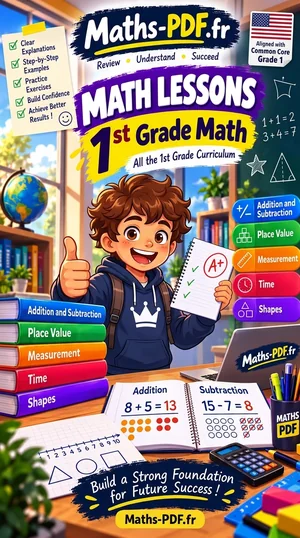
This 1st grade shapes lesson covers 2d and 3d shapes (Common Core 1.G.A.1, 1.G.A.2), with a free PDF to print.
Key takeaway: This lesson helps Grade 1 students name, describe, and combine 2D and 3D shapes.
- Topic: 2D and 3D Shapes (1st grade)
- Content: One-page lesson with a definition, a worked example and key facts
- Standards: 1.G.A.1, 1.G.A.2
- Answers: Explanations included
- Format: Free printable PDF, US Letter, black and white
Key takeaway: A clear Grade 1 lesson on 2D and 3D Shapes, with definitions, rules and worked examples: what is an attribute of a shape, which attributes do not change the name and what are 3D shapes. Read it before the practice worksheet; free to print or download as a PDF.
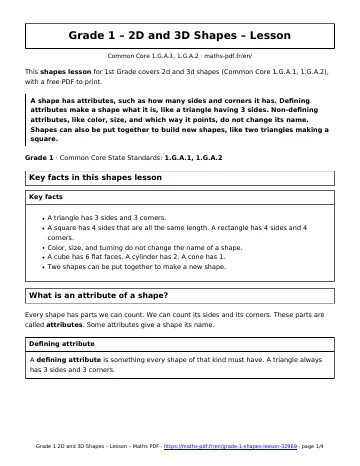
A shape has attributes, such as how many sides and corners it has. Defining attributes make a shape what it is, like a triangle having 3 sides. Non-defining attributes, like color, size, and which way it points, do not change its name. Shapes can also be put together to build new shapes, like two triangles making a square.
This lesson helps Grade 1 students name, describe, and combine 2D and 3D shapes. Children learn that the sides and corners decide a shape’s name, while color, size, and turning do not.
The lesson covers triangles, squares, rectangles, and circles, and the solids cube, cylinder, and cone. It explains defining attributes such as 3 sides or 6 flat faces, and shows how two shapes can join to make a new shape. Plan about ten minutes, with real objects such as a box, a can, and a party hat to hold.
Grade 1 · Common Core State Standards: 1.G.A.1, 1.G.A.2
Key facts in this 1st grade shapes lesson
- A triangle has 3 sides and 3 corners.
- Next, a square has 4 sides that are all the same length. A rectangle has 4 sides and 4 corners.
- Color, size, and turning do not change the name of a shape.
- Then, a cube has 6 flat faces. A cylinder has 2. A cone has 1.
- Two shapes can be put together to make a new shape.
What is an attribute of a shape?
Every shape has parts we can count. We can count its sides and its corners. These parts are called attributes. Some attributes give a shape its name.
| Shape | Sides | Corners |
|---|---|---|
| Triangle | 3 | 3 |
| Square | 4, all the same length | 4 |
| Rectangle | 4, the opposite sides match | 4 |
| Circle | none, it is round | 0 |
A square is a special rectangle. All its sides are the same length.
Which attributes do not change the name?
Color, size, and the way a shape is turned do not change its name. They are non-defining attributes. A big green triangle and a small orange triangle are both triangles.
What are 3D shapes?
A cube has 6 flat faces, and each face is a square. Also, a cylinder has 2 flat faces that are circles, plus a curved side. A cone has 1 flat face that is a circle, plus a point.
How can shapes be put together?
We can join shapes to make a new shape. Two triangles of the same size can make a square. Also, two squares can make a rectangle.
How do you name a shape?
- Count the sides.
- Count the corners.
- Check if all the sides are the same length.
- Do not use the color, the size, or the way it is turned.
Example: a shape has 4 corners and 4 sides, and all the sides are the same length. It is a square.
1st grade shapes lesson: questions and answers
What is a defining attribute?
A defining attribute is a part that every shape of one kind must have. A triangle must have 3 sides and 3 corners. If a shape does not have them, it is not a triangle.
Does turning a shape change its name?
No. A triangle that points down is still a triangle. The sides and corners stay the same when a shape is turned.
Is a square a rectangle?
Yes, a square is a special rectangle. It has 4 sides and 4 corners, and all its sides are the same length.
How are 2D shapes and 3D shapes different?
A 2D shape is flat, like a drawing of a circle. A 3D shape is solid, like a can. You can pick up a 3D shape and turn it in your hand.
How many flat faces do a cube, a cylinder, and a cone have?
A cube has 6 flat faces. Also, a cylinder has 2 flat faces. A cone has 1 flat face.
Common mistakes with this 1st grade shapes lesson
- First, students say an upside-down triangle is a new shape. Turning does not change the name. It still has 3 sides and 3 corners, so it is a triangle.
- Children call every long four-sided shape a rectangle and every short one a square. Then, check the sides. A square has 4 sides that are all the same length.
- Also, students mix up 2D and 3D shapes, calling a ball a circle. A circle is flat. A ball is a sphere, which you can hold, so it is a 3D shape.
How to study this chapter
- First, go on a shape hunt at home and find a cylinder in the kitchen, a cube in the toy box, and a cone at a party. Next, name each one and count the flat faces.
- Next, trace the faces of 3D objects on paper. Tracing a box face gives a rectangle, and tracing a can’s top gives a circle.
- Also, teachers can ask students to build a picture from two or three shapes and tell which shapes they used, such as a house from a square and a triangle.
Download the 1st grade shapes lesson as a PDF with the button below and keep it with your notes.
More questions about 1st grade shapes lesson
Is a square also a rectangle?
Yes, a square is a special kind of rectangle. Both have 4 sides and 4 square corners. Also, a square has the extra rule that all 4 sides are the same length. In Grade 1, children mainly learn to name each by its sides.
How are 2D and 3D shapes different?
A 2D shape is flat, like a square drawn on paper. A 3D shape is solid and takes up space, like a cube you can hold. Flat shapes have sides and corners. Solid shapes have faces, edges, and corners, and you can pick them up.
How many flat faces does each solid shape have?
A cube has 6 flat faces, a cylinder has 2, and a cone has 1. The cylinder’s flat faces are circles, and the cone’s flat face is one circle at the bottom. Also, a cube’s faces are all squares of the same size.
All Grade 1 chapters: Grade 1 math.
More 1st Grade math
Lessons
See all Addition Within 20 Lesson: Notes and Examples
- Measuring Length Lesson: Notes and Examples
- Telling Time to the Hour and Half Hour Lesson: Notes and Examples
- Comparing Two-Digit Numbers Lesson: Notes and Examples
- Tens and Ones Lesson: Notes and Examples
- Adding and Subtracting Tens Within 100 Lesson: Notes and Examples




Worksheets
See all



Tests
See all




Quizzes
See all- Adding and Subtracting Tens Within 100 Quiz: 10 Questions with Answers
- The Equal Sign and Word Problems Quiz: 10 Questions with Answers
- Halves and Fourths Quiz: 10 Questions with Answers
- 2D and 3D Shapes Quiz: 10 Questions with Answers
- Addition Within 20 Quiz: 10 Questions with Answers
- Counting to 120 Quiz: 10 Questions with Answers