1st Grade Measuring Length Lesson: Notes and Examples (Free PDF)
This 1st grade measuring length lesson covers measuring length (Common Core 1.MD.A.1, 1.MD.A.2), with a free PDF to print.
Key takeaway: This lesson helps Grade 1 students measure and compare lengths using objects as units.
- Topic: Measuring Length (1st grade)
- Content: One-page lesson with a definition, a worked example and key facts
- Standards: 1.MD.A.1, 1.MD.A.2
- Answers: Explanations included
- Format: Free printable PDF, US Letter, black and white
Key takeaway: A clear Grade 1 lesson on Measuring Length, with definitions, rules and worked examples: what is length, how do you compare and order objects by length and how do you measure length with units. Read it before the practice worksheet; free to print or download as a PDF.
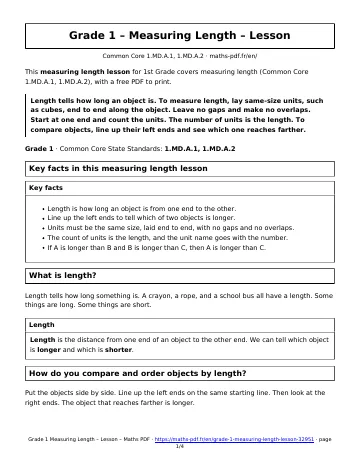
Length tells how long an object is. To measure length, lay same-size units, such as cubes, end to end along the object. Leave no gaps and make no overlaps. Start at one end and count the units. The number of units is the length. To compare objects, line up their left ends and see which one reaches farther.
This lesson helps Grade 1 students measure and compare lengths using objects as units. Children learn to line up the ends of two objects and to count same-size units laid end to end.
The lesson explains that length is how long something is from one end to the other. It shows how to measure with cubes or paper clips with no gaps and no overlaps, and why the unit name goes with the number. It also teaches ordering three objects and using a third object to compare two that cannot touch. Plan about ten minutes, with cubes ready.
Grade 1 · Common Core State Standards: 1.MD.A.1, 1.MD.A.2
Key facts in this 1st grade measuring length lesson
- Length is how long an object is from one end to the other.
- Line up the left ends to tell which of two objects is longer.
- Units must be the same size, laid end to end, with no gaps and no overlaps.
- Then, the count of units is the length, and the unit name goes with the number.
- If A is longer than B and B is longer than C, then A is longer than C.
What is length?
Length tells how long something is. A crayon, a rope, and a school bus all have a length. Some things are long. Some things are short.
How do you compare and order objects by length?
Put the objects side by side. Line up the left ends on the same starting line. Then look at the right ends. The object that reaches farther is longer.
Also, the marker is the longest. The crayon is the shortest. From shortest to longest the order is crayon, pencil, marker.
Sometimes two objects are far apart and cannot sit side by side. Use a third object to help. If a scarf is longer than a belt, and the belt is longer than a shoelace, then the scarf is longer than the shoelace.
How do you measure length with units?
- Pick one kind of unit. All the units must be the same size.
- Start at the left end of the object.
- Lay the units end to end. Leave no gaps and make no overlaps.
- Count the units. Say the number and the unit name.
Example. A paintbrush has 7 cubes laid along it with no gaps. The paintbrush is 7 cubes long. We can write \(7\) cubes.
What mistakes should you avoid?
- Do not leave gaps between the units.
- Do not stack units on top of each other.
- Do not start the row away from the left end of the object.
Do big units and small units give the same number?
No. A small unit needs more copies to cover the same length. Here the ribbon is 4 big cubes long. It is also 8 small cubes long. Always say the unit name, and use the same unit when two objects are compared.
If one pen is \(8\) cubes long and another pen is \(5\) cubes long, then \(8 > 5\), so the first pen is longer.
1st grade measuring length lesson: questions and answers
What does length mean in first grade math?
Length is how long an object is from one end to the other end. First graders compare lengths, order objects, and measure with small same-size units.
How do you measure length with cubes?
Start at the left end of the object. Lay cubes end to end with no gaps and no overlaps. Count the cubes. If there are 7 cubes, the object is 7 cubes long.
Why must all the units be the same size?
Different sizes make the count unfair. Two objects can only be compared by counting when the same kind of unit is used for both.
How do you order three objects by length?
Line up the left ends of all three. Find the object that reaches farthest, the one that reaches least, and the one in the middle. Then name them from shortest to longest or the other way.
How can you compare two objects that cannot touch?
Use a third object. If the first is longer than the third, and the third is longer than the second, then the first is longer than the second.
Common mistakes with this 1st grade measuring length lesson
- Students compare two pencils without lining up the left ends. A pencil that starts farther right can look longer. Line up the starting ends on the same line first.
- Children leave gaps between cubes or let them overlap, which changes the count. Place each cube touching the next with no space and no overlap.
- Also, when the ribbon is 3 big cubes and 6 small cubes, students think it changed length. The ribbon stayed the same. Bigger units give a smaller count.
How to study this chapter
- Measure common things at home, such as a spoon, a toothbrush, and a key, with the same paper clips. Then, say each length as a number with the unit name.
- Next, to compare two objects that cannot touch, use a string or paper strip. Next, cut it to match one object and hold it up to the other.
- Also, teachers can post a chart of objects ordered from shortest to longest and ask students to add one more in the right place.
Download the 1st grade measuring length lesson as a PDF with the button below and keep it with your notes.
More questions about 1st grade measuring length lesson
Why do we use the same size units to measure length?
Same-size units make the count fair and clear. If one cube is big and another is small, the count means nothing. When every unit is the same size, a spoon that is 7 cubes long and a pen that is 9 cubes long can be compared.
What does transitive mean when we compare lengths?
If A is longer than B and B is longer than C, then A is longer than C, even if A and C were never put side by side. This lets children compare without touching. It is a key idea in first grade measurement.
Should first graders use a ruler?
First grade starts with objects such as cubes and paper clips so that children understand what length is. Rulers and inches come in later grades. The cube idea is the foundation, since a ruler is just a row of same-size units with numbers.
All Grade 1 chapters: Grade 1 math.
More 1st Grade math
Lessons
See all Subtraction Within 20 Lesson: Notes and Examples
- The Equal Sign and Word Problems Lesson: Notes and Examples
- Counting and Numbers to 20 Lesson: Notes and Examples
- Addition Within 20 Lesson: Notes and Examples
- Adding and Subtracting Tens Within 100 Lesson: Notes and Examples
- 2D and 3D Shapes Lesson: Notes and Examples

Worksheets
See all
Tests
See all

Quizzes
See all- Telling Time to the Hour and Half Hour Quiz: 10 Questions with Answers
- Adding and Subtracting Tens Within 100 Quiz: 10 Questions with Answers
- Addition Within 20 Quiz: 10 Questions with Answers
- Comparing Two-Digit Numbers Quiz: 10 Questions with Answers
- Tens and Ones Quiz: 10 Questions with Answers
- Subtraction Within 20 Quiz: 10 Questions with Answers