1st Grade Addition Within 20 Worksheets with Answers (Free PDF)

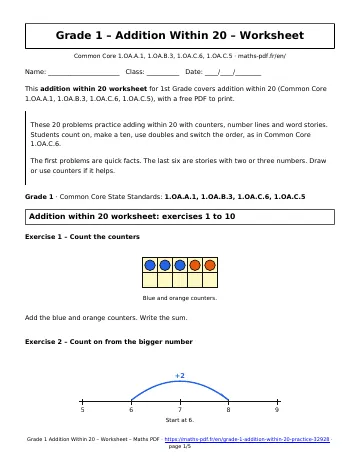
This 1st grade addition within 20 worksheet covers addition within 20 (Common Core 1.OA.A.1, 1.OA.B.3, 1.OA.C.6, 1.OA.C.5), with a free PDF to print.
Key takeaway: This worksheet helps Grade 1 students practice adding within 20 with pictures, number lines, and ten frames.
- Topic: Addition Within 20 (1st grade)
- Content: 20 worksheet problems, from easy to challenging
- Standards: 1.OA.A.1, 1.OA.B.3, 1.OA.C.6, 1.OA.C.5
- Answers: On a separate page, so you can try every worksheet problem first
- Format: Free printable PDF, US Letter, black and white
This worksheet helps Grade 1 students practice adding within 20 with pictures, number lines, and ten frames. First, children use each strategy from the lesson. Then they apply it to short stories.
The 20 problems start with counters, counting on, and adding zero. Next come doubles, switching the order, and make a ten. After that, children add three numbers and compare sums. Finally, they solve stories about stickers, marbles, muffins, and pages, and check a classmate’s claim. Allow about 25 minutes.
These 20 problems practice adding within 20 with counters, number lines and word stories. Students count on, make a ten, use doubles and switch the order, as in Common Core 1.OA.C.6.
The first problems are quick facts. The last six are stories with two or three numbers. Draw or use counters if it helps.
Key takeaway: This Grade 1 worksheet on Addition Within 20 gives 20 problems, from warm-up questions to harder applications. The answer key is on a separate page; free printable PDF.
Grade 1 · Common Core State Standards: 1.OA.A.1, 1.OA.B.3, 1.OA.C.6, 1.OA.C.5
1st grade addition within 20 worksheet: worksheet problems 1 to 10
1 – Count the counters
First, add the blue and orange counters. Write the sum.
2 – Count on from the bigger number
Next, find \(6 + 2\) by counting on.
3 – Add the picture
Maya has 5 stickers. Jamal gives her 3 more. Find \(5 + 3\).
4 – Add zero
Now, find \(9 + 0\).
5 – Doubles fact
Also, write the doubles fact for the picture and find the sum.
6 – Bigger doubles
First, find \(7 + 7\).
7 – Switch the order
Next, write \(3 + 8\) in the other order. Then find the sum.
8 – Make a ten with 9
Then, find \(9 + 4\). Use the frames.
9 – Make a ten with 8
Now, find \(8 + 6\). Make a ten first.
10 – Near doubles
Also, find \(6 + 7\). Use a doubles fact.
Worksheet problems 11 and up
11 – Same sum
First, write the missing number so the sentence is true: \(7 + 5 = 5 + \text{?}\).
12 – Count on 2
Next, count on 2 from 15. What number do you reach?
13 – Three numbers, make ten
Then, find \(2 + 7 + 3\).
14 – Three numbers, look for a pair
Now, find \(6 + 4 + 5\).
15 – Compare sums
Also, write <, > or = in the circle: \(8 + 5\) and \(9 + 3\).
16 – Sticker story
Priya has 7 star stickers. Her aunt gives her 6 more. How many stickers does Priya have now?
17 – Marbles together
Next, a jar holds 9 blue marbles and 8 orange marbles. How many marbles are in the jar?
18 – Muffin doubles
Diego bakes 6 muffins before lunch and 6 muffins after lunch. How many muffins does he bake in all?
19 – Pages read
Mei reads 8 pages on Monday, 2 pages on Tuesday and 6 pages on Wednesday. How many pages does she read in all?
20 – Is he right?
Noah says \(9 + 5\) has the same sum as \(10 + 4\). Is Noah right? Show how you know.

Key facts behind this 1st grade addition within 20 worksheet
- The sum is the total. In 5 + 3 = 8, the sum is 8.
- Counting on: start at the bigger number and count up the smaller one.
- Make a ten: 8 + 5 = 10 + 3 = 13.
- Doubles help: 6 + 6 = 12, so 6 + 7 = 13.
- Order does not matter, and adding 0 leaves a number the same.
Common mistakes with this 1st grade addition within 20 worksheet
- Children think adding zero changes the number. For example, 4 + 0 is not 0. Draw 4 counters and then draw no more, so the group stays the same.
- Near doubles can go wrong when students use the double and forget the extra one. For example, with 5 + 6, start from 5 + 5, then add one more.
- Also, in stories with three numbers, students add only two of them. First, underline every number in the story. Then look for two that make ten, and add the last one.
Tips before you start the worksheet problems
- When counting on, hold up fingers for each count. Then fold them down one at a time, so you stop at the right place.
- Next, act out each story with counters. Also, count them all after you place the groups, so the picture matches the numbers.
- Also, parents can ask why after a claim question. Hearing a child explain that two different facts can have the same sum shows real understanding.
Download the 1st grade addition within 20 worksheet as a PDF with the button below and keep it with your notes.
1st grade addition within 20 worksheet: frequently asked questions
Why does the worksheet compare sums with signs?
Comparing sums shows that a child understands what the numbers mean, not just the answers. First, the child must find both sums. Then the child decides which is greater. As a result, fact fluency gets stronger.
Is it wrong to use fingers to add within 20?
No. Fingers are a normal tool for young learners and help build understanding. Over time, children move toward strategies like doubles and make a ten, which are faster. Encourage drawing dots or using ten frames when numbers get larger than 10.
What is a missing addend in a number sentence?
It is a number that makes both sides equal. For example, in 6 + 5 = ? + 6, the missing number is 5. Children use the idea that order does not change the sum, so both sides match.
All Grade 1 chapters: Grade 1 math.
More 1st Grade math
Lessons
See all





Worksheets
See all





Tests
See all





Quizzes
See all Organizing and Reading Data Quiz: 10 Questions with Answers
- Comparing Two-Digit Numbers Quiz: 10 Questions with Answers
- Counting to 120 Quiz: 10 Questions with Answers
- 2D and 3D Shapes Quiz: 10 Questions with Answers
- Adding and Subtracting Tens Within 100 Quiz: 10 Questions with Answers
- The Equal Sign and Word Problems Quiz: 10 Questions with Answers