1st Grade Counting and Numbers to 20 Test with Answer Key (Free PDF)
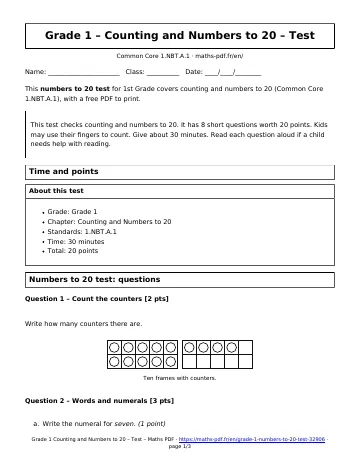
This 1st grade numbers to 20 test covers counting and numbers to 20 (Common Core 1.NBT.A.1), with a free PDF to print.
Key takeaway: This test helps Grade 1 teachers and parents check whether students can count and write numbers to 20.
- Topic: Counting and Numbers to 20 (1st grade)
- Content: 8 questions with point values, about 45 minutes
- Standards: 1.NBT.A.1
- Answers: On a separate page, so you can try every worksheet problem first
- Format: Free printable PDF, US Letter, black and white
This test helps Grade 1 teachers and parents check whether students can count and write numbers to 20. It covers counting objects, matching words and numerals, one more and one less, number lines, ten frames, and a marble story.
The test has 8 questions worth 20 points. First, students count counters on ten frames and write numerals. Then they count on, count back, and fill a frame. Finally, they solve a short marble story. Allow 30 minutes. Counters should stay on the desk only if your class allows them.
This test checks counting and numbers to 20. It has 8 short questions worth 20 points. Kids may use their fingers to count. Give about 30 minutes. Read each question aloud if a child needs help with reading.
Key takeaway: This Grade 1 test on Counting and Numbers to 20 works as a class assessment or a timed review at home: time and points, 1st grade numbers to 20 test: questions and test-taking strategy. The detailed answer key with scoring is on a separate page; free PDF.
Time and points
- Grade: Grade 1
- Chapter: Counting and Numbers to 20
- Standards: 1.NBT.A.1
- Time: 30 minutes
- Total: 20 points
1st grade numbers to 20 test: questions
1 – Count the counters [2 pts]
First, write how many counters there are.
2 – Words and numerals [3 pts]
- Write the numeral for seven. (1 point)
- Also, write the numeral for fifteen. (1 point)
- Also, write the numeral for twenty. (1 point)
3 – One more, one less [2 pts]
- Also, write the number that is one more than \(9\). (1 point)
- Write the number that is one less than \(16\). (1 point)
4 – Number line [3 pts]
Now, look at the number line.
- Write the number in the first box. (1 point)
- Also, write the number in the second box. (1 point)
- Write the number under the dot. (1 point)
5 – Count on [2 pts]
Also, start at \(12\). Write the next four numbers when counting on.
6 – Count back [2 pts]
First, write the missing numbers: \(19, 18\), ___, \(16\), ___
7 – Fill the frame [3 pts]
Next, look at the ten frame.
- How many counters are there? (1 point)
- How many more counters fill the frame? (1 point)
- Write how many counters there are after 3 more are added. (1 point)
Question 8 and after
8 – Marble story [3 pts]
Ethan has \(18\) marbles. He finds one more marble. Then he gives one marble to a friend.
- How many marbles does Ethan have after he finds one? (1 point)
- How many marbles does he have after he gives one away? (1 point)
- Write the number of marbles he started with. (1 point)

Key facts behind this 1st grade numbers to 20 test
- Touch each object once and say one number for each touch.
- Next, the last number you say tells how many objects there are.
- A full ten frame holds 10 counters; a second frame shows 11 to 20.
- Then, one more is the next number; one less is the number before.
- A numeral such as 14 is the written symbol for fourteen.
Common mistakes with this 1st grade numbers to 20 test
- When counting a ten frame row by row, students skip a counter. Instead, count in the same order every time, and touch each counter once.
- When counting back, students go one step too far. For example, in 17, 16, ___, 14, the blank is not 13. Then, check the numbers around the blank.
- Also, in one more stories, students write the number before. For example, one more than 15 is not 14. One more means the next number.
Test-taking strategy
- Count objects with your pencil tip, touching each one once. A quick tap helps you avoid skipping or counting twice.
- Next, for the ten frame question, count the empty boxes. Then that number tells how many counters fill the frame.
- Also, parents can ask for one more and one less at bedtime. A quick question each evening is better than a long review.
Download the 1st grade numbers to 20 test as a PDF with the button below and keep it with your notes.
1st grade numbers to 20 test: frequently asked questions
What should a student do if they lose count of objects?
Start over and move each object to a new spot as you count it. Moved objects are counted, and objects still in place are not. If the objects are printed on a page, put a small mark on each one.
How should children read a number line to 20 on a test?
Find the number closest to the blank and count one step at a time. Next, say the numbers in order as you go. Then check that your answer sits in the right place.
Can students use fingers on a test?
In Grade 1, yes. Fingers are a natural counting tool. Over time, students will move toward ten frames, number lines, and mental counting. If numbers go above 10, encourage the child to also use the ten frame or number line.
All Grade 1 chapters: Grade 1 math.
More 1st Grade math
Lessons
See all Counting to 120 Lesson: Notes and Examples
- Adding and Subtracting Tens Within 100 Lesson: Notes and Examples
- Addition Within 20 Lesson: Notes and Examples
- Halves and Fourths Lesson: Notes and Examples
- Telling Time to the Hour and Half Hour Lesson: Notes and Examples
- Counting and Numbers to 20 Lesson: Notes and Examples





Worksheets
See all- Adding and Subtracting Tens Within 100 Worksheets with Answers
- The Equal Sign and Word Problems Worksheets with Answers
- Halves and Fourths Worksheets with Answers
- Organizing and Reading Data Worksheets with Answers
- Telling Time to the Hour and Half Hour Worksheets with Answers
- Addition Within 20 Worksheets with Answers





Tests
See all




Quizzes
See all- 2D and 3D Shapes Quiz: 10 Questions with Answers
- Comparing Two-Digit Numbers Quiz: 10 Questions with Answers
- Addition Within 20 Quiz: 10 Questions with Answers
- Tens and Ones Quiz: 10 Questions with Answers
- Adding and Subtracting Tens Within 100 Quiz: 10 Questions with Answers
- The Equal Sign and Word Problems Quiz: 10 Questions with Answers