1st Grade Counting and Numbers to 20 Lesson: Notes and Examples (Free PDF)
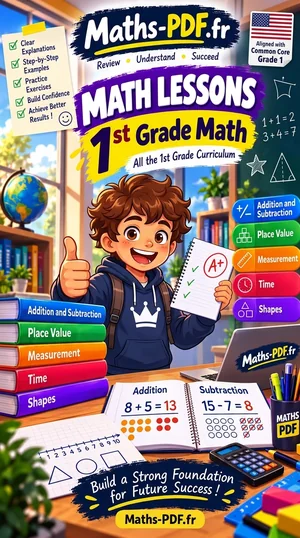
This 1st grade numbers to 20 lesson covers counting and numbers to 20 (Common Core 1.NBT.A.1), with a free PDF to print.
Key takeaway: This lesson helps Grade 1 students count objects up to 20 and read and write the numbers.
- Topic: Counting and Numbers to 20 (1st grade)
- Content: One-page lesson with a definition, a worked example and key facts
- Standards: 1.NBT.A.1
- Answers: Explanations included
- Format: Free printable PDF, US Letter, black and white
Key takeaway: A clear Grade 1 lesson on Counting and Numbers to 20, with definitions, rules and worked examples: how do you count objects up to 20, what is a ten frame and how do you find one more and one less. Read it before the practice worksheet; free to print or download as a PDF.
Counting means saying one number for each object, and the last number said tells how many there are. Ten frames show numbers from 11 to 20 as one full ten and some more ones. One more is the next number when you count forward. One less is the number just before when you count back.
This lesson helps Grade 1 students count objects up to 20 and read and write the numbers. Children learn to touch each object once, use a ten frame, and find one more and one less.
The lesson explains that the last number said tells how many. It shows how a full ten frame plus a second frame builds the numbers 11 to 20, and how numerals like 14 match the words fourteen. It also covers counting on, counting back, and finding the number after 19. Plan about ten minutes, with counters and a ten frame.
Grade 1 · Common Core State Standards: 1.NBT.A.1
Key facts in this 1st grade numbers to 20 lesson
- Touch each object once and say one number for each touch.
- Next, the last number you say tells how many objects there are.
- A full ten frame holds 10 counters; a second frame shows 11 to 20.
- Then, one more is the next number; one less is the number before.
- A numeral such as 14 is the written symbol for fourteen.
How do you count objects up to 20?
Touch each thing one time. Say one number for each touch. The last number you say tells how many there are.
What is a ten frame?
A ten frame has two rows of five boxes. When all ten boxes are full, you have ten. Extra counters go in a second frame. That makes every number from \(11\) to \(19\) easy to see: one full ten and some more.
| Numeral | Word | Think |
|---|---|---|
| \(11\) | eleven | ten and one more |
| \(12\) | twelve | ten and two more |
| \(13\) | thirteen | ten and three more |
| \(14\) | fourteen | ten and four more |
| \(15\) | fifteen | ten and five more |
| \(16\) | sixteen | ten and six more |
| \(17\) | seventeen | ten and seven more |
| \(18\) | eighteen | ten and eight more |
| \(19\) | nineteen | ten and nine more |
How do you find one more and one less?
On a number line, the next number to the right is one more. The next number to the left is one less. Counting forward gives one more each time. Counting back gives one less each time.
How do you count on from any number?
- Say the number you start with.
- Say the next number. Hold up one finger.
- Keep going until you reach the number you need.
Example: Start at \(16\) and count on four numbers. Say \(17\), \(18\), \(19\), \(20\). Four fingers are up, so you stop at \(20\).
You can also write numbers. A teen number has two digits. The first digit is \(1\) because there is one ten. The second digit tells how many ones. For \(17\) the second digit is \(7\). The number \(20\) has two tens and no ones.
1st grade numbers to 20 lesson: questions and answers
What does the last number said mean when counting?
The last number said tells how many objects are in the group. If you count 1 to 8 and stop, there are 8 objects.
How can a ten frame help with 13?
Fill one whole ten frame with 10 counters. Put 3 more counters in a second frame. That shows ten and three more, which is 13.
What number is one more than 19?
Count forward one step from 19. You say 20. So 20 is one more than 19.
How do you count back from 15?
Say 15, then 14, then 13. Each number is one less than the number before it.
Why does 17 begin with a 1?
The 1 stands for one ten. The 7 stands for seven ones. So 17 is one ten and seven ones.
Common mistakes with this 1st grade numbers to 20 lesson
- Students count the same object twice or skip one. Move each object to a new spot as you count it, so every object is touched once and none is missed.
- After counting, children say the whole count again when asked how many. The last number said is the answer. If you counted 13 last, there are 13 objects.
- Also, some children write teen numbers backward, like 61 for 16. Say ten and six, write the 1 first for the ten, then write the 6 for the ones.
How to study this chapter
- Use a ten frame with small toys. Fill the first frame with 10, then add ones on the second frame. Seeing 10 and 3 makes 13 clear.
- Next, count backward from 15 or 20 as a rocket countdown. Counting back helps with subtraction later, so make it playful and short.
- Also, parents can count objects around the house, such as forks or socks. Then, ask for one more and one less each time.
Download the 1st grade numbers to 20 lesson as a PDF with the button below and keep it with your notes.
More questions about 1st grade numbers to 20 lesson
Why do the numbers 11 to 19 have strange names?
The names eleven and twelve are old words. Thirteen to nineteen end in teen, which means ten, and show ten and some ones. Thirteen means three and ten. A ten frame helps because it shows one full ten and some extra counters.
How do you count backward from a teen number?
Say the number first, then the numbers that come before it, one at a time: 15, 14, 13, 12. Each number is one less than the last. A number line can help, since counting back means moving left one step at a time.
How many counters fill a ten frame?
A ten frame holds 10 counters, two rows of five. When it is full, you know there are 10. If 7 counters are in the frame, 3 boxes are empty, so 3 more counters fill it. This helps children with facts that make ten.
All Grade 1 chapters: Grade 1 math.

More 1st Grade math
Lessons
See all Comparing Two-Digit Numbers Lesson: Notes and Examples
- Counting to 120 Lesson: Notes and Examples
- Telling Time to the Hour and Half Hour Lesson: Notes and Examples
- Organizing and Reading Data Lesson: Notes and Examples
- Addition Within 20 Lesson: Notes and Examples
- Measuring Length Lesson: Notes and Examples





Worksheets
See all





Tests
See all



Quizzes
See all- The Equal Sign and Word Problems Quiz: 10 Questions with Answers
- Organizing and Reading Data Quiz: 10 Questions with Answers
- Measuring Length Quiz: 10 Questions with Answers
- 2D and 3D Shapes Quiz: 10 Questions with Answers
- Addition Within 20 Quiz: 10 Questions with Answers
- Counting and Numbers to 20 Quiz: 10 Questions with Answers