1st Grade Adding and Subtracting Tens Within 100 Lesson: Notes and Examples (Free PDF)

This 1st grade adding tens lesson covers adding and subtracting tens within 100 (Common Core 1.NBT.C.4, 1.NBT.C.5, 1.NBT.C.6), with a free PDF to print.
Key takeaway: This lesson helps Grade 1 students add and subtract tens and ones within 100.
- Topic: Adding and Subtracting Tens Within 100 (1st grade)
- Content: One-page lesson with a definition, a worked example and key facts
- Standards: 1.NBT.C.4, 1.NBT.C.5, 1.NBT.C.6
- Answers: Explanations included
- Format: Free printable PDF, US Letter, black and white
Key takeaway: A clear Grade 1 lesson on Adding and Subtracting Tens Within 100, with definitions, rules and worked examples: how do you add ones to a two-digit number, what if the ones make a new ten and how do you add tens to a number. Read it before the practice worksheet; free to print or download as a PDF.
To add to a two-digit number, add ones to ones and tens to tens. For 34 + 5, the tens stay 3 and 4 + 5 = 9, so the sum is 39. For 10 more or 10 less, change only the tens digit. To subtract tens, count tens: 80 – 30 is 5 tens.
This lesson helps Grade 1 students add and subtract tens and ones within 100. Children learn to see a number like 46 as 4 tens and 6 ones, and then use that idea to add, subtract, and jump by ten.
The lesson starts with adding ones to a two-digit number, such as 34 + 5. Next it shows how to make the next ten when the ones pass 9, as in 38 + 5. It ends with adding and subtracting whole tens, like 80 – 30. Read it in about ten minutes, and use blocks or a hundred chart while you read.
Grade 1 · Common Core State Standards: 1.NBT.C.4, 1.NBT.C.5, 1.NBT.C.6
Key facts in this 1st grade adding tens lesson
- A two-digit number has tens and ones, like 34 = 3 tens and 4 ones.
- Next, to add ones, keep the tens and add the ones.
- If the ones pass 9, make the next ten first.
- 10 more or 10 less changes only the tens digit.
- Then, to subtract tens, think of tens: 8 tens – 3 tens = 5 tens.
How do you add ones to a two-digit number?
Every two-digit number has tens and ones. To add ones, keep the tens the same and add the ones.
Example: \(34 + 5\). The tens stay at 3. The ones are \(4 + 5 = 9\). So the sum is 39.
What if the ones make a new ten?
Sometimes the ones add up past 9. Then make the next ten first. Split the number you add into two small parts.
- Find how many more make the next ten.
- Add that part first.
- Also, add the part that is left.
Example: \(38 + 5\). First \(38 + 2 = 40\). Then \(40 + 3 = 43\). So \(38 + 5 = 43\).
How do you add tens to a number?
Add the tens and keep the ones. In \(42 + 30\) the 2 ones stay the same. Think 4 tens and 3 tens make 7 tens. So the sum is 72. On a hundred chart, each jump down one row adds 10.
How do you find 10 more or 10 less?
10 more changes the tens digit and keeps the ones digit. 10 more than 47 is 57. 10 less than 47 is 37. You can do this in your head.
How do you subtract tens?
Count tens, not ones. For \(80 – 30\), think 8 tens minus 3 tens is 5 tens. That is 50. This works for numbers from 10 to 90.
1st grade adding tens lesson: questions and answers
How do you add a one-digit number to a two-digit number?
Keep the tens the same and add the ones. For 52 + 6, the ones are 2 + 6 = 8, so the sum is 58. If the ones pass 9, make the next ten first.
How do you add tens to a number?
Add the tens digits and keep the ones. For 26 + 30, 2 tens plus 3 tens is 5 tens, so the sum is 56. The ones stay 6.
What is 10 more than a number?
It is the number with the tens digit one bigger. 10 more than 63 is 73. On a hundred chart, move down one row.
How do you subtract tens like 70 – 20?
Think of tens. 7 tens minus 2 tens is 5 tens. So 70 – 20 = 50. Check with blocks by crossing out 2 rods.
Can you add numbers in any order?
Yes. 4 + 52 and 52 + 4 both equal 56. Start with the bigger number to make counting easier.
Common mistakes with this 1st grade adding tens lesson
- Students add the digits across and write 34 + 5 = 84. The tens digit must stay the same because only ones are being added. Then, say 3 tens and 9 ones before writing the answer.
- Some children answer 40 + 30 = 7. They add 4 + 3 and forget the tens are really 40 and 30. Ask how many tens the answer has, then write the zero.
- When making the next ten, students split the number badly, like 38 + 5 = 38 + 1 + 4. Always ask how many more make 40 first. Here it is 2, so the other part is 3.
How to study this chapter
- Build each number with ten rods and single cubes. Moving three rods away from eight rods shows 80 – 30 = 50 better than any rule can.
- Practice 10 more and 10 less on a hundred chart. Next, put a finger on 47, slide down one row, and say 57. The ones digit never moves.
- Also, parents can play a quick game at dinner. Say a two-digit number, then ask for 10 more or 10 less. Five questions a night build fast mental math.
Download the 1st grade adding tens lesson as a PDF with the button below and keep it with your notes.
More questions about 1st grade adding tens lesson
Why do first graders learn tens and ones before adding two-digit numbers?
Tens and ones are the base of our number system, and every two-digit addition uses them. When a child knows 52 is 5 tens and 2 ones, adding 30 means only the tens change. That one idea makes 52 + 30 = 82 simple and quick.
What is the easiest way to add 9 to a two-digit number?
Add 10 and then take one back. For 35 + 9, think 35 + 10 = 45, then 45 – 1 = 44. Another way is to make the next ten first: 35 + 5 = 40, then 40 + 4 = 44. Also, pick the way that feels easier.
Which Common Core standards cover adding tens in Grade 1?
Three standards apply: 1.NBT.C.4 covers adding a two-digit number and a one-digit number or a multiple of ten. 1.NBT.C.5 covers mentally finding 10 more or 10 less. 1.NBT.C.6 covers subtracting multiples of ten from multiples of ten within 100.
All Grade 1 chapters: Grade 1 math.
Free printable PDF
1st Grade Adding and Subtracting Tens Within 100 Lesson: Notes and Examples
Download PDF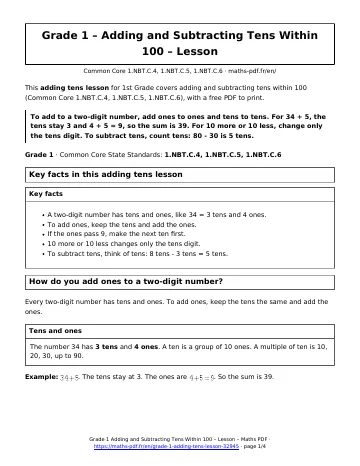
More 1st Grade math
Lessons
See all Halves and Fourths Lesson: Notes and Examples
- Counting and Numbers to 20 Lesson: Notes and Examples
- Tens and Ones Lesson: Notes and Examples
- The Equal Sign and Word Problems Lesson: Notes and Examples
- Organizing and Reading Data Lesson: Notes and Examples
- Comparing Two-Digit Numbers Lesson: Notes and Examples






Worksheets
See all





Tests
See all





Quizzes
See all- Measuring Length Quiz: 10 Questions with Answers
- The Equal Sign and Word Problems Quiz: 10 Questions with Answers
- Halves and Fourths Quiz: 10 Questions with Answers
- Counting to 120 Quiz: 10 Questions with Answers
- Addition Within 20 Quiz: 10 Questions with Answers
- Counting and Numbers to 20 Quiz: 10 Questions with Answers