1st Grade Addition Within 20 Test Answer Key and Scoring Guide (PDF)

This 1st grade addition within 20 test answer key covers addition within 20 (Common Core 1.OA.A.1, 1.OA.B.3, 1.OA.C.6, 1.OA.C.5), with a free PDF to print.
Key takeaway: This answer key helps Grade 1 teachers score the addition within 20 test and understand where students need more help.
- Topic: Addition Within 20 (1st grade)
- Content: Worked solutions and a scoring guide for 8 questions
- Standards: 1.OA.A.1, 1.OA.B.3, 1.OA.C.6, 1.OA.C.5
- Answers: Every step shown, with the method to review
- Format: Free printable PDF, US Letter, black and white
This answer key helps Grade 1 teachers score the addition within 20 test and understand where students need more help. It gives the correct answer for every part and the points for each one.
The test totals 20 points. Questions 1 and 3 to 4 are worth 2 points, questions 2, 5, 7, and 8 are worth 3 points, and question 6 is worth 2 points. Use the notes to separate counting slips from strategy errors. Scoring takes around ten minutes for a small class.
This answer key shows each solution and how many points each part earns. Give full credit when the sentence and the sum are both correct. Give partial credit for a correct method with a small counting slip.
Key takeaway: Worked answers for the Grade 1 test on Addition Within 20, with the scoring for each problem. Use it to grade yourself after a timed attempt; free PDF.
Grade 1 · Common Core State Standards: 1.OA.A.1, 1.OA.B.3, 1.OA.C.6, 1.OA.C.5
1st grade addition within 20 test answer key: worked solutions
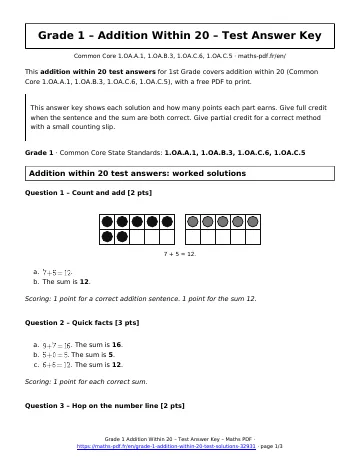
1 – Count and add [2 pts]
- \(7 + 5 = 12\).
- So, the sum is 12.
Scoring: 1 point for a correct addition sentence. 1 point for the sum 12.
2 – Quick facts [3 pts]
- \(9 + 7 = 16\). So, the sum is 16.
- \(5 + 0 = 5\). The sum is 5.
- \(6 + 6 = 12\). The sum is 12.
Scoring: 1 point for each correct sum.
3 – Hop on the number line [2 pts]
- \(9 + 5 = 14\).
- So, the hop ends at 14.
Scoring: 1 point for the sentence 9 + 5 = 14. 1 point for the endpoint 14.
4 – Flip the addends [2 pts]
- \(9 + 6\).
- \(9 + 6 = 15\), so the sum is 15.
Scoring: 1 point for 9 + 6. 1 point for the sum 15.
5 – Three numbers [3 pts]
- 3 and 7 make 10. \(10 + 9 = 19\). So, the sum is 19.
- 5 and 5 make 10. \(8 + 10 = 18\). The sum is 18.
Scoring: part a: 1 point for a correct method and 1 point for 19. Part b: 1 point for 18.
6 – Compare [2 pts]
- \(7 + 6 = 13\), \(8 + 4 = 12\). \(7 + 6 > 8 + 4\).
- \(9 + 3 = 12\), \(6 + 6 = 12\). \(9 + 3 = 6 + 6\).
Scoring: 1 point for each correct symbol (> then =).
Question 7 and after
7 – Bead story [3 pts]
\(8 + 6 = 14\). Aisha has 14 beads.
Scoring: 1 point for adding the two numbers. 1 point for the sentence 8 + 6 = 14. 1 point for the answer 14 beads.
8 – Fill the frame [3 pts]
- 2 counters move.
- 7 – 2 = 5 is left. \(10 + 5\).
- \(8 + 7 = 15\). The sum is 15.
Scoring: 1 point for each correct part.
Total score
20 points
Key facts behind this 1st grade addition within 20 test answer key
- The sum is the total. In 5 + 3 = 8, the sum is 8.
- Counting on: start at the bigger number and count up the smaller one.
- Make a ten: 8 + 5 = 10 + 3 = 13.
- Doubles help: 6 + 6 = 12, so 6 + 7 = 13.
- Order does not matter, and adding 0 leaves a number the same.
Common mistakes with this 1st grade addition within 20 test answer key
- Giving full credit for a sum with the wrong number sentence in question 1 hides a gap. The sentence must match the picture, such as 4 + 5 = 9 for the counters shown.
- In question 4, a student may rewrite 6 + 9 as 6 + 9 again. The addends must be swapped to give 9 + 6, then the sum 15.
- Also, marking question 8 only by the final sum misses the point. The question asks how many counters move, so the answer is a count, not the sum.
How to learn from your test
- Sort missed questions into counting on, doubles, make a ten, and three-number sums. A pattern across the class shows what to reteach first.
- Next, return tests with a short fix-it task: choose two missed parts and solve them again with counters or a ten frame.
- Parents should look for a repeated error, like always missing facts that cross ten, and practice that single type for a week.
Download the 1st grade addition within 20 test answer key as a PDF with the button below and keep it with your notes.
1st grade addition within 20 test answer key: frequently asked questions
How should partial credit work on the three-number question?
Because question 5 has two parts worth 2 and 1 points, give each part its own credit. A child who finds 3 + 9 + 7 correctly but misses 8 + 5 + 5 still earns points for the first. Note whether the child used a make ten pair.
What score means a student is ready for subtraction within 20?
A score of 16 or more out of 20 shows strong understanding of addition strategies. Students scoring between 12 and 15 can move on with extra practice on the missed skills. Below 12, review counting on and make a ten before starting subtraction.
Should I count a correct answer found with counters?
Yes. Using counters is a valid strategy in Grade 1. Over time, ask children to explain how they could solve it without counters, such as by counting on or using a double. The goal is steady growth from objects to mental strategies.
All Grade 1 chapters: Grade 1 math.
More 1st Grade math
Lessons
See all Adding and Subtracting Tens Within 100 Lesson: Notes and Examples
- Organizing and Reading Data Lesson: Notes and Examples
- Counting and Numbers to 20 Lesson: Notes and Examples
- Addition Within 20 Lesson: Notes and Examples
- Halves and Fourths Lesson: Notes and Examples
- Telling Time to the Hour and Half Hour Lesson: Notes and Examples




Worksheets
See all- The Equal Sign and Word Problems Worksheets with Answers
- Halves and Fourths Worksheets with Answers
- Adding and Subtracting Tens Within 100 Worksheets with Answers
- Telling Time to the Hour and Half Hour Worksheets with Answers
- 2D and 3D Shapes Worksheets with Answers
- Comparing Two-Digit Numbers Worksheets with Answers




Tests
See all



Quizzes
See all- Counting and Numbers to 20 Quiz: 10 Questions with Answers
- Subtraction Within 20 Quiz: 10 Questions with Answers
- Telling Time to the Hour and Half Hour Quiz: 10 Questions with Answers
- Adding and Subtracting Tens Within 100 Quiz: 10 Questions with Answers
- Measuring Length Quiz: 10 Questions with Answers
- Comparing Two-Digit Numbers Quiz: 10 Questions with Answers