Algebra 1 Adding, Subtracting and Multiplying Polynomials Lesson: Notes and Examples (Free PDF)

This multiplying polynomials lesson for Algebra 1 covers adding, subtracting and multiplying polynomials (Common Core A-APR.A.1), with a free PDF to print.
Key takeaway: This lesson helps Algebra 1 students name polynomials and add, subtract, and multiply them without losing terms or signs.
- Topic: Adding, Subtracting and Multiplying Polynomials (Algebra 1)
- Content: One-page lesson with a definition, a worked example and key facts
- Standards: A-APR.A.1
- Answers: Explanations included
- Format: Free printable PDF, US Letter, black and white
Key takeaway: A clear Algebra 1 lesson on Adding, Subtracting and Multiplying Polynomials, with definitions, rules and worked examples: what is a polynomial, how do you add and subtract polynomials and how do you multiply polynomials. Read it before the practice worksheet; free to print or download as a PDF.
A polynomial is a sum of terms with whole-number exponents, such as 3x² – 5x + 7. To add or subtract, combine like terms. To multiply, distribute each term of one polynomial across the other, using FOIL or an area model. Special products include the square of a binomial and the difference of squares.
This lesson helps Algebra 1 students name polynomials and add, subtract, and multiply them without losing terms or signs. You see each operation as a short routine built on like terms and the distributive property.
The lesson covers degree and leading coefficient, standard form, adding and subtracting by combining like terms, multiplying a monomial by a polynomial, the FOIL pattern, the square of a binomial, and the difference of squares. Also, an area model shows why each product has the terms it does. Next, plan about 35 minutes, and expand each worked example yourself before you read the answer.
Algebra 1 · Common Core State Standards: A-APR.A.1
Key facts in this multiplying polynomials lesson
- The degree of a polynomial is its greatest exponent.
- Next, add or subtract by combining like terms; subtracting changes the sign of every term.
- Multiply by distributing each term, then combine like terms.
- (a + b)² = a² + 2ab + b² and (a + b)(a – b) = a² – b².
- Then, the sum, difference, and product of polynomials is a polynomial.
What is a polynomial?
The leading coefficient is the coefficient of the term with the highest degree. In \(2x^{3} – 7x + 4\), the degree is 3 and the leading coefficient is 2.
How do you add and subtract polynomials?
Combine like terms, which have the same variable and exponent. To subtract, change the sign of every term in the second polynomial first.
Example: Subtract \((5x^{2} + 3x – 2) – (2x^{2} – x + 6)\). Distribute the negative: \(5x^{2} + 3x – 2 – 2x^{2} + x – 6\). Combine: \(3x^{2} + 4x – 8\).
How do you multiply polynomials?
Multiply every term of one polynomial by every term of the other, then combine like terms. For two binomials, you can use FOIL (First, Outer, Inner, Last) or an area model.
- Multiply each term in the first factor by each term in the second.
- Write all the partial products.
- Combine like terms and write in standard form.
What are the special products?
Two patterns save time. The square of a binomial is \((a + b)^{2} = a^{2} + 2ab + b^{2}\). The product of a sum and a difference is \((a + b)(a – b) = a^{2} – b^{2}\).
The middle term of a square is twice the product of the two terms, so \((x + 5)^{2} = x^{2} + 2(x)(5) + 25\). Note that \((x + 5)^{2}\) is not equal to \(x^{2} + 25\).
Why are polynomials closed under these operations?
The sum, difference, and product of two polynomials is always another polynomial, just as the sum and product of integers is an integer. Division does not always give a polynomial.
Multiplying polynomials lesson: questions and answers
What is the degree of a polynomial?
It is the highest exponent of the variable. The polynomial 2x³ – 7x + 4 has degree 3.
What is FOIL?
FOIL is a memory aid for multiplying two binomials: multiply the First terms, Outer terms, Inner terms, and Last terms, then add the products.
How do you subtract polynomials?
Distribute the negative sign to every term in the second polynomial, then combine like terms.
Why is (x + 5)² not x² + 25?
Squaring a binomial means multiplying it by itself, which creates the middle term 2(5)x = 10x. So (x + 5)² = x² + 10x + 25.
What does closed mean for polynomials?
It means adding, subtracting, or multiplying polynomials always gives another polynomial, just as adding integers always gives an integer.
Common mistakes with this multiplying polynomials lesson
- Students write \((x + 5)^{2}\) as \(x^{2} + 25\). Squaring means multiplying the binomial by itself, so there is a middle term, and the result is \(x^{2} + 10x + 25\).
- Students subtract only the first term of the second polynomial. As a result, a minus sign in front of a group changes the sign of every term inside the group.
- Students add exponents when they combine like terms. Adding \(3x^{2}\) and \(2x^{2}\) gives \(5x^{2}\), because only the coefficients are added and the power stays the same.
How to study this chapter
- Write polynomials in standard form before you add or subtract. Aligned powers make like terms easy to spot.
- Draw an area model for any product of two binomials. The four boxes show the four partial products, so no term is forgotten.
- Parents can check a result by substituting a small number, such as 2, into the problem and the answer and comparing.
Download the multiplying polynomials lesson as a PDF with the button below and keep it with your notes.
More questions about multiplying polynomials lesson
How many terms does the product of two binomials have?
Before combining, the product of two binomials has four terms, one from each pair of multiplications. After combining like terms, it usually has three. In \((x + 3)(x + 2)\), the middle terms 2x and 3x combine to 5x, giving \(x^{2} + 5x + 6\).
What is the difference between a monomial, binomial, and trinomial?
The names count the terms. As a result, a monomial has one term, a binomial has two, and a trinomial has three. In other words, the word polynomial covers any number of terms. Also, the degree is a separate idea and comes from the highest exponent of the variable.
Why is the difference of squares missing a middle term?
The two middle terms are opposites and cancel. In \((x + 8)(x – 8)\), you get -8x and +8x, which add to zero. Also, that leaves \(x^{2} – 64\). Also, the pattern works only when the binomials have the same terms and opposite signs.
All Algebra 1 chapters: Algebra 1 math.
Free printable PDF
Algebra 1 Adding, Subtracting and Multiplying Polynomials Lesson: Notes and Examples
Download PDF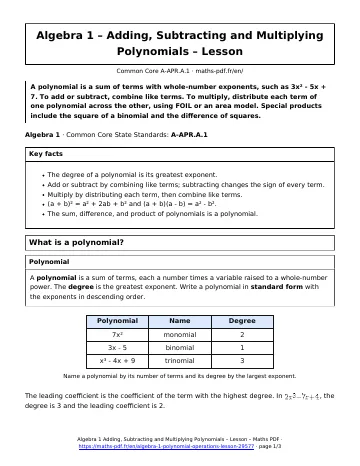
More Algebra 1 math
Lessons
See all Scatter Plots, Lines of Fit and Two-Way Tables Lesson: Notes and Examples
- Solving Quadratic Equations Lesson: Notes and Examples
- Exponent Rules and Radicals Lesson: Notes and Examples
- Systems of Linear Equations Lesson: Notes and Examples
- Graphing Quadratic Functions and Transformations Lesson: Notes and Examples
- Arithmetic and Geometric Sequences Lesson: Notes and Examples






Worksheets
See all- Adding, Subtracting and Multiplying Polynomials Worksheets with Answers
- Arithmetic and Geometric Sequences Worksheets with Answers
- Literal Equations and Formulas Worksheets with Answers
- Graphing Linear Equations Worksheets with Answers
- Factoring Polynomials Worksheets with Answers
- Graphing Quadratic Functions and Transformations Worksheets with Answers






Tests
See all- Structure of Algebraic Expressions Test with Answer Key
- Exponential Functions and Growth Test with Answer Key
- Systems of Linear Equations Test with Answer Key
- Adding, Subtracting and Multiplying Polynomials Test with Answer Key
- Slope and Rate of Change Test with Answer Key
- Linear Inequalities in Two Variables and Systems Test with Answer Key






Quizzes
See all- Arithmetic and Geometric Sequences Quiz: 10 Questions with Answers
- Literal Equations and Formulas Quiz: 10 Questions with Answers
- Solving Quadratic Equations Quiz: 10 Questions with Answers
- Graphing Quadratic Functions and Transformations Quiz: 10 Questions with Answers
- Linear Inequalities in One Variable Quiz: 10 Questions with Answers
- Scatter Plots, Lines of Fit and Two-Way Tables Quiz: 10 Questions with Answers