Algebra 1 Arithmetic and Geometric Sequences Lesson: Notes and Examples (Free PDF)

This arithmetic and geometric sequences lesson for Algebra 1 covers arithmetic and geometric sequences (Common Core F-IF.A.3, F-BF.A.1a, F-BF.A.2, F-LE.A.2), with a free PDF to print.
Key takeaway: This lesson helps Algebra 1 students recognize arithmetic and geometric sequences and write rules for them.
- Topic: Arithmetic and Geometric Sequences (Algebra 1)
- Content: One-page lesson with a definition, a worked example and key facts
- Standards: F-IF.A.3, F-BF.A.1a, F-BF.A.2, F-LE.A.2
- Answers: Explanations included
- Format: Free printable PDF, US Letter, black and white
Key takeaway: A clear Algebra 1 lesson on Arithmetic and Geometric Sequences, with definitions, rules and worked examples: what is a sequence, what is an arithmetic sequence and what is a geometric sequence. Read it before the practice worksheet; free to print or download as a PDF.
A sequence is an ordered list of numbers that can be written as a function of the position n. In an arithmetic sequence you add a common difference d each time. In a geometric sequence you multiply by a common ratio r each time. Recursive rules build each term from the previous one.
This lesson helps Algebra 1 students recognize arithmetic and geometric sequences and write rules for them. You learn that a sequence is a function whose inputs are the positions 1, 2, 3, and so on.
The lesson covers the common difference and the common ratio, recursive rules that build each term from the one before, explicit rules that give any term directly, and the link between arithmetic sequences and lines and between geometric sequences and exponential growth. Examples include a growing pattern of squares. Plan about 30 minutes, and write the first four terms of each rule you meet.
Algebra 1 · Common Core State Standards: F-IF.A.3, F-BF.A.1a, F-BF.A.2, F-LE.A.2
Key facts in this arithmetic and geometric sequences lesson
- A sequence is a function whose inputs are the positions 1, 2, 3, and so on.
- Arithmetic: add d each time; aₙ = a₁ + (n – 1)d.
- Geometric: multiply by r each time; aₙ = a₁ · r^(n-1).
- Then, a recursive rule gives each term from the previous term; an explicit rule gives any term directly.
- Arithmetic sequences are linear; geometric sequences are exponential.
What is a sequence?
What is an arithmetic sequence?
In an arithmetic sequence, you add the same number, the common difference \(d\), to get the next term.
The recursive rule says how to get a term from the previous one: \(a_{n} = a_{n-1} + d\). The explicit rule gives any term directly: \(a_{n} = a_{1} + (n – 1)d\). For 4, 7, 10, 13 this is \(a_{n} = 4 + (n – 1)(3)\), which simplifies to \(a_{n} = 3n + 1\).
What is a geometric sequence?
In a geometric sequence, you multiply by the same number, the common ratio \(r\), each time.
The recursive rule is \(a_{n} = r \cdot a_{n-1}\) and the explicit rule is \(a_{n} = a_{1} \cdot r^{n-1}\). For 3, 6, 12, 24 the explicit rule is \(a_{n} = 3 \cdot 2^{n-1}\), so the 8th term is \(3 \cdot 2^{7} = 384\).
How do you write a rule for a sequence?
- Subtract consecutive terms. If the differences match, it is arithmetic.
- Divide consecutive terms. If the ratios match, it is geometric.
- Substitute the first term and the common difference or ratio into the explicit rule.
- Check the rule with the first two terms.
Example: The figures use 5, 7, and 9 squares. The differences are 2, so the rule is \(a_{n} = 5 + (n – 1)(2)\), which simplifies to \(a_{n} = 2n + 3\). Figure 10 uses \(2(10) + 3 = 23\) squares.
Arithmetic sequences grow by equal steps, so they are linear. Geometric sequences grow by equal factors, so they are exponential.
Tip: Check a rule with the first two terms before you use it. For \(a_{n} = 3n + 1\), the first term is \(3(1) + 1 = 4\) and the second is \(3(2) + 1 = 7\), which match the list.
Arithmetic and geometric sequences lesson: questions and answers
How do you find the common difference?
Subtract any term from the next term. In 4, 7, 10, 13 the common difference is 7 – 4 = 3.
How do you find the common ratio?
Divide any term by the term before it. In 3, 6, 12, 24 the common ratio is 6 ÷ 3 = 2.
What is the difference between recursive and explicit rules?
A recursive rule needs the previous term, such as aₙ = aₙ₋₁ + 3. An explicit rule, such as aₙ = 3n + 1, gives the nth term directly.
Why is a sequence a function?
Each position number n has exactly one term aₙ, so the sequence assigns one output to each input from 1, 2, 3, and so on.
How can you tell arithmetic from geometric?
If consecutive terms have a constant difference, it is arithmetic. If they have a constant ratio, it is geometric.
Common mistakes with this arithmetic and geometric sequences lesson
- Students write \(a_{n} = a_{1} + nd\) for an arithmetic sequence. The first term has no added difference, so the rule uses \(n – 1\) copies of d, not n copies.
- Students find a common ratio by subtracting. If the terms are 3, 6, 12, 24, the ratio is 2 because each term is divided by the one before it.
- Students use the starting position 0 when the problem counts from 1. Then, check whether the first term is called \(a_{1}\), and keep that numbering in your formula.
How to study this chapter
- Test your explicit rule by plugging in n = 1. As a result, the result must be the first term, and n = 2 must give the second.
- For a quick type check, find both the differences and the ratios of the first three terms. So, only one of them stays constant.
- Parents can use a savings pattern, such as adding the same amount each week, to show an arithmetic sequence in daily life.
Download the arithmetic and geometric sequences lesson as a PDF with the button below and keep it with your notes.
More questions about arithmetic and geometric sequences lesson
Can a sequence be both arithmetic and geometric?
Only in a special case. A constant sequence such as 5, 5, 5, 5 has a common difference of 0 and a common ratio of 1, so it fits both. For every other sequence, the differences or the ratios are constant, but not both.
How do you find which term of a sequence equals a given number?
Set the explicit rule equal to the number and solve for n. For the sequence 5, 10, 15, 20, the rule is \(a_{n} = 5n\). Setting 5n equal to 95 gives n = 19, so 95 is the 19th term.
How do you write a rule from two non-consecutive terms?
Divide the change in the terms by the change in the positions to find d, then use one term to find \(a_{1}\). If \(a_{2} = 5\) and \(a_{6} = 21\), then d is 16 divided by 4, which is 4, so \(a_{1}\) is 1.
All Algebra 1 chapters: Algebra 1 math.
Free printable PDF
Algebra 1 Arithmetic and Geometric Sequences Lesson: Notes and Examples
Download PDF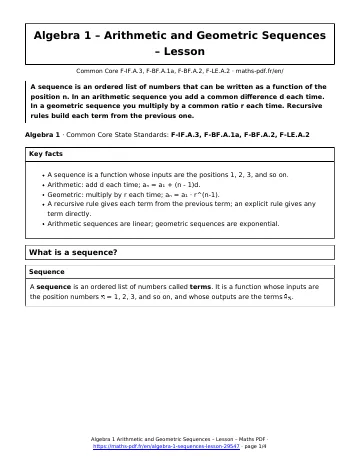
More Algebra 1 math
Lessons
See all Structure of Algebraic Expressions Lesson: Notes and Examples
- Scatter Plots, Lines of Fit and Two-Way Tables Lesson: Notes and Examples
- Literal Equations and Formulas Lesson: Notes and Examples
- Factoring Polynomials Lesson: Notes and Examples
- Graphing Quadratic Functions and Transformations Lesson: Notes and Examples
- Linear Inequalities in Two Variables and Systems Lesson: Notes and Examples





Worksheets
See all- Factoring Polynomials Worksheets with Answers
- Linear Inequalities in One Variable Worksheets with Answers
- Structure of Algebraic Expressions Worksheets with Answers
- Exponent Rules and Radicals Worksheets with Answers
- Graphing Quadratic Functions and Transformations Worksheets with Answers
- Data Distributions and Summary Statistics Worksheets with Answers






Tests
See all- Data Distributions and Summary Statistics Test with Answer Key
- Literal Equations and Formulas Test with Answer Key
- Functions and Function Notation Test with Answer Key
- Solving Quadratic Equations Test with Answer Key
- Adding, Subtracting and Multiplying Polynomials Test with Answer Key
- Systems of Linear Equations Test with Answer Key





Quizzes
See all- Structure of Algebraic Expressions Quiz: 10 Questions with Answers
- Data Distributions and Summary Statistics Quiz: 10 Questions with Answers
- Systems of Linear Equations Quiz: 10 Questions with Answers
- Solving Linear Equations in One Variable Quiz: 10 Questions with Answers
- Solving Quadratic Equations Quiz: 10 Questions with Answers
- Functions and Function Notation Quiz: 10 Questions with Answers