Algebra 1 Structure of Algebraic Expressions Lesson: Notes and Examples (Free PDF)


This algebraic expressions lesson covers structure of algebraic expressions (Common Core A-SSE.A.1a, A-SSE.A.1b), with a free PDF to print.
Key takeaway: This lesson helps Algebra 1 students name the parts of an algebraic expression and simplify it with confidence.
- Topic: Structure of Algebraic Expressions (Algebra 1)
- Content: One-page lesson with a definition, a worked example and key facts
- Standards: A-SSE.A.1a, A-SSE.A.1b
- Answers: Explanations included
- Format: Free printable PDF, US Letter, black and white
Key takeaway: A clear Algebra 1 lesson on Structure of Algebraic Expressions, with definitions, rules and worked examples: what are the parts of an algebraic expression, how do you interpret an expression in context and how do you simplify an expression. Read it before the practice worksheet; free to print or download as a PDF.
An algebraic expression is built from terms, which are numbers, variables, or products of both. A coefficient is the number multiplying a variable, a constant has no variable, and factors are multiplied together. Reading each part in context, and treating a group in parentheses as one quantity, lets you interpret, simplify, and compare expressions correctly.
This lesson helps Algebra 1 students name the parts of an algebraic expression and simplify it with confidence. You learn what a term, a coefficient, a constant, and a factor are before you combine anything.
The lesson shows how to spot like terms, use the distributive property, and treat a group such as \((x + 3)\) as a single quantity. In other words, it ends by reading the meaning of each part in a real situation, such as a fee plus a rate. Then, plan about 25 minutes, and say each part out loud as you label the example expressions.
Algebra 1 · Common Core State Standards: A-SSE.A.1a, A-SSE.A.1b
Key facts in this algebraic expressions lesson
- Terms are separated by + and – signs, and each term keeps its own sign.
- Next, a coefficient multiplies a variable; a constant has no variable.
- Like terms have the same variable part and can be combined by adding coefficients.
- Then, a grouped expression such as (x + 3) can be treated as one factor.
- In a model, a coefficient is often a rate and a constant is a starting amount.
What are the parts of an algebraic expression?
An algebraic expression joins numbers and variables with operations. Before you simplify anything, name its parts.
In \(3x^{2} – 5x + 7\) there are 3 terms. The coefficients are 3 and -5, and the constant is 7. The sign in front of a term belongs to that term.
How do you interpret an expression in context?
Each part of an expression tells a story. A gym charges a $25 joining fee and $18 per month. After \(m\) months, the cost in dollars is \(18m + 25\). The coefficient 18 is the rate: dollars added per month. The constant 25 is the starting amount that is paid once.
When you read an expression, ask what each term measures and what its units are. A term with a variable changes as the variable changes. A constant stays the same.
How can you see part of an expression as a single quantity?
Parentheses group several terms into one factor. In \(5(x + 3)\), the group \((x + 3)\) is one quantity that is multiplied by 5. If \((x + 3)\) is 10, the whole expression is just \(5 \times 10 = 50\).
The same idea helps with formulas. In \(P(1 + r)^{n}\) the factor \((1 + r)^{n}\) does not depend on \(P\), so the expression is the starting amount \(P\) multiplied by a growth factor.
How do you simplify an expression?
Simplifying means writing an equivalent expression with fewer terms. Use the distributive property and combine like terms, which are terms with the same variable part.
- Distribute each factor over its group.
- Circle like terms (same variable and exponent).
- Add or subtract the coefficients of like terms.
Example: Simplify \(4(x + 2) + 3x – 5\). Distribute: \(4x + 8 + 3x – 5\). Combine \(4x + 3x\): the result is \(7x + 3\).
Algebraic expressions lesson: questions and answers
What is the difference between a term and a factor?
Terms are added or subtracted, while factors are multiplied. In 3x + 5, the terms are 3x and 5. In 3x, the factors are 3 and x.
What is a coefficient?
A coefficient is the number that multiplies a variable. In -7y the coefficient is -7. If no number is written, as in x, the coefficient is 1.
What are like terms?
Like terms have exactly the same variables with the same exponents. The terms 5x and -2x are like terms, but 5x and 5x² are not.
How do you interpret a term in a word problem?
Ask what the number and the variable stand for and what units go with the term. In 2.25b, if b is the number of brownies sold at $2.25 each, the term is the money earned from brownies.
Why can a group in parentheses be treated as one quantity?
The parentheses mean the terms inside are evaluated together first. So (x + 3) acts like a single number whenever it is multiplied, divided, or raised to a power.
Common mistakes with this algebraic expressions lesson
- Students lose the sign in front of a term. In \(3x^{2} – 5x + 7\) the coefficient of \(x\) is -5, not 5. Next, circle each term together with the sign on its left.
- Students combine unlike terms such as \(4x\) and \(4x^{2}\). Like terms need the same variable part, including the exponent, so these two stay separate.
- Students confuse a term with a factor. In \(5(x – 2)\) the 5 and the group are factors of one product, not two terms added together.
How to study this chapter
- Before simplifying, draw a slash between terms and write the sign above each one. Counting terms then takes a few seconds.
- Replace a variable with a small number, such as 2, in the original and in your simplified result. Matching values is a fast check.
- Parents can use a phone bill or a gym membership at home. Ask which part is the fixed fee and which part changes with use.
Download the algebraic expressions lesson as a PDF with the button below and keep it with your notes.
More questions about algebraic expressions lesson
Is a constant a term?
Yes, a constant is a term that has no variable. In \(2x + 9\) the number 9 is a term, and it is called the constant term. Also, it does not change when x changes, which is why it often stands for a starting amount or a fixed fee.
Why does the minus sign belong to the term after it?
Subtraction is the same as adding the opposite. So \(8 – 3x\) means 8 plus negative 3x, and the term is -3x. Keeping the sign attached prevents errors when you reorder terms or combine like terms.
How do you simplify an expression with parentheses?
Use the distributive property to multiply each term inside by the factor outside, then combine like terms. For \(2(x + 4) + 3x\), first get \(2x + 8 + 3x\), then combine to get \(5x + 8\). In other words, a negative factor flips every sign inside.
All Algebra 1 chapters: Algebra 1 math.
Free printable PDF
Algebra 1 Structure of Algebraic Expressions Lesson: Notes and Examples
Download PDF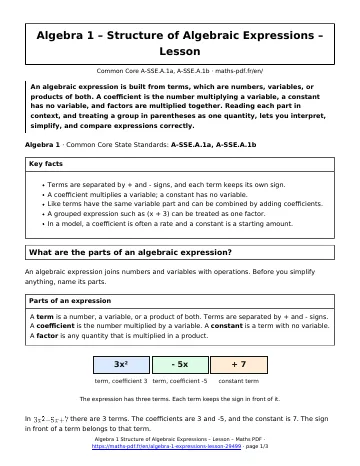
More Algebra 1 math
Lessons
See all Solving Linear Equations in One Variable Lesson: Notes and Examples
- Linear Inequalities in Two Variables and Systems Lesson: Notes and Examples
- Graphing Quadratic Functions and Transformations Lesson: Notes and Examples
- Arithmetic and Geometric Sequences Lesson: Notes and Examples
- Scatter Plots, Lines of Fit and Two-Way Tables Lesson: Notes and Examples
- Slope and Rate of Change Lesson: Notes and Examples






Worksheets
See all- Factoring Polynomials Worksheets with Answers
- Scatter Plots, Lines of Fit and Two-Way Tables Worksheets with Answers
- Linear Inequalities in One Variable Worksheets with Answers
- Exponential Functions and Growth Worksheets with Answers
- Literal Equations and Formulas Worksheets with Answers
- Writing Linear Equations and Functions Worksheets with Answers






Tests
See all- Factoring Polynomials Test with Answer Key
- Writing Linear Equations and Functions Test with Answer Key
- Adding, Subtracting and Multiplying Polynomials Test with Answer Key
- Solving Linear Equations in One Variable Test with Answer Key
- Arithmetic and Geometric Sequences Test with Answer Key
- Slope and Rate of Change Test with Answer Key






Quizzes
See all- Data Distributions and Summary Statistics Quiz: 10 Questions with Answers
- Structure of Algebraic Expressions Quiz: 10 Questions with Answers
- Exponent Rules and Radicals Quiz: 10 Questions with Answers
- Exponential Functions and Growth Quiz: 10 Questions with Answers
- Solving Quadratic Equations Quiz: 10 Questions with Answers
- Adding, Subtracting and Multiplying Polynomials Quiz: 10 Questions with Answers