Algebra 1 Solving Linear Equations in One Variable Lesson: Notes and Examples (Free PDF)

This algebra 1 solving linear equations lesson covers solving linear equations in one variable (Common Core A-REI.A.1, A-REI.B.3, A-CED.A.1), with a free PDF to print.
Key takeaway: This lesson helps Algebra 1 students solve linear equations in one variable by keeping both sides balanced.
- Topic: Solving Linear Equations in One Variable (Algebra 1)
- Content: One-page lesson with a definition, a worked example and key facts
- Standards: A-REI.A.1, A-REI.B.3, A-CED.A.1
- Answers: Explanations included
- Format: Free printable PDF, US Letter, black and white
Key takeaway: A clear Algebra 1 lesson on Solving Linear Equations in One Variable, with definitions, rules and worked examples: what is a linear equation in one variable, how do you solve a two-step equation and how do you write an equation from a word problem. Read it before the practice worksheet; free to print or download as a PDF.
A linear equation in one variable, such as 3x + 5 = 20, is solved by using inverse operations on both sides until the variable stands alone. Do the same operation to both sides to keep the equation balanced. Equations can have one solution, no solution when a false statement remains, or infinitely many solutions when a true statement remains.
This lesson helps Algebra 1 students solve linear equations in one variable by keeping both sides balanced. You learn the order of steps, from one-step equations to equations with variables on both sides.
The lesson covers properties of equality, two-step equations, distributing and combining like terms, fraction coefficients, and the three possible outcomes: one solution, no solution, or infinitely many. Worked examples use a balance picture and a tape diagram so each step has a visual meaning. Then, plan about 35 minutes, and check every example by substituting the answer into the original equation.
Algebra 1 · Common Core State Standards: A-REI.A.1, A-REI.B.3, A-CED.A.1
Key facts in this algebra 1 solving linear equations lesson
- Do the same operation to both sides of an equation to keep it balanced.
- Undo addition and subtraction first, then multiplication and division.
- With variables on both sides, collect variable terms on one side and constants on the other.
- Then, a false statement such as 6 = 5 means no solution; a true statement such as 8 = 8 means infinitely many.
- Check a solution by substituting it into the original equation.
What is a linear equation in one variable?
A linear equation in one variable can be written as \(ax + b = c\), where \(a\) is not zero. Solving it means finding the value of the variable that makes both sides equal. That value is the solution.
How do you solve a two-step equation?
Undo the operations in the reverse order of the order of operations. First undo addition or subtraction, then undo multiplication or division.
How do you solve an equation with variables on both sides?
- Distribute and combine like terms on each side.
- Move the variable terms to one side by adding or subtracting.
- Move the constants to the other side.
- Divide by the coefficient of the variable.
- Check by substituting the solution into the original equation.
Example: Solve \(5x – 3 = 2x + 12\). Subtract \(2x\) from both sides: \(3x – 3 = 12\). Add 3: \(3x = 15\). Divide by 3: \(x = 5\). Check: \(5(5) – 3 = 22 \text{ and } 2(5) + 12 = 22\), so the solution is correct.
Can an equation have no solution or infinitely many?
Yes. If the variable terms cancel and a false statement remains, such as \(6 = 5\), there is no solution. If a true statement remains, such as \(8 = 8\), every real number is a solution.
How do you write an equation from a word problem?
Define the variable, translate the words into an expression for each side, and set the sides equal. A savings plan that starts with $40 and adds $15 each week reaches $190 when \(40 + 15w = 190\).
Algebra 1 solving linear equations lesson: questions and answers
What does it mean to solve an equation?
Solving means finding every value of the variable that makes the equation true. For 2x + 1 = 9 the only solution is x = 4, because 2(4) + 1 = 9.
Why do you do the same thing to both sides?
An equation says two quantities are equal. Applying the same operation to both keeps them equal, like keeping a balance scale level.
How do you solve an equation with a fraction coefficient?
Multiply both sides by the reciprocal of the fraction. For (2/3)x = 12, multiply both sides by 3/2 to get x = 18.
What does it mean when the variable disappears?
If a false statement such as 6 = 5 remains, there is no solution. If a true statement such as 8 = 8 remains, every real number is a solution.
How can you check your answer?
Substitute the solution into the original equation and simplify both sides. If the two sides are equal, the solution is correct.
Common mistakes with this algebra 1 solving linear equations lesson
- Students apply an operation to only one side. If you add 5 to the left side, add 5 to the right side too, or the equation is no longer true.
- Students undo multiplication before addition in a two-step equation. In \(3x + 5 = 20\), subtract 5 first, then divide by 3, because the addition was done last.
- Students distribute to only the first term. In \(3(x – 2)\), multiply 3 by both x and -2 to get \(3x – 6\), including the sign.
How to study this chapter
- Write each step on its own line, with the operation you used in the margin. Also, it makes errors easy to find.
- Before you start, decide which side will hold the variable. Moving the smaller variable term avoids negative coefficients.
- Parents can ask the student to check the answer in the original equation aloud. That one habit catches most mistakes.
Download the algebra 1 solving linear equations lesson as a PDF with the button below and keep it with your notes.
More questions about algebra 1 solving linear equations lesson
How do you solve an equation with variables on both sides?
Use inverse operations to collect the variable terms on one side and the constants on the other, then divide by the coefficient. For \(5x – 3 = 2x + 12\), subtract 2x to get \(3x – 3 = 12\), add 3 to get \(3x = 15\), so x = 5.
How do you solve an equation with parentheses?
Distribute first, then combine like terms, then solve as usual. For \(3(x – 2) = 2x + 5\), the left side becomes \(3x – 6\). Next, subtract 2x and add 6 to get x = 11. Next, substitute 11 to confirm that both sides equal 27.
How do you write an equation from a word problem?
Name the unknown, find the quantity that is stated twice in two different ways, and set those two expressions equal. If 4 tickets plus a 6 dollar fee total 38 dollars, write \(4t + 6 = 38\). Solve it, then answer in a sentence with units.
All Algebra 1 chapters: Algebra 1 math.
Free printable PDF
Algebra 1 Solving Linear Equations in One Variable Lesson: Notes and Examples
Download PDF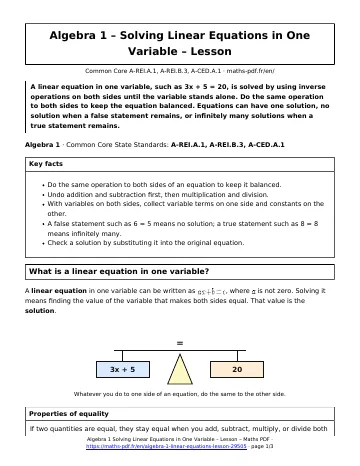
More Algebra 1 math
Lessons
See all Literal Equations and Formulas Lesson: Notes and Examples
- Systems of Linear Equations Lesson: Notes and Examples
- Graphing Linear Equations Lesson: Notes and Examples
- Adding, Subtracting and Multiplying Polynomials Lesson: Notes and Examples
- Arithmetic and Geometric Sequences Lesson: Notes and Examples
- Exponent Rules and Radicals Lesson: Notes and Examples




Worksheets
See all- Graphing Linear Equations Worksheets with Answers
- Adding, Subtracting and Multiplying Polynomials Worksheets with Answers
- Linear Inequalities in Two Variables and Systems Worksheets with Answers
- Scatter Plots, Lines of Fit and Two-Way Tables Worksheets with Answers
- Data Distributions and Summary Statistics Worksheets with Answers
- Writing Linear Equations and Functions Worksheets with Answers





Tests
See all- Literal Equations and Formulas Test with Answer Key
- Arithmetic and Geometric Sequences Test with Answer Key
- Solving Linear Equations in One Variable Test with Answer Key
- Linear Inequalities in One Variable Test with Answer Key
- Data Distributions and Summary Statistics Test with Answer Key
- Structure of Algebraic Expressions Test with Answer Key





Quizzes
See all- Exponential Functions and Growth Quiz: 10 Questions with Answers
- Solving Quadratic Equations Quiz: 10 Questions with Answers
- Linear Inequalities in One Variable Quiz: 10 Questions with Answers
- Factoring Polynomials Quiz: 10 Questions with Answers
- Functions and Function Notation Quiz: 10 Questions with Answers
- Linear Inequalities in Two Variables and Systems Quiz: 10 Questions with Answers