Algebra 1 Systems of Linear Equations Lesson: Notes and Examples (Free PDF)

This algebra 1 systems of equations lesson covers systems of linear equations (Common Core A-REI.C.5, A-REI.C.6, A-REI.D.11, A-CED.A.3), with a free PDF to print.
Key takeaway: This lesson helps Algebra 1 students solve systems of two linear equations by graphing, substitution, and elimination.
- Topic: Systems of Linear Equations (Algebra 1)
- Content: One-page lesson with a definition, a worked example and key facts
- Standards: A-REI.C.5, A-REI.C.6, A-REI.D.11, A-CED.A.3
- Answers: Explanations included
- Format: Free printable PDF, US Letter, black and white
Key takeaway: A clear Algebra 1 lesson on Systems of Linear Equations, with definitions, rules and worked examples: what is a system of linear equations, what is the substitution method and what is the elimination method. Read it before the practice worksheet; free to print or download as a PDF.
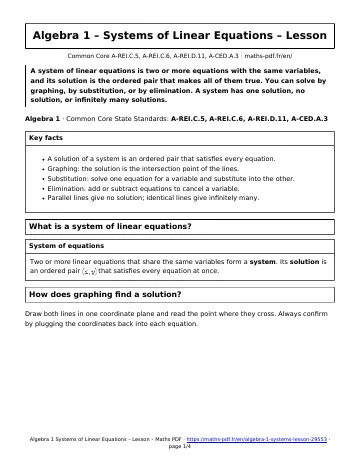
A system of linear equations is two or more equations with the same variables, and its solution is the ordered pair that makes all of them true. You can solve by graphing, by substitution, or by elimination. A system has one solution, no solution, or infinitely many solutions.
This lesson helps Algebra 1 students solve systems of two linear equations by graphing, substitution, and elimination. You learn what a solution means and how to pick the method that fits the equations.
The lesson covers the solution as an ordered pair that satisfies both equations, the intersection point of two lines, solving for one variable and substituting, adding or subtracting equations to cancel a variable, multiplying first when needed, and the cases of no solution and infinitely many solutions. Then, plan about 40 minutes, and check every solution in both equations.
Algebra 1 · Common Core State Standards: A-REI.C.5, A-REI.C.6, A-REI.D.11, A-CED.A.3
Key facts in this algebra 1 systems of equations lesson
- A solution of a system is an ordered pair that satisfies every equation.
- Graphing: the solution is the intersection point of the lines.
- Substitution: solve one equation for a variable and substitute into the other.
- Elimination: add or subtract equations to cancel a variable.
- Parallel lines give no solution; identical lines give infinitely many.
What is a system of linear equations?
How does graphing find a solution?
Draw both lines in one coordinate plane and read the point where they cross. Always confirm by plugging the coordinates back into each equation.
In this picture, \(y = x + 1\) and \(y = -x + 5\) both give the same point \((2, 3)\) at the crossing.
Can a system have no answer, or too many?
Two lines in a plane meet at one point, never meet, or lie on top of each other. So a system has exactly one solution, none, or infinitely many.
Parallel lines share a slope but have different intercepts. If your algebra ends with a false statement like \(0 = 5\), the lines are parallel. If it ends with a true statement like \(4 = 4\), the two equations describe the same line.
What is the substitution method?
- Isolate one variable in one equation.
- Replace that variable in the other equation with the expression you found.
- Solve the resulting one-variable equation, then back-substitute to get the second value.
What is the elimination method?
Add or subtract the two equations so that one variable drops out. If no variable cancels, scale one or both equations first. For example, adding \(2x + 3y = 12\) and \(4x – 3y = 6\) produces \(6x = 18\).
Worked example: From \(6x = 18\) we get \(x = 3\). Putting that into \(2x + 3y = 12\) gives \(2(3) + 3y = 12\), so \(y = 2\), and the solution is \((3, 2)\).
How do you set up a word problem as a system?
Name two unknowns, translate each fact into its own equation, and solve. Suppose a theater sold 8 tickets for $60, with adult tickets at $9 and student tickets at $6. With \(a + s = 8\) for the count and \(9a + 6s = 60\) for the money, the system is ready to solve.
Algebra 1 systems of equations lesson: questions and answers
What is the solution of a system of equations?
It is the ordered pair (x, y) that makes both equations true. Graphically it is the point where the lines intersect.
When should you use substitution?
Use substitution when one equation is already solved for a variable or has a variable with coefficient 1, such as y = 3x or x + y = 12.
When should you use elimination?
Use elimination when both equations are in standard form Ax + By = C and the coefficients of a variable are equal or opposite, or can be made so by multiplying.
How can a system have no solution?
If the lines are parallel, they have the same slope but different intercepts and never meet. Algebra then gives a false statement like 0 = 5.
How do you check a solution?
Substitute the ordered pair into both original equations. If both are true, the pair is the solution.
Common mistakes with this algebra 1 systems of equations lesson
- Students check a solution in only one equation. An ordered pair must satisfy both equations, so substitute it into each one before you call it a solution.
- Students substitute into the same equation they solved. After solving \(y = 3x\), substitute into the other equation, \(x + y = 12\), not back into the first.
- Students add equations without matching coefficients. Elimination works only when the coefficients of one variable are opposites, so multiply one or both equations first.
How to study this chapter
- Look at the equations before you choose a method. If one already has a variable alone, use substitution. If both are in standard form, use elimination.
- After you find x, substitute it into the simpler equation to find y, then write the answer as an ordered pair.
- Parents can ask for a story that matches a system, such as two gym plans, and ask when they cost the same.
Download the algebra 1 systems of equations lesson as a PDF with the button below and keep it with your notes.
More questions about algebra 1 systems of equations lesson
What does it mean when elimination gives a false statement?
A false statement such as 0 equals 8 means the system has no solution. The lines are parallel, with the same slope and different intercepts, so they never meet. In other words, the equations have no ordered pair in common.
What does it mean when both variables cancel and the statement is true?
A true statement such as 0 equals 0 means the two equations describe the same line. Every point on the line is a solution, so the system has infinitely many solutions. For example, 2x + 4y = 8 and x + 2y = 4 are the same line.
How do you solve a system when neither equation is solved for a variable?
Use elimination, or solve one equation for a variable first and then substitute. For 2x + 3y = 13 and 5x – 2y = 4, multiply the first by 2 and the second by 3, add the results, and solve. You get x = 2 and y = 3.
All Algebra 1 chapters: Algebra 1 math.
More Algebra 1 math
Lessons
See all Adding, Subtracting and Multiplying Polynomials Lesson: Notes and Examples
- Writing Linear Equations and Functions Lesson: Notes and Examples
- Linear Inequalities in Two Variables and Systems Lesson: Notes and Examples
- Exponent Rules and Radicals Lesson: Notes and Examples
- Solving Linear Equations in One Variable Lesson: Notes and Examples
- Scatter Plots, Lines of Fit and Two-Way Tables Lesson: Notes and Examples






Worksheets
See all- Scatter Plots, Lines of Fit and Two-Way Tables Worksheets with Answers
- Slope and Rate of Change Worksheets with Answers
- Structure of Algebraic Expressions Worksheets with Answers
- Arithmetic and Geometric Sequences Worksheets with Answers
- Exponent Rules and Radicals Worksheets with Answers
- Graphing Quadratic Functions and Transformations Worksheets with Answers






Tests
See all- Adding, Subtracting and Multiplying Polynomials Test with Answer Key
- Linear Inequalities in Two Variables and Systems Test with Answer Key
- Linear Inequalities in One Variable Test with Answer Key
- Structure of Algebraic Expressions Test with Answer Key
- Exponent Rules and Radicals Test with Answer Key
- Graphing Quadratic Functions and Transformations Test with Answer Key






Quizzes
See all- Factoring Polynomials Quiz: 10 Questions with Answers
- Literal Equations and Formulas Quiz: 10 Questions with Answers
- Linear Inequalities in One Variable Quiz: 10 Questions with Answers
- Arithmetic and Geometric Sequences Quiz: 10 Questions with Answers
- Adding, Subtracting and Multiplying Polynomials Quiz: 10 Questions with Answers
- Functions and Function Notation Quiz: 10 Questions with Answers