Algebra 1 Factoring Polynomials Quiz: 10 Questions with Answers


This factoring polynomials quiz for Algebra 1 covers factoring polynomials (Common Core A-SSE.A.2, A-SSE.B.3a, A-APR.B.3), with a free PDF to print.
Key takeaway: This quiz helps Algebra 1 students check quickly whether they recognize the main factoring patterns.
- Topic: Factoring Polynomials (Algebra 1)
- Content: 10 multiple-choice questions with instant explanations
- Standards: A-SSE.A.2, A-SSE.B.3a, A-APR.B.3
- Answers: Explanations included
- Format: Free printable PDF, US Letter, black and white
This quiz helps Algebra 1 students check quickly whether they recognize the main factoring patterns. Also, each question has one correct choice and a brief explanation.
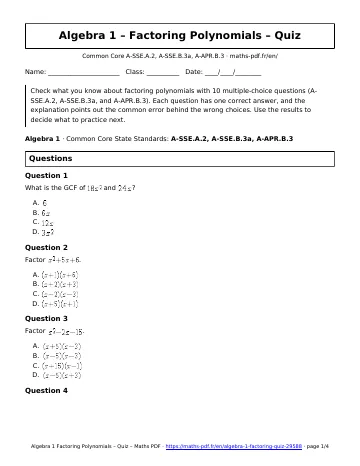
The quiz has 10 multiple-choice questions and takes about 10 minutes. Question 1 asks for the GCF of \(18x^{2}\) and \(24x\). Questions 2 to 4 factor trinomials, including one from an area model. Also, questions 5 to 7 cover \(x^{2} – 100\), \(x^{2} – 16x + 64\), and \(3x^{2} + 6x\). Questions 8 to 10 connect factoring to rectangle area, zeros, and the identity for \(x^{2} – 4\).
Key takeaway: This Algebra 1 quiz on Factoring Polynomials checks the main ideas in 11 questions, each with the correct answer explained. Take it after the lesson to see what you have mastered; free and printable.
Algebra 1 · Common Core State Standards: A-SSE.A.2, A-SSE.B.3a, A-APR.B.3
Factoring polynomials quiz: 10 questions
Question 6 and after
Remember
- Factor out the greatest common factor (GCF) first.
- Next, for x² + bx + c, find two numbers with product c and sum b.
- Difference of squares: a² – b² = (a + b)(a – b).
- Perfect square trinomials: a² ± 2ab + b² = (a ± b)².
- If a product is zero, one of its factors is zero, so factored form shows the zeros.
Common mistakes with this factoring polynomials quiz
- Students give the product of the two numbers as the greatest common factor. However, the GCF is the largest number that divides both, and it includes any shared variable.
- Students choose a factor pair with the right product but the wrong sum. Instead, check both: the pair must multiply to c and add to b.
- Students read the zeros of a factored function with the wrong signs. Because a zero makes a factor equal to zero, solve each factor for x.
Tips to get a high score
- Take the quiz once without any notes, then review the explanations. So, each wrong choice is a mistake that real students make.
- If you miss the trinomial questions, build a table of factor pairs and sums for 12, 15, and 24 and practice reading it.
- Teachers can use question 10 for a discussion on why agreeing at one value does not prove two expressions equal.
Download the factoring polynomials quiz as a PDF with the button below and keep it with your notes.
Factoring polynomials quiz: frequently asked questions
How do I factor a simple trinomial quickly?
Find two numbers that multiply to the last term and add to the middle coefficient. For example, in \(x^{2} + 9x + 20\), the pair 4 and 5 works, so the answer is \((x + 4)(x + 5)\). Then multiply the binomials back to check.
Does agreeing at one value prove two expressions are equal?
No. Two expressions can match at one input and differ elsewhere. Also, that agreement is evidence, not proof. In other words, a proof uses a pattern, such as the difference of squares, that works for every value of x.
What is the area model for factoring?
It is a rectangle split into four boxes, where the total area is the trinomial and the two sides are its factors. You fill in the boxes and read the sides. For \(x^{2} + 8x + 15\), the sides are x + 3 and x + 5.
All Algebra 1 chapters: Algebra 1 math.
More Algebra 1 math
Lessons
See all Functions and Function Notation Lesson: Notes and Examples
- Linear Inequalities in One Variable Lesson: Notes and Examples
- Solving Quadratic Equations Lesson: Notes and Examples
- Exponential Functions and Growth Lesson: Notes and Examples
- Data Distributions and Summary Statistics Lesson: Notes and Examples
- Factoring Polynomials Lesson: Notes and Examples






Worksheets
See all- Solving Quadratic Equations Worksheets with Answers
- Graphing Linear Equations Worksheets with Answers
- Solving Linear Equations in One Variable Worksheets with Answers
- Scatter Plots, Lines of Fit and Two-Way Tables Worksheets with Answers
- Functions and Function Notation Worksheets with Answers
- Arithmetic and Geometric Sequences Worksheets with Answers






Tests
See all- Solving Linear Equations in One Variable Test with Answer Key
- Data Distributions and Summary Statistics Test with Answer Key
- Functions and Function Notation Test with Answer Key
- Structure of Algebraic Expressions Test with Answer Key
- Graphing Linear Equations Test with Answer Key
- Factoring Polynomials Test with Answer Key






Quizzes
See all- Adding, Subtracting and Multiplying Polynomials Quiz: 10 Questions with Answers
- Slope and Rate of Change Quiz: 10 Questions with Answers
- Literal Equations and Formulas Quiz: 10 Questions with Answers
- Functions and Function Notation Quiz: 10 Questions with Answers
- Graphing Quadratic Functions and Transformations Quiz: 10 Questions with Answers
- Solving Linear Equations in One Variable Quiz: 10 Questions with Answers