Algebra 1 Exponential Functions and Growth Lesson: Notes and Examples (Free PDF)


This algebra 1 exponential functions lesson covers exponential functions and growth (Common Core F-LE.A.1, F-LE.A.2, F-LE.A.3, F-IF.C.7e, F-IF.C.8b), with a free PDF to print.
Key takeaway: This lesson helps Algebra 1 students recognize, write, and graph exponential functions of the form \(f(x) = a \cdot b^{x}\).
- Topic: Exponential Functions and Growth (Algebra 1)
- Content: One-page lesson with a definition, a worked example and key facts
- Standards: F-LE.A.1, F-LE.A.2, F-LE.A.3, F-IF.C.7e, F-IF.C.8b
- Answers: Explanations included
- Format: Free printable PDF, US Letter, black and white
Key takeaway: A clear Algebra 1 lesson on Exponential Functions and Growth, with definitions, rules and worked examples: what is an exponential function, how do you tell linear from exponential and how do growth and decay rates become factors. Read it before the practice worksheet; free to print or download as a PDF.
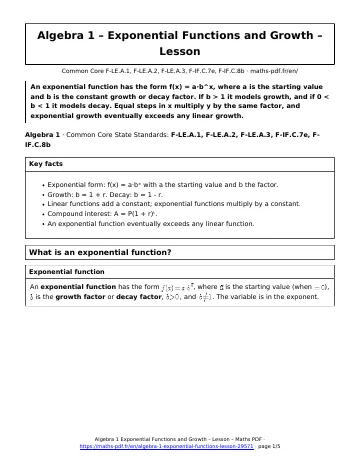
An exponential function has the form f(x) = a·b^x, where a is the starting value and b is the constant growth or decay factor. If b > 1 it models growth, and if 0 < b < 1 it models decay. Equal steps in x multiply y by the same factor, and exponential growth eventually exceeds any linear growth.
This lesson helps Algebra 1 students recognize, write, and graph exponential functions of the form \(f(x) = a \cdot b^{x}\). You learn to tell growth from decay and exponential patterns from linear ones.
The lesson covers the starting value, the growth or decay factor, tables with a constant ratio, the shape of the graph, and compound interest. Worked examples include doubling, a halving sequence, and a savings account. Plan about 30 minutes to read and copy the examples, then use the tables as a checklist whenever a new problem hands you a list of values.
Algebra 1 · Common Core State Standards: F-LE.A.1, F-LE.A.2, F-LE.A.3, F-IF.C.7e, F-IF.C.8b
Key facts in this algebra 1 exponential functions lesson
- Exponential form: f(x) = a·bˣ with a the starting value and b the factor.
- Growth: b = 1 + r. Decay: b = 1 – r.
- Linear functions add a constant; exponential functions multiply by a constant.
- Compound interest: A = P(1 + r)ᵗ.
- An exponential function eventually exceeds any linear function.
What is an exponential function?
When \(b > 1\), the function grows. When \(0 < b < 1\), it decays. The graph has a y-intercept at \((0, a)\) and approaches the x-axis without touching it. The domain is all real numbers and the range is \(y > 0\) when \(a > 0\).
How do you tell linear from exponential?
Look at the table. If equal steps in \(x\) add the same amount to \(y\), the function is linear. If they multiply \(y\) by the same factor, it is exponential.
How do growth and decay rates become factors?
A growth rate \(r\) gives the factor \(b = 1 + r\). Also, a decay rate \(r\) gives \(b = 1 – r\). A population of 20,000 growing 4% per year is modeled by \(P = 20000(1.04)^{t}\). A car losing 15% of its value each year has \(V = 24000(0.85)^{t}\).
How does compound interest work?
With principal \(P\), annual rate \(r\), and \(t\) years, the amount is \(A = P(1 + r)^{t}\). For $1,500 at 6% for 8 years, \(A = 1500(1.06)^{8} \approx 2390.77\). Half-life problems use the factor \(\frac{1}{2}\), because the amount halves at each period.
- Identify the starting value \(a\).
- Find the factor \(b\) from the rate or the table ratio.
- Write \(f(x) = a \cdot b^{x}\) and evaluate at the needed value of \(x\).
Why does exponential growth beat linear growth?
A linear function adds a fixed amount each step. An exponential function multiplies, so the added amount keeps getting bigger. Sooner or later it passes every linear function.
Tip: To choose between a linear and an exponential model, ask whether the quantity changes by a fixed amount or by a fixed percent. A gym fee that rises $5 each month is linear. A savings account that grows 5% each month is exponential.
Algebra 1 exponential functions lesson: questions and answers
What is the difference between linear and exponential growth?
Linear growth adds the same amount each step. Exponential growth multiplies by the same factor each step, so the amount added keeps getting larger.
How do you find the growth factor from a percent?
Add the rate to 1 for growth, so 4% growth gives 1.04. Subtract it from 1 for decay, so 15% decay gives 0.85.
What does the number a mean in a·b^x?
It is the starting value, the output when x = 0. In y = 3·2ˣ the graph crosses the y-axis at (0, 3).
Does an exponential graph ever touch the x-axis?
No. For a > 0 the output is always positive, and the graph gets closer to the x-axis without touching it.
How do you solve an equation like 2^x = 32?
Write both sides with the same base: 32 = 2⁵, so 2ˣ = 2⁵ and x = 5.
Common mistakes with this algebra 1 exponential functions lesson
- Students use 12 percent growth as the factor 0.12. A growth rate is added to 1, so the factor is 1.12. Write the factor first and check that it is above 1 for growth.
- Students call a table exponential after seeing that the outputs rise. Then, check the ratio of consecutive outputs. Also, a constant difference means linear, and a constant ratio means exponential.
- Students think an exponential graph reaches the x-axis. It gets close, but because \(b^{x}\) is never zero, the graph only approaches the axis and never touches it.
How to study this chapter
- Keep two columns in every table, one for differences and one for ratios. As a result, the column that stays constant tells you the function type.
- Always plug in \(x = 0\) first. As a result, the output is the starting value \(a\), which gives half of the equation immediately.
- Parents can show a savings example at home. Ask how a balance with 5 percent yearly interest changes, then compare with adding the same dollar amount each year.
Download the algebra 1 exponential functions lesson as a PDF with the button below and keep it with your notes.
More questions about algebra 1 exponential functions lesson
How do you write an exponential function from two points?
Use the point with \(x = 0\) for \(a\), then divide the second output by the first when the inputs are one step apart to get \(b\). For points \((0, 5)\) and \((1, 10)\), \(a\) is 5 and \(b\) is 2, so \(y = 5 \cdot 2^{x}\).
What is the domain and range of an exponential function?
The domain is all real numbers because you can put any number into the exponent. For \(y = 3 \cdot 2^{x}\), the range is \(y > 0\), since the outputs are always positive. If \(a\) is negative, the range is below zero instead.
What is half-life in an exponential decay problem?
Half-life is the time it takes for an amount to fall to half its value. As a result, a 80 mg dose with a half-life of 6 hours becomes 40 mg after 6 hours and 20 mg after 12 hours. In other words, the exponent is the number of half-lives, \(t/6\).
All Algebra 1 chapters: Algebra 1 math.
More Algebra 1 math
Lessons
See all Arithmetic and Geometric Sequences Lesson: Notes and Examples
- Solving Quadratic Equations Lesson: Notes and Examples
- Structure of Algebraic Expressions Lesson: Notes and Examples
- Functions and Function Notation Lesson: Notes and Examples
- Linear Inequalities in One Variable Lesson: Notes and Examples
- Adding, Subtracting and Multiplying Polynomials Lesson: Notes and Examples






Worksheets
See all- Graphing Linear Equations Worksheets with Answers
- Scatter Plots, Lines of Fit and Two-Way Tables Worksheets with Answers
- Solving Linear Equations in One Variable Worksheets with Answers
- Writing Linear Equations and Functions Worksheets with Answers
- Graphing Quadratic Functions and Transformations Worksheets with Answers
- Systems of Linear Equations Worksheets with Answers






Tests
See all- Structure of Algebraic Expressions Test with Answer Key
- Systems of Linear Equations Test with Answer Key
- Linear Inequalities in Two Variables and Systems Test with Answer Key
- Arithmetic and Geometric Sequences Test with Answer Key
- Solving Linear Equations in One Variable Test with Answer Key
- Scatter Plots, Lines of Fit and Two-Way Tables Test with Answer Key






Quizzes
See all- Graphing Quadratic Functions and Transformations Quiz: 10 Questions with Answers
- Adding, Subtracting and Multiplying Polynomials Quiz: 10 Questions with Answers
- Linear Inequalities in One Variable Quiz: 10 Questions with Answers
- Exponent Rules and Radicals Quiz: 10 Questions with Answers
- Factoring Polynomials Quiz: 10 Questions with Answers
- Structure of Algebraic Expressions Quiz: 10 Questions with Answers