Algebra 1 Adding, Subtracting and Multiplying Polynomials Quiz: 10 Questions with Answers


This multiplying polynomials quiz for Algebra 1 covers adding, subtracting and multiplying polynomials (Common Core A-APR.A.1), with a free PDF to print.
Key takeaway: This quiz helps Algebra 1 students check quickly whether they can work with polynomials.
- Topic: Adding, Subtracting and Multiplying Polynomials (Algebra 1)
- Content: 10 multiple-choice questions with instant explanations
- Standards: A-APR.A.1
- Answers: Explanations included
- Format: Free printable PDF, US Letter, black and white
This quiz helps Algebra 1 students check quickly whether they can work with polynomials. In other words, each question has one correct choice and a short explanation that names the usual trap.
The quiz has 10 multiple-choice questions and takes about 10 minutes. Question 1 asks for the degree of \(3x^{4} – 2x^{2} + 9\). Questions 2 and 3 add and subtract, and questions 4 and 8 use area models. Questions 5, 6, 7, and 9 multiply binomials, a square, a difference of squares, and a monomial with a trinomial. Question 10 asks whether an expression with a negative exponent is a polynomial.
Key takeaway: This Algebra 1 quiz on Adding, Subtracting and Multiplying Polynomials checks the main ideas in 11 questions, each with the correct answer explained. Take it after the lesson to see what you have mastered; free and printable.
Algebra 1 · Common Core State Standards: A-APR.A.1
Multiplying polynomials quiz: 10 questions
Question 7 and after
Remember
- The degree of a polynomial is its greatest exponent.
- Next, add or subtract by combining like terms; subtracting changes the sign of every term.
- Multiply by distributing each term, then combine like terms.
- (a + b)² = a² + 2ab + b² and (a + b)(a – b) = a² – b².
- Then, the sum, difference, and product of polynomials is a polynomial.
Common mistakes with this multiplying polynomials quiz
- Students subtract a negative constant and write minus. However, subtracting a negative number adds it, so change the sign before you combine.
- Students write a binomial square as the sum of two squares. Instead, include the middle term, which is twice the product of the two terms.
- Students call any expression with a variable a polynomial. Because a polynomial needs whole-number exponents, check each exponent.
Tips to get a high score
- Take the quiz once without notes, and then read all ten explanations, including those for questions you got right.
- For area model questions, write the four partial products before you combine them. As a result, the picture supports the algebra.
- Teachers can use questions 3 and 6 as a two-minute check on signs and the middle term.
Download the multiplying polynomials quiz as a PDF with the button below and keep it with your notes.
Multiplying polynomials quiz: frequently asked questions
How can I find the degree of a polynomial?
Find the term with the greatest exponent on the variable, and that exponent is the degree. For example, \(2x^{5} – x + 4\) has degree 5. Also, a constant by itself has degree 0. Also, ignore the coefficients when you look, because only the exponents matter.
How do I multiply a monomial by a trinomial?
Multiply the monomial by each term of the trinomial, adding exponents on the variable. For example, \(2x(x^{2} + 3x – 1)\) gives \(2x^{3}\), then \(6x^{2}\), then -2x. Then, write the three results as one polynomial.
Why is an expression with a variable in a denominator not a polynomial?
A polynomial allows only whole-number powers of the variable. In other words, a term such as one over x has a negative exponent, which breaks the definition. As a result, the expression is not a polynomial, even though it looks similar.
All Algebra 1 chapters: Algebra 1 math.
Free printable PDF
Algebra 1 Adding, Subtracting and Multiplying Polynomials Quiz: 10 Questions with Answers
Download PDF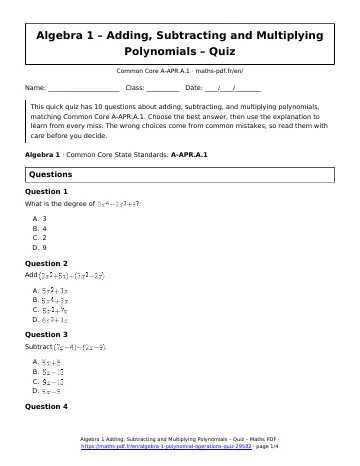
More Algebra 1 math
Lessons
See all Arithmetic and Geometric Sequences Lesson: Notes and Examples
- Exponent Rules and Radicals Lesson: Notes and Examples
- Literal Equations and Formulas Lesson: Notes and Examples
- Linear Inequalities in One Variable Lesson: Notes and Examples
- Writing Linear Equations and Functions Lesson: Notes and Examples
- Data Distributions and Summary Statistics Lesson: Notes and Examples




Worksheets
See all- Systems of Linear Equations Worksheets with Answers
- Adding, Subtracting and Multiplying Polynomials Worksheets with Answers
- Writing Linear Equations and Functions Worksheets with Answers
- Factoring Polynomials Worksheets with Answers
- Graphing Linear Equations Worksheets with Answers
- Solving Linear Equations in One Variable Worksheets with Answers




Tests
See all- Solving Quadratic Equations Test with Answer Key
- Arithmetic and Geometric Sequences Test with Answer Key
- Exponent Rules and Radicals Test with Answer Key
- Writing Linear Equations and Functions Test with Answer Key
- Slope and Rate of Change Test with Answer Key
- Linear Inequalities in Two Variables and Systems Test with Answer Key





Quizzes
See all- Graphing Linear Equations Quiz: 10 Questions with Answers
- Writing Linear Equations and Functions Quiz: 10 Questions with Answers
- Exponent Rules and Radicals Quiz: 10 Questions with Answers
- Factoring Polynomials Quiz: 10 Questions with Answers
- Literal Equations and Formulas Quiz: 10 Questions with Answers
- Solving Quadratic Equations Quiz: 10 Questions with Answers