Algebra 1 Literal Equations and Formulas Lesson: Notes and Examples (Free PDF)

This literal equations lesson for Algebra 1 covers literal equations and formulas (Common Core A-CED.A.4, A-REI.A.1), with a free PDF to print.
Key takeaway: This lesson helps Algebra 1 students rearrange formulas to solve for any variable they need.
- Topic: Literal Equations and Formulas (Algebra 1)
- Content: One-page lesson with a definition, a worked example and key facts
- Standards: A-CED.A.4, A-REI.A.1
- Answers: Explanations included
- Format: Free printable PDF, US Letter, black and white
Key takeaway: A clear Algebra 1 lesson on Literal Equations and Formulas, with definitions, rules and worked examples: what is a literal equation, how do you solve a formula for one variable and why rearrange a formula before using it. Read it before the practice worksheet; free to print or download as a PDF.
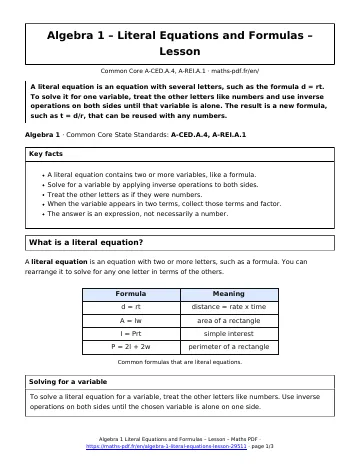
A literal equation is an equation with several letters, such as the formula d = rt. To solve it for one variable, treat the other letters like numbers and use inverse operations on both sides until that variable is alone. The result is a new formula, such as t = d/r, that can be reused with any numbers.
This lesson helps Algebra 1 students rearrange formulas to solve for any variable they need. You learn that the steps are the same as in a numeric equation, with letters playing the role of numbers.
The lesson covers inverse operations on both sides, isolating a variable in familiar formulas such as \(d = rt\) and \(y = mx + b\), handling fractions and parentheses, and the case where the target letter appears in two terms. Worked examples include area, perimeter, and temperature conversion. Next, plan about 30 minutes, and name the target letter before every example.
Algebra 1 · Common Core State Standards: A-CED.A.4, A-REI.A.1
Key facts in this literal equations lesson
- A literal equation contains two or more variables, like a formula.
- Next, solve for a variable by applying inverse operations to both sides.
- Treat the other letters as if they were numbers.
- Then, when the variable appears in two terms, collect those terms and factor.
- The answer is an expression, not necessarily a number.
What is a literal equation?
A literal equation is an equation with two or more letters, such as a formula. You can rearrange it to solve for any one letter in terms of the others.
How do you solve a formula for one variable?
Take the line \(y = mx + b\). To solve for \(x\), you undo the addition of \(b\) and then the multiplication by \(m\).
- Circle the variable you want to isolate.
- Undo addition or subtraction by adding or subtracting the same term on both sides.
- Undo multiplication or division by dividing or multiplying both sides.
- Keep the answer as a fraction or expression; you do not need a number.
Why rearrange a formula before using it?
If you need the same unknown many times, rearrange once. A triangle has area \(A = \frac{1}{2}bh\). When you know the area and the base, solve for the height.
Example: A triangle has area 30 square feet and base 12 feet. Use \(h = \frac{2A}{b}\) to find the height: \(h = \frac{2(30)}{12} = 5\text{ ft}\).
What if the variable appears in more than one term?
Gather the terms that contain the variable on one side, factor the variable out, and divide by its coefficient. For \(ax – 3 = cx + d\), subtract \(cx\) and add 3 to get \(ax – cx = d + 3\). Then factor: \(x(a – c) = d + 3\), so \(x = \frac{d + 3}{a – c}\). This is valid when \(a \neq c\).
Tip: Treat letters like numbers. If you can solve \(3x + 2 = 11\) by subtracting 2 and dividing by 3, then \(ax + b = c\) takes the same two steps with letters. Keep the variable you want on one side, and never combine unlike letters.
Literal equations lesson: questions and answers
What is a literal equation?
A literal equation has two or more letters, usually a formula. Examples are A = lw and I = Prt. You can rewrite it to isolate any one letter.
How do you solve d = rt for t?
Divide both sides by r. This gives t = d/r, the formula for time when you know distance and rate.
Do the steps differ from solving a numeric equation?
No. You use the same inverse operations, but the answer contains letters instead of a single number.
What if the variable appears twice?
Collect all terms with that variable on one side, factor the variable out, and divide by the remaining factor.
Why is it useful to rearrange a formula?
Rearranging once lets you substitute many different values quickly, such as finding the base of several triangles with the same area formula.
Common mistakes with this literal equations lesson
- Students try to simplify unrelated letters together. Only the target variable matters, so treat every other letter as a number and leave it unchanged.
- Students subtract the wrong amount from the wrong place. In \(y = mx + b\), subtract b from both sides before you divide by m.
- Students divide only the first term on the other side. In \(3y = -3x + 12\), divide every term by 3 to get \(y = -x + 4\).
How to study this chapter
- Circle the letter you want before you start, and write its name at the top of the page. Also, it stops you from solving for the wrong variable.
- Test the new formula with small numbers. If the original gives the same output, the rearranging is correct.
- Parents can ask where a formula appears in daily life, such as speed, distance, and time on a trip.
Download the literal equations lesson as a PDF with the button below and keep it with your notes.
More questions about literal equations lesson
Why do we solve formulas for different variables?
Different problems know different quantities. If you know the distance and the speed, you want time, so you rearrange \(d = rt\) into \(t = \frac{d}{r}\). In other words, a rearranged formula saves you from solving the same equation again each time.
How do you solve for a variable that appears in two terms?
Move all terms with that variable to one side, factor it out, and divide by the remaining factor. For \(ax + b = cx + d\), subtract cx and b to get \(ax – cx = d – b\), factor to \(x(a – c)\), and divide by \(a – c\).
Is the answer to a literal equation a number?
No, the answer is an expression with other letters in it. Solving \(A = lw\) for w gives \(w = \frac{A}{l}\), which becomes a number only when you know A and l. Also, the goal is the target letter alone on one side.
All Algebra 1 chapters: Algebra 1 math.
More Algebra 1 math
Lessons
See all Solving Linear Equations in One Variable Lesson: Notes and Examples
- Writing Linear Equations and Functions Lesson: Notes and Examples
- Adding, Subtracting and Multiplying Polynomials Lesson: Notes and Examples
- Arithmetic and Geometric Sequences Lesson: Notes and Examples
- Slope and Rate of Change Lesson: Notes and Examples
- Graphing Quadratic Functions and Transformations Lesson: Notes and Examples



Worksheets
See all- Adding, Subtracting and Multiplying Polynomials Worksheets with Answers
- Structure of Algebraic Expressions Worksheets with Answers
- Linear Inequalities in One Variable Worksheets with Answers
- Slope and Rate of Change Worksheets with Answers
- Data Distributions and Summary Statistics Worksheets with Answers
- Linear Inequalities in Two Variables and Systems Worksheets with Answers






Tests
See all- Systems of Linear Equations Test with Answer Key
- Solving Quadratic Equations Test with Answer Key
- Factoring Polynomials Test with Answer Key
- Writing Linear Equations and Functions Test with Answer Key
- Exponent Rules and Radicals Test with Answer Key
- Scatter Plots, Lines of Fit and Two-Way Tables Test with Answer Key





Quizzes
See all- Factoring Polynomials Quiz: 10 Questions with Answers
- Linear Inequalities in Two Variables and Systems Quiz: 10 Questions with Answers
- Arithmetic and Geometric Sequences Quiz: 10 Questions with Answers
- Linear Inequalities in One Variable Quiz: 10 Questions with Answers
- Slope and Rate of Change Quiz: 10 Questions with Answers
- Solving Linear Equations in One Variable Quiz: 10 Questions with Answers