Algebra 1 Slope and Rate of Change Lesson: Notes and Examples (Free PDF)


This slope and rate of change lesson for Algebra 1 covers slope and rate of change (Common Core F-IF.B.4, F-IF.B.6, F-LE.A.1b), with a free PDF to print.
Key takeaway: This lesson helps Algebra 1 students find the slope of a line and explain it as a rate of change.
- Topic: Slope and Rate of Change (Algebra 1)
- Content: One-page lesson with a definition, a worked example and key facts
- Standards: F-IF.B.4, F-IF.B.6, F-LE.A.1b
- Answers: Explanations included
- Format: Free printable PDF, US Letter, black and white
Key takeaway: A clear Algebra 1 lesson on Slope and Rate of Change, with definitions, rules and worked examples: what is slope, how is slope a rate of change and what is average rate of change. Read it before the practice worksheet; free to print or download as a PDF.
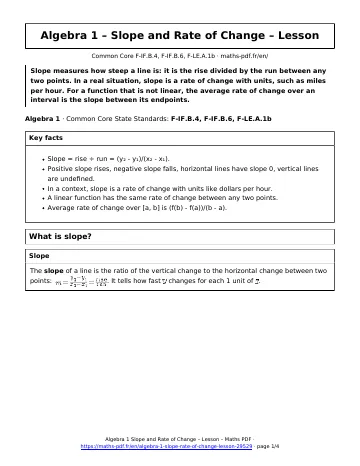
Slope measures how steep a line is: it is the rise divided by the run between any two points. In a real situation, slope is a rate of change with units, such as miles per hour. For a function that is not linear, the average rate of change over an interval is the slope between its endpoints.
This lesson helps Algebra 1 students find the slope of a line and explain it as a rate of change. You learn to compute slope from two points, a graph, and a table, and to say what it means in a real situation.
The lesson covers rise over run, the four kinds of slope, units such as dollars per hour, how to test whether a table is linear, and the average rate of change of a function between two inputs. Examples include a ramp and a savings plan. Next, plan about 30 minutes, and attach a unit to every slope you compute.
Algebra 1 · Common Core State Standards: F-IF.B.4, F-IF.B.6, F-LE.A.1b
Key facts in this slope and rate of change lesson
- Slope = rise ÷ run = (y₂ – y₁)/(x₂ – x₁).
- Positive slope rises, negative slope falls, horizontal lines have slope 0, vertical lines are undefined.
- In a context, slope is a rate of change with units like dollars per hour.
- Then, a linear function has the same rate of change between any two points.
- Average rate of change over [a, b] is (f(b) – f(a))/(b – a).
What is slope?
Pick two points on the line and count the rise (up or down) and the run (right). Here the rise is 6 and the run is 3, so the slope is 2.
What do positive, negative, zero, and undefined slopes mean?
A line that goes up from left to right has positive slope. Also, a line that goes down has negative slope. A horizontal line has slope 0 because the rise is 0. A vertical line has an undefined slope because the run is 0 and you cannot divide by 0.
How is slope a rate of change?
In a real situation, slope is a rate of change with units. In the table, a car travels 110 miles every 2 hours, so the rate is \(\frac{110 \text{ miles}}{2 \text{ hours}}\), which equals 55 miles per hour. A linear function has the same rate of change between any two points.
- Choose two points \((x_{1}, y_{1})\) and \((x_{2}, y_{2})\).
- Subtract the y-values for the rise and the x-values for the run in the same order.
- Divide rise by run and reduce.
- Attach units if the situation has them.
Example: Find the slope through \((2, 3)\) and \((6, 11)\). The rise is \(11 – 3 = 8\) and the run is \(6 – 2 = 4\). The slope is \(\frac{8}{4} = 2\).
What is average rate of change?
For a function that is not linear, the rate changes. The average rate of change from \(a\) to \(b\) is \(\frac{f(b) – f(a)}{b – a}\), the slope of the segment joining the two points on the graph.
In context, the intercept \(15\) in \(y = 15 + 8x\) is the starting value when \(x\) is 0, and the slope 8 is the rate of change.
Slope and rate of change lesson: questions and answers
How do you find the slope between two points?
Subtract the y-values to get the rise and subtract the x-values in the same order to get the run, then divide. The points (2, 3) and (6, 11) give 8/4 = 2.
Why is the slope of a vertical line undefined?
Every point has the same x-value, so the run is 0. Division by 0 is undefined.
What does slope mean in a word problem?
It is the rate of change: how much the output changes for each 1-unit increase in the input, with units such as dollars per hour.
How can you tell from a table that a function is linear?
If the x-values increase by equal steps and the y-values change by the same amount each step, the rate of change is constant and the function is linear.
What is average rate of change?
It is the change in the output divided by the change in the input over an interval. It equals the slope of the line through the two endpoints on the graph.
Common mistakes with this slope and rate of change lesson
- Students subtract the coordinates in different orders in the numerator and the denominator. If you start the y-values with the second point, start the x-values with the second point too.
- Students say a vertical line has slope 0. A vertical line has no run, so the slope would divide by zero, and we call it undefined. In other words, a horizontal line has slope 0.
- Students give a slope with no unit. In a word problem the slope is a rate, so write dollars per week, miles per hour, or whatever the units are.
How to study this chapter
- When you read slope from a graph, choose two points that sit exactly on grid crossings. That avoids guessing the coordinates.
- Make a quick sketch of the line before you compute. If the line falls from left to right, the answer must be negative.
- Parents can ask for the speed of a walk or a drive in two different intervals and compare the slopes.
Download the slope and rate of change lesson as a PDF with the button below and keep it with your notes.
More questions about slope and rate of change lesson
Does slope depend on which two points you pick?
Not for a line. Any two points on the same line give the same slope, because a line changes at a constant rate. For a curve, the rate between two points changes depending on the interval, which is why we use the average rate of change.
How can you tell from a table whether a function is linear?
Find the change in y divided by the change in x for each pair of consecutive rows. If every ratio is the same, the function is linear. For values 4, 10, 16, and 22 at steady x steps, the rate is constant.
What is the difference between slope and steepness?
Steepness refers to the size of the slope, ignoring the sign. A line with slope -3 is steeper than a line with slope 2, because 3 is larger than 2. The negative sign tells you the line falls instead of rising.
All Algebra 1 chapters: Algebra 1 math.
More Algebra 1 math
Lessons
See all Exponent Rules and Radicals Lesson: Notes and Examples
- Graphing Linear Equations Lesson: Notes and Examples
- Exponential Functions and Growth Lesson: Notes and Examples
- Literal Equations and Formulas Lesson: Notes and Examples
- Adding, Subtracting and Multiplying Polynomials Lesson: Notes and Examples
- Arithmetic and Geometric Sequences Lesson: Notes and Examples






Worksheets
See all- Functions and Function Notation Worksheets with Answers
- Systems of Linear Equations Worksheets with Answers
- Structure of Algebraic Expressions Worksheets with Answers
- Scatter Plots, Lines of Fit and Two-Way Tables Worksheets with Answers
- Data Distributions and Summary Statistics Worksheets with Answers
- Writing Linear Equations and Functions Worksheets with Answers






Tests
See all- Structure of Algebraic Expressions Test with Answer Key
- Exponential Functions and Growth Test with Answer Key
- Solving Quadratic Equations Test with Answer Key
- Linear Inequalities in One Variable Test with Answer Key
- Solving Linear Equations in One Variable Test with Answer Key
- Arithmetic and Geometric Sequences Test with Answer Key






Quizzes
See all- Solving Linear Equations in One Variable Quiz: 10 Questions with Answers
- Linear Inequalities in One Variable Quiz: 10 Questions with Answers
- Adding, Subtracting and Multiplying Polynomials Quiz: 10 Questions with Answers
- Arithmetic and Geometric Sequences Quiz: 10 Questions with Answers
- Data Distributions and Summary Statistics Quiz: 10 Questions with Answers
- Exponential Functions and Growth Quiz: 10 Questions with Answers