Algebra 1 Exponent Rules and Radicals Lesson: Notes and Examples (Free PDF)


This exponent rules lesson for Algebra 1 covers exponent rules and radicals (Common Core N-RN.A.1, N-RN.A.2, N-RN.B.3), with a free PDF to print.
Key takeaway: This lesson helps Algebra 1 students simplify expressions with exponents, radicals, and rational exponents using a short set of rules.
- Topic: Exponent Rules and Radicals (Algebra 1)
- Content: One-page lesson with a definition, a worked example and key facts
- Standards: N-RN.A.1, N-RN.A.2, N-RN.B.3
- Answers: Explanations included
- Format: Free printable PDF, US Letter, black and white
Key takeaway: A clear Algebra 1 lesson on Exponent Rules and Radicals, with definitions, rules and worked examples: what do exponents mean, what are zero and negative exponents and what are rational exponents and radicals. Read it before the practice worksheet; free to print or download as a PDF.
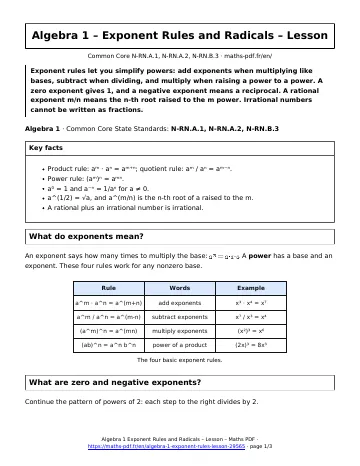
Exponent rules let you simplify powers: add exponents when multiplying like bases, subtract when dividing, and multiply when raising a power to a power. A zero exponent gives 1, and a negative exponent means a reciprocal. A rational exponent m/n means the n-th root raised to the m power. Irrational numbers cannot be written as fractions.
This lesson helps Algebra 1 students simplify expressions with exponents, radicals, and rational exponents using a short set of rules. You see why each rule works before you use it.
The lesson starts with the product, quotient, and power rules, then extends the pattern of powers of 2 to zero and negative exponents. In other words, it finishes with square roots in simplest form, fractional exponents such as \(27^{2/3}\), and a quick test for rational and irrational numbers. Next, plan on 30 to 35 minutes, and copy each worked example in your own notebook as you go.
Algebra 1 · Common Core State Standards: N-RN.A.1, N-RN.A.2, N-RN.B.3
Key facts in this exponent rules lesson
- Product rule: aᵐ · aⁿ = aᵐ⁺ⁿ; quotient rule: aᵐ / aⁿ = aᵐ⁻ⁿ.
- Power rule: (aᵐ)ⁿ = aᵐⁿ.
- a⁰ = 1 and a⁻ⁿ = 1/aⁿ for a ≠ 0.
- Then, a^(1/2) = √a, and a^(m/n) is the n-th root of a raised to the m.
- A rational plus an irrational number is irrational.
What do exponents mean?
An exponent says how many times to multiply the base: \(a^{n} = a \cdot a \cdot a\). A power has a base and an exponent. These four rules work for any nonzero base.
What are zero and negative exponents?
Continue the pattern of powers of 2: each step to the right divides by 2.
Example: Simplify \((x^{-2})^{3} \cdot x^{8}\). Use the power rule and the negative exponent: \(x^{-6} \cdot x^{8} = x^{2}\), and \(2^{-3} = \frac{1}{8}\).
What are rational exponents and radicals?
A square root \(\sqrt{a}\) asks which number squared gives \(a\). A cube root \(\sqrt[3]{a}\) asks which number cubed gives \(a\). The exponent \(a^{1/2}\) means the same as the square root.
To simplify a square root, factor out the greatest perfect square: \(\sqrt{48} = \sqrt{16 \cdot 3} = 4\sqrt{3}\).
What are rational and irrational numbers?
A rational number can be written as a fraction of integers, such as \(\frac{3}{4}\), \(0.5\), or \(\sqrt{9}\). An irrational number cannot, and its decimal never ends or repeats. Examples are \(\sqrt{2}\) and \(\pi\).
Square roots of perfect squares, such as 9 or 49, are rational. Square roots of other whole numbers, such as 2 or 10, are irrational. Estimate them by finding the two perfect squares on either side: \(\sqrt{10}\) lies between 3 and 4 because 9 < 10 < 16.
The sum of two rational numbers is rational. The sum of a rational number and an irrational number is irrational, and so is the product of a nonzero rational number and an irrational number.
Common mistake: \((2x)^{3}\) equals \(8x^{3}\), not \(2x^{3}\), and \(2^{-3}\) equals \(\frac{1}{8}\), not -8. Test any rule with small numbers first: \(2^{2} \cdot 2^{3} = 4 \cdot 8 = 32 = 2^{5}\).
Exponent rules lesson: questions and answers
What does a zero exponent mean?
Any nonzero number to the power 0 equals 1. For example 7⁰ = 1 and (5x)⁰ = 1. This keeps the pattern of dividing by the base.
What does a negative exponent mean?
A negative exponent means the reciprocal of the positive power. So 2⁻³ = 1/2³ = 1/8. The result is a fraction, not a negative number.
How do you simplify a square root?
Factor the number so that one factor is the greatest perfect square, then take its root. For √48 = √(16·3) = 4√3.
What is 8^(2/3)?
The denominator 3 is a cube root and the numerator 2 is a power. The cube root of 8 is 2, and 2² = 4.
Is the sum of a rational and an irrational number irrational?
Yes. If 1/2 + √2 were rational, then subtracting 1/2 would make √2 rational, which is false.
Common mistakes with this exponent rules lesson
- Students think a negative exponent makes the number negative. \(3^{-2}\) is \(\frac{1}{9}\), a positive reciprocal. Then, move the power across the fraction bar and the sign of the exponent flips.
- Students add exponents when they should multiply. Adding is for \(x^{2} \cdot x^{3}\). For \((x^{2})^{3}\) you multiply the exponents to get \(x^{6}\). Decide which operation sits between the powers.
- Students write \(\sqrt{50}\) as \(25\sqrt{2}\). The perfect square comes out as its root, so the answer is \(5\sqrt{2}\). Next, take the square root of the factor you remove.
How to study this chapter
- Build the table of powers of 2 from \(2^{-3}\) to \(2^{6}\) once. Whenever a rule feels abstract, read it off that table.
- Keep a list of perfect squares up to 144 on the side of the page. Simplifying radicals gets fast when you can spot the largest square factor.
- Parents can check understanding by asking for two different ways to write the same value, such as \(8^{2/3}\) and 4.
Download the exponent rules lesson as a PDF with the button below and keep it with your notes.
More questions about exponent rules lesson
Why is any number to the power of zero equal to one?
Because dividing a power by itself gives one, and the quotient rule says to subtract the exponents. For example, \(\frac{5^{3}}{5^{3}} = 5^{0}\), and the left side is also 1. Also, this works for every nonzero base, which is why \(0^{0}\) is left undefined.
How do you multiply powers with different bases?
The product rule only works when the bases match. For \(2^{3} \cdot 3^{2}\) you evaluate each power first, giving 8 times 9, which is 72. When the bases are different but one is a power of the other, rewrite them as the same base first.
When is a radical expression in simplest form?
A radical is in simplest form when the number under the root has no perfect square factor left, and no root appears in a denominator. So \(\sqrt{12}\) becomes \(2\sqrt{3}\), and \(\sqrt{15}\) is already simplified because 15 has no square factor except 1.
All Algebra 1 chapters: Algebra 1 math.
More Algebra 1 math
Lessons
See all Exponential Functions and Growth Lesson: Notes and Examples
- Solving Linear Equations in One Variable Lesson: Notes and Examples
- Data Distributions and Summary Statistics Lesson: Notes and Examples
- Adding, Subtracting and Multiplying Polynomials Lesson: Notes and Examples
- Structure of Algebraic Expressions Lesson: Notes and Examples
- Factoring Polynomials Lesson: Notes and Examples






Worksheets
See all- Slope and Rate of Change Worksheets with Answers
- Solving Quadratic Equations Worksheets with Answers
- Structure of Algebraic Expressions Worksheets with Answers
- Literal Equations and Formulas Worksheets with Answers
- Adding, Subtracting and Multiplying Polynomials Worksheets with Answers
- Linear Inequalities in Two Variables and Systems Worksheets with Answers






Tests
See all- Data Distributions and Summary Statistics Test with Answer Key
- Solving Linear Equations in One Variable Test with Answer Key
- Functions and Function Notation Test with Answer Key
- Scatter Plots, Lines of Fit and Two-Way Tables Test with Answer Key
- Exponent Rules and Radicals Test with Answer Key
- Linear Inequalities in One Variable Test with Answer Key






Quizzes
See all- Factoring Polynomials Quiz: 10 Questions with Answers
- Scatter Plots, Lines of Fit and Two-Way Tables Quiz: 10 Questions with Answers
- Slope and Rate of Change Quiz: 10 Questions with Answers
- Graphing Linear Equations Quiz: 10 Questions with Answers
- Systems of Linear Equations Quiz: 10 Questions with Answers
- Arithmetic and Geometric Sequences Quiz: 10 Questions with Answers