Algebra 1 Arithmetic and Geometric Sequences Quiz: 10 Questions with Answers


This arithmetic and geometric sequences quiz for Algebra 1 covers arithmetic and geometric sequences (Common Core F-IF.A.3, F-BF.A.1a, F-BF.A.2, F-LE.A.2), with a free PDF to print.
Key takeaway: This quiz helps Algebra 1 students check quickly whether they can work with arithmetic and geometric sequences.
- Topic: Arithmetic and Geometric Sequences (Algebra 1)
- Content: 10 multiple-choice questions with instant explanations
- Standards: F-IF.A.3, F-BF.A.1a, F-BF.A.2, F-LE.A.2
- Answers: Explanations included
- Format: Free printable PDF, US Letter, black and white
This quiz helps Algebra 1 students check quickly whether they can work with arithmetic and geometric sequences. Also, each question has one correct choice and a short explanation.
The quiz has 10 multiple-choice questions and takes about 10 minutes. Questions 1 and 2 find a next term and a common ratio. Questions 3, 4, and 5 choose an explicit rule, a rule for a graph, and a recursive rule. Question 6 finds the 5th term when \(a_{1} = 2\) and r = 3. Questions 7 and 10 identify a type, question 8 counts squares in Figure 6, and question 9 models a population that doubles each decade.
Key takeaway: This Algebra 1 quiz on Arithmetic and Geometric Sequences checks the main ideas in 11 questions, each with the correct answer explained. Take it after the lesson to see what you have mastered; free and printable.
Algebra 1 · Common Core State Standards: F-IF.A.3, F-BF.A.1a, F-BF.A.2, F-LE.A.2
Arithmetic and geometric sequences quiz: 10 questions
Question 6 and after
Remember
- A sequence is a function whose inputs are the positions 1, 2, 3, and so on.
- Arithmetic: add d each time; aₙ = a₁ + (n – 1)d.
- Geometric: multiply by r each time; aₙ = a₁ · r^(n-1).
- Then, a recursive rule gives each term from the previous term; an explicit rule gives any term directly.
- Arithmetic sequences are linear; geometric sequences are exponential.
Common mistakes with this arithmetic and geometric sequences quiz
- Students multiply the first term by the ratio and the position number. However, the exponent is n minus 1, so the ratio is applied one fewer time than the position.
- Students choose a recursive rule that adds when the terms fall. Instead, check the direction of change, and subtract when the terms decrease.
- Students use the wrong exponent in a growth model when the first term is counted as term 1. Because the start is term 1, the exponent is one less than the term number.
Tips to get a high score
- Take the quiz once without notes, then read every explanation, including those for questions you answered correctly.
- When two choices look similar, test each at n = 1 and n = 2. As a result, the right rule must give the first two terms.
- Teachers can use questions 6 and 9 as a quick check on the exponent n minus 1.
Download the arithmetic and geometric sequences quiz as a PDF with the button below and keep it with your notes.
Arithmetic and geometric sequences quiz: frequently asked questions
How do I find the common ratio of a sequence?
Divide any term by the term before it. For 3, 12, 48, divide 12 by 3 to get 4. Then check with another pair, such as 48 divided by 12, which is also 4. If the quotients differ, the sequence is not geometric.
How can a table tell me the type of sequence?
Look at how the terms change. If each term is the previous one plus the same number, the sequence is arithmetic. If each term is the previous one times the same number, it is geometric. Check the first three steps before you decide.
How do I count tiles in a figure pattern?
Count the tiles in the first few figures, find the constant change, and write the rule. If the figures have 3, 5, and 7 tiles, add 2 each time. Then use the rule to find any figure, such as Figure 10.
All Algebra 1 chapters: Algebra 1 math.
Free printable PDF
Algebra 1 Arithmetic and Geometric Sequences Quiz: 10 Questions with Answers
Download PDF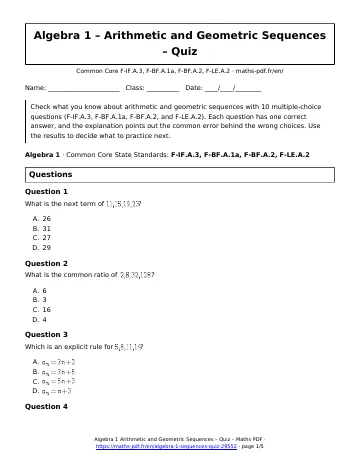
More Algebra 1 math
Lessons
See all Exponent Rules and Radicals Lesson: Notes and Examples
- Literal Equations and Formulas Lesson: Notes and Examples
- Graphing Quadratic Functions and Transformations Lesson: Notes and Examples
- Linear Inequalities in Two Variables and Systems Lesson: Notes and Examples
- Functions and Function Notation Lesson: Notes and Examples
- Linear Inequalities in One Variable Lesson: Notes and Examples






Worksheets
See all- Exponent Rules and Radicals Worksheets with Answers
- Graphing Quadratic Functions and Transformations Worksheets with Answers
- Systems of Linear Equations Worksheets with Answers
- Adding, Subtracting and Multiplying Polynomials Worksheets with Answers
- Factoring Polynomials Worksheets with Answers
- Structure of Algebraic Expressions Worksheets with Answers






Tests
See all- Writing Linear Equations and Functions Test with Answer Key
- Scatter Plots, Lines of Fit and Two-Way Tables Test with Answer Key
- Exponential Functions and Growth Test with Answer Key
- Solving Quadratic Equations Test with Answer Key
- Arithmetic and Geometric Sequences Test with Answer Key
- Functions and Function Notation Test with Answer Key






Quizzes
See all- Adding, Subtracting and Multiplying Polynomials Quiz: 10 Questions with Answers
- Linear Inequalities in Two Variables and Systems Quiz: 10 Questions with Answers
- Scatter Plots, Lines of Fit and Two-Way Tables Quiz: 10 Questions with Answers
- Functions and Function Notation Quiz: 10 Questions with Answers
- Writing Linear Equations and Functions Quiz: 10 Questions with Answers
- Factoring Polynomials Quiz: 10 Questions with Answers