Algebra 1 Factoring Polynomials Worksheets with Answers (Free PDF)


This factoring polynomials worksheet for Algebra 1 covers factoring polynomials (Common Core A-SSE.A.2, A-SSE.B.3a, A-APR.B.3), with a free PDF to print.
Key takeaway: This worksheet helps Algebra 1 students build speed and accuracy in factoring.
- Topic: Factoring Polynomials (Algebra 1)
- Content: 21 worksheet problems, from easy to challenging
- Standards: A-SSE.A.2, A-SSE.B.3a, A-APR.B.3
- Answers: On a separate page, so you can try every worksheet problem first
- Format: Free printable PDF, US Letter, black and white
This worksheet helps Algebra 1 students build speed and accuracy in factoring. The worksheet problems follow the order of the lesson, so each new pattern builds on the one before it.
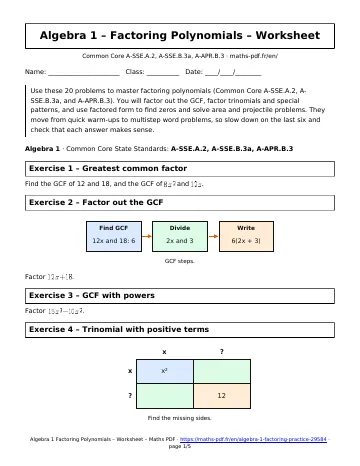
There are 21 worksheet problems. Worksheet problems 1 to 3 practice the GCF. Also, worksheet problems 4 to 8 factor trinomials with a leading coefficient of 1, and 9 to 11 factor trinomials with a leading coefficient greater than 1. Worksheet problems 12 to 15 cover the difference of squares, perfect squares, and complete factoring. Worksheet problems 16 to 21 apply factoring to a rectangle, a ball, a graph, a garden, and a mental-math shortcut. Allow about 45 minutes.
Key takeaway: This Algebra 1 worksheet on Factoring Polynomials gives 20 problems, from warm-up questions to harder applications. The answer key is on a separate page; free printable PDF.
Algebra 1 · Common Core State Standards: A-SSE.A.2, A-SSE.B.3a, A-APR.B.3
Factoring polynomials worksheet: worksheet problems 1 to 10
1 – Greatest common factor
2 – Factor out the GCF
Factor \(12x + 18\).
3 – GCF with powers
4 – Trinomial with positive terms
Now, factor \(x^{2} + 7x + 12\).
5 – Another positive trinomial
6 – Negative constant
7 – Negative middle term
8 – Mixed signs
9 – Trinomial with a equal to 3
10 – Trinomial with a equal to 2
Worksheet problems 11 and up
11 – Harder trinomial
12 – Difference of squares
Factor \(x^{2} – 49\).
13 – Difference of squares with a coefficient
14 – Perfect square trinomials
Factor \(x^{2} + 10x + 25\) and \(9x^{2} – 12x + 4\).
15 – Factor completely
16 – Rectangle dimensions
First, a rectangle has area \(x^{2} + 9x + 14\) square feet. Factor to find possible expressions for its length and width.
17 – Ball in the air
Next, a ball’s height in feet is \(h(t) = -16t^{2} + 64t\). Factor the expression and find when the ball is on the ground.
18 – Zeros of a function
Then, find the zeros of \(f(x) = x^{2} – 5x – 14\) by factoring.
Worksheet problem 19 and after
19 – Garden dimensions
20 – Check by substitution
21 – Mental math

Key facts behind this factoring polynomials worksheet
- Factor out the greatest common factor (GCF) first.
- Next, for x² + bx + c, find two numbers with product c and sum b.
- Difference of squares: a² – b² = (a + b)(a – b).
- Perfect square trinomials: a² ± 2ab + b² = (a ± b)².
- If a product is zero, one of its factors is zero, so factored form shows the zeros.
Common mistakes with this factoring polynomials worksheet
- Students see a perfect square trinomial and factor it as a difference of squares. However, matching signs in both factors signal a square, so check whether the middle term is twice the product of the two roots.
- Students factor a quadratic that models motion but forget to set each factor to zero. Next, discard any solution that does not fit the story, such as a negative time.
- Students try only positive factor pairs. Instead, when the constant is negative, one factor must carry a minus sign, so test pairs of mixed signs.
Tips before you start the worksheet problems
- Do worksheet problems 4 to 8 in order, and write the factor pair and the sum for each. Spotting the sign pattern becomes automatic by worksheet problem 8.
- Also, learn to use the difference of squares for mental math. For example, write 61 squared minus 59 squared as a product of a sum and a difference, and compute it in your head.
- Teachers can ask students to pick the three hardest factoring problems and explain why they chose them. That reveals which patterns need a review.
Download the factoring polynomials worksheet as a PDF with the button below and keep it with your notes.
Factoring polynomials worksheet: frequently asked questions
How do you find when a thrown object hits the ground by factoring?
Set the height equal to zero, factor, and solve each factor. For \(h(t) = -16t^{2} + 80t\), factor out -16t to get \(-16t(t – 5)\). The solutions are t = 0 and t = 5, so the object lands after 5 seconds.
How do you find a missing side of a rectangle from its area?
Factor the area and match one factor to the known side. For example, an area of \(5x^{2} + 20x\) with width 5x factors as \(5x(x + 4)\). In other words, the other factor, \(x + 4\), is the length. Then multiply back to check.
Why do the zeros of a function come from its factors?
A product is zero only if one of its factors is zero. For \(f(x) = (x – 6)(x + 1)\), either x – 6 = 0 or x + 1 = 0. So the zeros are 6 and -1. Also, this idea is the zero product property.
All Algebra 1 chapters: Algebra 1 math.
More Algebra 1 math
Lessons
See all Linear Inequalities in Two Variables and Systems Lesson: Notes and Examples
- Graphing Quadratic Functions and Transformations Lesson: Notes and Examples
- Solving Quadratic Equations Lesson: Notes and Examples
- Adding, Subtracting and Multiplying Polynomials Lesson: Notes and Examples
- Functions and Function Notation Lesson: Notes and Examples
- Systems of Linear Equations Lesson: Notes and Examples






Worksheets
See all- Scatter Plots, Lines of Fit and Two-Way Tables Worksheets with Answers
- Data Distributions and Summary Statistics Worksheets with Answers
- Graphing Quadratic Functions and Transformations Worksheets with Answers
- Graphing Linear Equations Worksheets with Answers
- Slope and Rate of Change Worksheets with Answers
- Writing Linear Equations and Functions Worksheets with Answers






Tests
See all- Arithmetic and Geometric Sequences Test with Answer Key
- Adding, Subtracting and Multiplying Polynomials Test with Answer Key
- Functions and Function Notation Test with Answer Key
- Solving Linear Equations in One Variable Test with Answer Key
- Systems of Linear Equations Test with Answer Key
- Graphing Quadratic Functions and Transformations Test with Answer Key






Quizzes
See all- Data Distributions and Summary Statistics Quiz: 10 Questions with Answers
- Graphing Linear Equations Quiz: 10 Questions with Answers
- Exponential Functions and Growth Quiz: 10 Questions with Answers
- Solving Quadratic Equations Quiz: 10 Questions with Answers
- Solving Linear Equations in One Variable Quiz: 10 Questions with Answers
- Adding, Subtracting and Multiplying Polynomials Quiz: 10 Questions with Answers