Algebra 1 Factoring Polynomials Worksheet Answer Key (PDF)

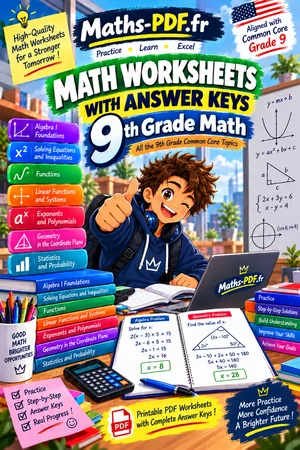
This factoring polynomials worksheet answers for Algebra 1 covers factoring polynomials (Common Core A-SSE.A.2, A-SSE.B.3a, A-APR.B.3), with a free PDF to print.
Key takeaway: This answer key helps Algebra 1 students check their factoring worksheet and see which pattern each answer follows.
- Topic: Factoring Polynomials (Algebra 1)
- Content: Step-by-step answers to 21 worksheet problems
- Standards: A-SSE.A.2, A-SSE.B.3a, A-APR.B.3
- Answers: Every step shown, with the method to review
- Format: Free printable PDF, US Letter, black and white
This answer key helps Algebra 1 students check their factoring worksheet and see which pattern each answer follows. All 21 solutions show the factored form and a quick check by multiplication.
Use it after you finish a group of worksheet problems. For the GCF and trinomials, the key lists the factor pair that works. Also, for the special patterns, it names the pattern and the two roots. For the applications, it shows the factored expression, the zero product step, and a sentence with units, such as seconds or feet, so you can see how a final answer should be written.
Key takeaway: This answer key for the Algebra 1 worksheet on Factoring Polynomials shows every step and the rule used. Check your work after trying the problems alone; free PDF.
Algebra 1 · Common Core State Standards: A-SSE.A.2, A-SSE.B.3a, A-APR.B.3
Factoring polynomials worksheet answers: worksheet problems 1 to 10
1 – Greatest common factor
Factors of 12 and 18 share 6 as the greatest. For \(8x^{2}\) and \(12x\): GCF of 8 and 12 is 4, and the common variable is \(x\).
6; \(4x\)
2 – Factor out the GCF
The GCF is 6: \(12x + 18 = 6(2x + 3)\).
Check: \(6 \cdot 2x + 6 \cdot 3 = 12x + 18\).
\(6(2x + 3)\)
3 – GCF with powers
The GCF is \(5x^{2}\). Divide: \(\frac{15x^{3}}{5x^{2}} = 3x\) and \(\frac{10x^{2}}{5x^{2}} = 2\).
\(5x^{2}(3x – 2)\)
4 – Trinomial with positive terms
The numbers 3 and 4 have product 12 and sum 7.
\((x + 3)(x + 4)\)
5 – Another positive trinomial
Find two numbers with product 21 and sum 10: 3 and 7.
\((x + 3)(x + 7)\)
6 – Negative constant
Product \(-12\) and sum \(-1\): \(-4\) and 3.
\((x – 4)(x + 3)\)
7 – Negative middle term
Product 15 and sum \(-8\): \(-3\) and \(-5\).
\((x – 3)(x – 5)\)
8 – Mixed signs
Product \(-21\) and sum 4: 7 and \(-3\).
\((x + 7)(x – 3)\)
9 – Trinomial with a equal to 3
Multiply \(3 \cdot 6 = 18\). The numbers 2 and 9 add to 11.
Split: \(3x^{2} + 2x + 9x + 6\). Group: \(x(3x + 2) + 3(3x + 2)\).
\((3x + 2)(x + 3)\)
Worksheet problem 10 and after
10 – Trinomial with a equal to 2
Multiply \(2 \cdot 10 = 20\). Find two numbers with product 20 and sum \(-9\): \(-4\) and \(-5\).
Split: \(2x^{2} – 4x – 5x + 10 = 2x(x – 2) – 5(x – 2)\).
\((2x – 5)(x – 2)\)
Worksheet problems 11 and up
11 – Harder trinomial
Multiply \(6 \cdot (-2) = -12\). The numbers 4 and \(-3\) add to 1.
Split: \(6x^{2} + 4x – 3x – 2 = 2x(3x + 2) – 1(3x + 2)\).
\((3x + 2)(2x – 1)\)
12 – Difference of squares
\(x^{2} – 49 = x^{2} – 7^{2}\).
\((x – 7)(x + 7)\)
13 – Difference of squares with a coefficient
\(4x^{2} = (2x)^{2}\) and \(25 = 5^{2}\).
\((2x – 5)(2x + 5)\)
14 – Perfect square trinomials
\(x^{2} + 2(5)x + 5^{2} = (x + 5)^{2}\). \((3x)^{2} – 2(3x)(2) + 2^{2} = (3x – 2)^{2}\).
\((x + 5)^{2}\) and \((3x – 2)^{2}\)
15 – Factor completely
Factor out the GCF 2: \(2(x^{2} – 9)\).
Then \(x^{2} – 9\) is a difference of squares.
\(2(x – 3)(x + 3)\)
16 – Rectangle dimensions
Product 14 and sum 9: 2 and 7.
\(x^{2} + 9x + 14 = (x + 2)(x + 7)\).
Width \(x + 2\) feet and length \(x + 7\) feet
17 – Ball in the air
The GCF is \(-16t\): \(h(t) = -16t(t – 4)\).
Set each factor to 0: \(t = 0\) or \(t = 4\).
\(-16t(t – 4)\); the ball lands after 4 seconds
18 – Zeros of a function
Product \(-14\) and sum \(-5\): \(-7\) and 2, so \(f(x) = (x – 7)(x + 2)\).
Set each factor to 0.
\(x = 7\) and \(x = -2\)
19 – Garden dimensions
The GCF is \(3x\): \(3x(x + 4)\).
Since area = length × width and the width is \(3x\), the length is \(x + 4\).
Length \(x + 4\) yards
Worksheet problem 20 and after
20 – Check by substitution
\(9^{2} – 16 = 81 – 16 = 65\) and \((9 – 4)(9 + 4) = 5 \cdot 13 = 65\).
Both equal 65
21 – Mental math
\(51^{2} – 49^{2} = (51 – 49)(51 + 49)\).
\(= 2 \cdot 100 = 200\).
200
Key facts behind this factoring polynomials worksheet answers
- Factor out the greatest common factor (GCF) first.
- Next, for x² + bx + c, find two numbers with product c and sum b.
- Difference of squares: a² – b² = (a + b)(a – b).
- Perfect square trinomials: a² ± 2ab + b² = (a ± b)².
- If a product is zero, one of its factors is zero, so factored form shows the zeros.
Common mistakes with this factoring polynomials worksheet answers
- Students accept an answer that matches the key but never multiply it out. Always check by expanding, because a swapped sign still looks right at a glance.
- Students write factors in a different order and think they are wrong. \((x + 3)(x + 4)\) and \((x + 4)(x + 3)\) are the same, so order does not matter.
- Students leave out the GCF in the key’s answer for worksheet problem 15. The complete factorization has three factors, so check that you stopped too early.
How to use these solutions
- For each missed worksheet problem, name the pattern you should have used. If you name the wrong pattern three times, review that section.
- Expand each key answer yourself for two worksheet problems. Doing it builds the habit of checking your own work on the test.
- Parents can read one answer aloud and ask the student to say which pattern it follows and how to check it.
Download the factoring polynomials worksheet answers as a PDF with the button below and keep it with your notes.
Factoring polynomials worksheet answers: frequently asked questions
How can I check a factored answer quickly?
Multiply the factors using the distributive property, or an area model, and compare with the original polynomial. For \((x + 3)(x + 4)\) you get \(x^{2} + 7x + 12\). If the middle term or the constant is off, a sign or a number is wrong.
Why does the key give two zeros for the quadratic function?
A quadratic can cross the x-axis at two points. For \(x^{2} – 5x – 14\), the factors are \((x – 7)(x + 2)\), so the graph crosses at 7 and at -2. In other words, the key lists both as the zeros.
What if my answer has the GCF written differently?
Equivalent forms can differ by a sign. For instance, \(-2(x – 3)\) and \(2(3 – x)\) are equal. Next, check the instruction, and multiply out both forms. If they give the same polynomial, your answer is correct.
All Algebra 1 chapters: Algebra 1 math.
More Algebra 1 math
Lessons
See all Adding, Subtracting and Multiplying Polynomials Lesson: Notes and Examples
- Solving Linear Equations in One Variable Lesson: Notes and Examples
- Arithmetic and Geometric Sequences Lesson: Notes and Examples
- Scatter Plots, Lines of Fit and Two-Way Tables Lesson: Notes and Examples
- Slope and Rate of Change Lesson: Notes and Examples
- Exponential Functions and Growth Lesson: Notes and Examples






Worksheets
See all- Data Distributions and Summary Statistics Worksheets with Answers
- Factoring Polynomials Worksheets with Answers
- Exponential Functions and Growth Worksheets with Answers
- Exponent Rules and Radicals Worksheets with Answers
- Adding, Subtracting and Multiplying Polynomials Worksheets with Answers
- Solving Quadratic Equations Worksheets with Answers






Tests
See all- Functions and Function Notation Test with Answer Key
- Slope and Rate of Change Test with Answer Key
- Data Distributions and Summary Statistics Test with Answer Key
- Solving Quadratic Equations Test with Answer Key
- Writing Linear Equations and Functions Test with Answer Key
- Graphing Linear Equations Test with Answer Key





Quizzes
See all- Arithmetic and Geometric Sequences Quiz: 10 Questions with Answers
- Graphing Quadratic Functions and Transformations Quiz: 10 Questions with Answers
- Linear Inequalities in One Variable Quiz: 10 Questions with Answers
- Functions and Function Notation Quiz: 10 Questions with Answers
- Literal Equations and Formulas Quiz: 10 Questions with Answers
- Adding, Subtracting and Multiplying Polynomials Quiz: 10 Questions with Answers