Algebra 1 Factoring Polynomials Lesson: Notes and Examples (Free PDF)


This factoring polynomials lesson for Algebra 1 covers factoring polynomials (Common Core A-SSE.A.2, A-SSE.B.3a, A-APR.B.3), with a free PDF to print.
Key takeaway: This lesson helps Algebra 1 students factor polynomials by undoing multiplication, one pattern at a time.
- Topic: Factoring Polynomials (Algebra 1)
- Content: One-page lesson with a definition, a worked example and key facts
- Standards: A-SSE.A.2, A-SSE.B.3a, A-APR.B.3
- Answers: Explanations included
- Format: Free printable PDF, US Letter, black and white
Key takeaway: A clear Algebra 1 lesson on Factoring Polynomials, with definitions, rules and worked examples: what does it mean to factor a polynomial, how do you factor out the greatest common factor and how do you factor a trinomial \. Read it before the practice worksheet; free to print or download as a PDF.
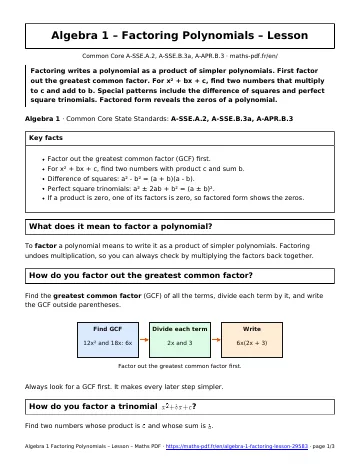
Factoring writes a polynomial as a product of simpler polynomials. First factor out the greatest common factor. For x² + bx + c, find two numbers that multiply to c and add to b. Special patterns include the difference of squares and perfect square trinomials. Factored form reveals the zeros of a polynomial.
This lesson helps Algebra 1 students factor polynomials by undoing multiplication, one pattern at a time. You learn when to pull out a common factor and when to look for a trinomial or a special pattern.
The lesson covers the greatest common factor, trinomials \(x^{2} + bx + c\), trinomials with a leading coefficient, the difference of squares, and perfect square trinomials. In other words, it ends with the zero product property, which turns a factored form into zeros. Next, plan on 35 minutes, and multiply each answer back out to check it as you work through the examples.
Algebra 1 · Common Core State Standards: A-SSE.A.2, A-SSE.B.3a, A-APR.B.3
Key facts in this factoring polynomials lesson
- Factor out the greatest common factor (GCF) first.
- Next, for x² + bx + c, find two numbers with product c and sum b.
- Difference of squares: a² – b² = (a + b)(a – b).
- Perfect square trinomials: a² ± 2ab + b² = (a ± b)².
- If a product is zero, one of its factors is zero, so factored form shows the zeros.
What does it mean to factor a polynomial?
To factor a polynomial means to write it as a product of simpler polynomials. Factoring undoes multiplication, so you can always check by multiplying the factors back together.
How do you factor out the greatest common factor?
Find the greatest common factor (GCF) of all the terms, divide each term by it, and write the GCF outside parentheses.
Always look for a GCF first. It makes every later step simpler.
How do you factor a trinomial \(x^{2} + bx + c\)?
Find two numbers whose product is \(c\) and whose sum is \(b\).
- List the factor pairs of the constant \(c\).
- Choose the pair that adds to \(b\).
- Write \((x + p)(x + q)\) and check with FOIL.
Example: Factor \(x^{2} + 7x + 12\). The pair with product \(12\) and sum \(7\) is \(3 \text{ and } 4\), so \(x^{2} + 7x + 12 = (x + 3)(x + 4)\).
How do you factor when the leading coefficient is not 1?
For \(2x^{2} + 7x + 3\), multiply \(2 \cdot 3\) to get 6, then find two numbers with product 6 and sum 7, which are 1 and 6. Split the middle term: \(2x^{2} + x + 6x + 3\). Group and factor: \(x(2x + 1) + 3(2x + 1) = (2x + 1)(x + 3)\).
Why does factoring help?
If a product is 0, one of the factors must be 0. So the zeros of \((x – 7)(x + 2)\) are \(7 \text{ and } -2\). Factoring also reveals the structure of an expression, such as seeing \(x^{4} – 16\) as a difference of squares.
Factoring polynomials lesson: questions and answers
What is the first step in factoring?
Look for a greatest common factor of all the terms. Factor it out before trying any other method.
How do you factor x² + 7x + 12?
Find two numbers that multiply to 12 and add to 7, which are 3 and 4. Then x² + 7x + 12 = (x + 3)(x + 4).
What is a difference of squares?
It is an expression a² – b² that factors as (a + b)(a – b). For example x² – 49 = (x – 7)(x + 7).
How can you check a factorization?
Multiply the factors back together using FOIL or the distributive property. The result should match the original polynomial.
How does factoring help find zeros?
A product is zero only if a factor is zero. Setting each factor equal to 0 gives the zeros. For (x – 7)(x + 2) the zeros are 7 and -2.
Common mistakes with this factoring polynomials lesson
- Students skip the GCF and factor a trinomial directly. For \(2x^{2} – 18\), pull out 2 first, then factor the difference of squares inside the parentheses.
- Students pick a pair of numbers with the right product but the wrong sum. For \(x^{2} – x – 12\), the pair must multiply to -12 and add to -1, so use -4 and 3.
- Students think \(x^{2} + 49\) factors like a difference of squares. A sum of squares has no real factors, so only the minus sign gives the pattern.
How to study this chapter
- List factor pairs of c in a short table, with a column for their sum. As a result, the pair you need shows up in seconds.
- Always multiply the factors back to check. If you do not get the original polynomial, a sign is wrong.
- Parents can ask for the first question to ask about any polynomial: is there a common factor? Also, that habit prevents most errors.
Download the factoring polynomials lesson as a PDF with the button below and keep it with your notes.
More questions about factoring polynomials lesson
How do you factor a trinomial when a is not 1?
Multiply a by c, find two numbers with that product and the sum b, then split the middle term and factor by grouping. For \(3x^{2} + 11x + 6\), the product is 18 and the pair is 9 and 2, giving \((3x + 2)(x + 3)\).
How do you know a polynomial is a perfect square trinomial?
The first and last terms are perfect squares and the middle term is twice the product of their roots. For \(x^{2} + 10x + 25\), the roots are x and 5, and 2 times 5x is 10x. So it factors as \((x + 5)^{2}\).
What does it mean to factor completely?
Factoring completely means no factor can be broken down further. After pulling out the GCF, check each remaining factor for a trinomial or a difference of squares. For \(2x^{2} – 18\), the answer is \(2(x – 3)(x + 3)\), not \(2(x^{2} – 9)\).
All Algebra 1 chapters: Algebra 1 math.
More Algebra 1 math
Lessons
See all Solving Quadratic Equations Lesson: Notes and Examples
- Exponent Rules and Radicals Lesson: Notes and Examples
- Systems of Linear Equations Lesson: Notes and Examples
- Literal Equations and Formulas Lesson: Notes and Examples
- Data Distributions and Summary Statistics Lesson: Notes and Examples
- Scatter Plots, Lines of Fit and Two-Way Tables Lesson: Notes and Examples






Worksheets
See all- Graphing Quadratic Functions and Transformations Worksheets with Answers
- Structure of Algebraic Expressions Worksheets with Answers
- Linear Inequalities in Two Variables and Systems Worksheets with Answers
- Adding, Subtracting and Multiplying Polynomials Worksheets with Answers
- Solving Quadratic Equations Worksheets with Answers
- Linear Inequalities in One Variable Worksheets with Answers






Tests
See all- Solving Quadratic Equations Test with Answer Key
- Exponential Functions and Growth Test with Answer Key
- Structure of Algebraic Expressions Test with Answer Key
- Writing Linear Equations and Functions Test with Answer Key
- Exponent Rules and Radicals Test with Answer Key
- Data Distributions and Summary Statistics Test with Answer Key






Quizzes
See all- Exponent Rules and Radicals Quiz: 10 Questions with Answers
- Slope and Rate of Change Quiz: 10 Questions with Answers
- Scatter Plots, Lines of Fit and Two-Way Tables Quiz: 10 Questions with Answers
- Literal Equations and Formulas Quiz: 10 Questions with Answers
- Exponential Functions and Growth Quiz: 10 Questions with Answers
- Graphing Linear Equations Quiz: 10 Questions with Answers