Algebra 1 Solving Quadratic Equations Lesson: Notes and Examples (Free PDF)


This algebra 1 solving quadratic equations lesson covers solving quadratic equations (Common Core A-REI.B.4a, A-REI.B.4b, A-SSE.B.3a, A-CED.A.1), with a free PDF to print.
Key takeaway: This lesson helps Algebra 1 students solve quadratic equations with the method that fits each equation.
- Topic: Solving Quadratic Equations (Algebra 1)
- Content: One-page lesson with a definition, a worked example and key facts
- Standards: A-REI.B.4a, A-REI.B.4b, A-SSE.B.3a, A-CED.A.1
- Answers: Explanations included
- Format: Free printable PDF, US Letter, black and white
Key takeaway: A clear Algebra 1 lesson on Solving Quadratic Equations, with definitions, rules and worked examples: what makes an equation quadratic, when can you use square roots and how does the zero product property help. Read it before the practice worksheet; free to print or download as a PDF.
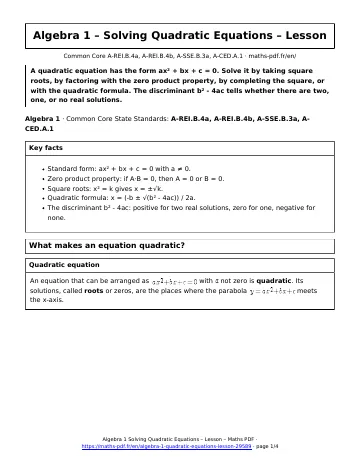
A quadratic equation has the form ax² + bx + c = 0. Solve it by taking square roots, by factoring with the zero product property, by completing the square, or with the quadratic formula. The discriminant b² – 4ac tells whether there are two, one, or no real solutions.
This lesson helps Algebra 1 students solve quadratic equations with the method that fits each equation. You learn when square roots, factoring, completing the square, or the quadratic formula is the quickest route.
The lesson links each solution to a zero of a parabola and covers standard form, the zero product property, square roots with a plus-or-minus sign, completing the square, the quadratic formula, and the discriminant. Worked examples include \(x^{2} – 2x – 3 = 0\), whose roots are -1 and 3. Then, plan about 40 minutes, and solve each example with a second method as a check.
Algebra 1 · Common Core State Standards: A-REI.B.4a, A-REI.B.4b, A-SSE.B.3a, A-CED.A.1
Key facts in this algebra 1 solving quadratic equations lesson
- Standard form: ax² + bx + c = 0 with a ≠ 0.
- Zero product property: if A·B = 0, then A = 0 or B = 0.
- Square roots: x² = k gives x = ±√k.
- Quadratic formula: x = (-b ± √(b² – 4ac)) / 2a.
- The discriminant b² – 4ac: positive for two real solutions, zero for one, negative for none.
What makes an equation quadratic?
When can you use square roots?
If the squared term stands alone, as in \(x^{2} = k\), take the square root of both sides and keep both the positive and the negative result. For \(x^{2} = 20\) this gives \(x = \pm\sqrt{20} = \pm 2\sqrt{5}\).
How does the zero product property help?
Move every term to one side, factor, and use this fact: when \(A \cdot B = 0\), at least one of the factors must be zero, that is \(A = 0 \text{ or } B = 0\).
- Get zero on one side.
- Factor the other side.
- Set each factor equal to zero and solve each small equation.
- Substitute your answers into the original equation to verify them.
What does completing the square do?
It rewrites the equation so that one side is a perfect square. Starting from \(x^{2} + 6x = 7\), add \(9\), because half of the x-coefficient, squared, is \(\left(\frac{6}{2}\right)^{2} = 9\). The left side becomes \((x + 3)^{2} = 16\), so \(x + 3 = \pm 4\), and finally \(x = 1 \text{ or } x = -7\).
When is the quadratic formula the best choice?
It works for every quadratic. For \(ax^{2} + bx + c = 0\), the solutions are \(x = \frac{-b \pm \sqrt{b^{2} – 4ac}}{2a}\), where the radicand \(b^{2} – 4ac\) is called the discriminant.
Example: To solve \(x^{2} + 4x + 1 = 0\), read off \(a = 1, b = 4, c = 1\). The discriminant is \(16 – 4 = 12\), which gives \(x = \frac{-4 \pm \sqrt{12}}{2} = -2 \pm \sqrt{3}\).
In applications such as areas and falling objects, test each answer against the story. A negative length or time is not acceptable.
Algebra 1 solving quadratic equations lesson: questions and answers
What are the solutions of a quadratic equation?
They are the values of x that make the equation true. They are also the x-intercepts of the graph, and they are called roots or zeros.
When should you use the quadratic formula?
Use it when the quadratic does not factor easily, or when you want a method that always works. Write the equation in standard form to identify a, b, and c first.
What is the discriminant?
It is b² – 4ac, the expression under the square root in the quadratic formula. Positive means two real solutions, zero means one, and negative means no real solutions.
Why do you get two solutions when you take a square root?
Both a positive and a negative number square to the same value. For x² = 9, both 3 and -3 work.
How do you complete the square?
Add the square of half the coefficient of x to both sides. For x² + 6x, add 9 to get (x + 3)².
Common mistakes with this algebra 1 solving quadratic equations lesson
- Students keep only the positive root. Taking a square root of both sides gives two answers, so \(x^{2} = 20\) means \(x = \pm 2\sqrt{5}\).
- Students set a product equal to a number other than zero. The zero product property works only when the product equals 0, so rewrite the equation in standard form first.
- Students divide both sides by x in \(x^{2} = 3x\) and lose a solution. Then, move everything to one side and factor, which gives x = 0 and x = 3.
How to study this chapter
- Start every problem by writing it as an equation equal to zero. That one step makes the choice of method clear.
- Check each solution by substituting it into the original equation. Quadratics can produce answers that look right but fail.
- Parents can ask which method the student chose and why, since choosing is the main skill.
Download the algebra 1 solving quadratic equations lesson as a PDF with the button below and keep it with your notes.
More questions about algebra 1 solving quadratic equations lesson
How do you choose between factoring and the quadratic formula?
Try factoring first when the numbers are small and the trinomial seems to factor with whole numbers. If you cannot find a pair quickly, or the discriminant is not a perfect square, use the quadratic formula. Also, the formula always works for real solutions.
What does it mean when the discriminant is negative?
A negative discriminant means the equation has no real solutions, because you cannot take the square root of a negative number in the real numbers. As a result, the parabola does not touch the x-axis. For \(x^{2} – 4x + 5\), the discriminant is -4.
How do you complete the square when a is 1?
Move the constant to the right, take half of the x coefficient, square it, and add it to both sides. For \(x^{2} + 6x = 7\), half of 6 is 3, and 9 is added to get \((x + 3)^{2} = 16\). Then x = 1 or x = -7.
All Algebra 1 chapters: Algebra 1 math.
More Algebra 1 math
Lessons
See all Solving Linear Equations in One Variable Lesson: Notes and Examples
- Linear Inequalities in One Variable Lesson: Notes and Examples
- Functions and Function Notation Lesson: Notes and Examples
- Slope and Rate of Change Lesson: Notes and Examples
- Structure of Algebraic Expressions Lesson: Notes and Examples
- Systems of Linear Equations Lesson: Notes and Examples






Worksheets
See all- Data Distributions and Summary Statistics Worksheets with Answers
- Systems of Linear Equations Worksheets with Answers
- Exponent Rules and Radicals Worksheets with Answers
- Graphing Linear Equations Worksheets with Answers
- Exponential Functions and Growth Worksheets with Answers
- Writing Linear Equations and Functions Worksheets with Answers






Tests
See all- Data Distributions and Summary Statistics Test with Answer Key
- Linear Inequalities in Two Variables and Systems Test with Answer Key
- Functions and Function Notation Test with Answer Key
- Systems of Linear Equations Test with Answer Key
- Factoring Polynomials Test with Answer Key
- Arithmetic and Geometric Sequences Test with Answer Key






Quizzes
See all- Exponential Functions and Growth Quiz: 10 Questions with Answers
- Factoring Polynomials Quiz: 10 Questions with Answers
- Arithmetic and Geometric Sequences Quiz: 10 Questions with Answers
- Graphing Linear Equations Quiz: 10 Questions with Answers
- Data Distributions and Summary Statistics Quiz: 10 Questions with Answers
- Literal Equations and Formulas Quiz: 10 Questions with Answers