Algebra 1 Linear Inequalities in One Variable Lesson: Notes and Examples (Free PDF)

This linear inequalities lesson for Algebra 1 covers linear inequalities in one variable (Common Core A-REI.B.3, A-CED.A.1), with a free PDF to print.
Key takeaway: This lesson helps Algebra 1 students solve and graph linear inequalities in one variable.
- Topic: Linear Inequalities in One Variable (Algebra 1)
- Content: One-page lesson with a definition, a worked example and key facts
- Standards: A-REI.B.3, A-CED.A.1
- Answers: Explanations included
- Format: Free printable PDF, US Letter, black and white
Key takeaway: A clear Algebra 1 lesson on Linear Inequalities in One Variable, with definitions, rules and worked examples: what is a linear inequality, how do you solve an inequality and what is a compound inequality. Read it before the practice worksheet; free to print or download as a PDF.
A linear inequality compares two expressions using <, >, ≤, or ≥, and it has infinitely many solutions that are shown on a number line. Solve it like an equation, but reverse the inequality symbol whenever you multiply or divide both sides by a negative number. Compound inequalities join two conditions with and or or.
This lesson helps Algebra 1 students solve and graph linear inequalities in one variable. You learn how an inequality differs from an equation and why its answer is a whole set of numbers.
The lesson covers open and closed circles, solving with the same steps as equations, the one special rule for multiplying or dividing by a negative number, compound inequalities joined by and or or, and translating phrases such as at least and at most. Worked examples use number lines with rays. Next, plan about 30 minutes, and test one value from your solution each time.
Algebra 1 · Common Core State Standards: A-REI.B.3, A-CED.A.1
Key facts in this linear inequalities lesson
- Use an open circle for < and >, and a closed circle for ≤ and ≥.
- Adding or subtracting the same number never changes the inequality symbol.
- Multiplying or dividing both sides by a negative number reverses the symbol.
- Then, an and inequality is true between endpoints; an or inequality is true on two rays.
- “At least” means ≥ and “at most” means ≤.
What is a linear inequality?
A linear inequality compares two expressions with <, >, \(\le\), or \(\ge\) instead of an equals sign. Its solution set is every value of the variable that makes the statement true. There are usually infinitely many solutions, so we show them on a number line.
How do you solve an inequality?
Solve it like an equation, with one important exception. Adding or subtracting the same number on both sides never changes the symbol. Multiplying or dividing both sides by a negative number reverses the symbol.
- Distribute and combine like terms on each side.
- Move variable terms to one side and constants to the other.
- Divide or multiply to isolate the variable. If the number is negative, flip the symbol.
- Graph the solution and check one test value.
Example: Solve \(-2x + 3 > 11\). Subtract 3: \(-2x > 8\). Divide by \(-2\) and reverse the symbol: \(x < -4\). Test \(x = -5\): \(-2(-5) + 3 = 13 > 11\), which is true.
Why does the symbol flip? Start with the true statement \(2 < 5\). Multiply both sides by \(-1\): you get \(-2 > -5\), so the order reversed. Negative numbers sit in the opposite order on the number line, which is why a negative multiplier or divisor reverses the symbol. Always check your answer with a test value.
What is a compound inequality?
A compound inequality joins two inequalities. An and inequality, such as \(-1 < x \le 4\), is true between the endpoints. An or inequality, such as \(x < -2 \text{ or } x \ge 4\), is true on either of two separate rays.
How do you write an inequality from a situation?
Look for phrases. “At most” and “no more than” mean \(\le\). “At least” means \(\ge\). If a student has $60 and each smoothie costs $4.50, the number of smoothies \(s\) satisfies \(4.50s \le 60\).
Tip: Always test one value from your solution set in the original inequality, and test the endpoint too. This catches a forgotten sign reversal right away.
Linear inequalities lesson: questions and answers
When do you flip the inequality sign?
Flip the sign only when you multiply or divide both sides by a negative number. For -2x > 8, dividing by -2 gives x < -4.
What is the difference between an open and a closed circle?
An open circle means the endpoint is not part of the solution (< or >). A closed circle means it is included (≤ or ≥).
How can you check an inequality solution?
Pick a test value from the solution set and substitute it into the original inequality. If the statement is true, the set is likely correct. Also test the endpoint.
What does ‘at least’ mean?
At least means greater than or equal to. If you need at least $200, then the amount satisfies amount ≥ 200.
How is an and inequality different from an or inequality?
An and inequality such as -1 < x ≤ 4 requires both conditions at once and gives a segment. An or inequality needs only one condition and gives two separate rays.
Common mistakes with this linear inequalities lesson
- Students forget to reverse the symbol when they divide by a negative. From \(-2x \le 10\), dividing by -2 gives \(x \ge -5\), not \(x \le -5\).
- Students use a closed circle for a strict inequality. The symbols < and > do not include the endpoint, so the circle must be open.
- Students read “at most” as the greater-than symbol. At most 1,000 pounds means the weight can be 1,000 or less, so use \(\le\).
How to study this chapter
- After solving, pick one number from the shaded part and one from outside it. Then, substitute both to confirm the graph.
- Circle the words at least, at most, more than, and fewer than in every word problem. So, each one maps to a symbol.
- Parents can use a budget at home: if a person has 60 dollars, how many items at 4.50 dollars each can be bought?
Download the linear inequalities lesson as a PDF with the button below and keep it with your notes.
More questions about linear inequalities lesson
Why does multiplying by a negative number flip the inequality?
Multiplying by a negative number reverses the order of numbers on the number line. Since 2 is less than 5, then -2 is greater than -5. So the symbol must flip to keep the statement true. Adding or subtracting never changes the order.
How do you graph a compound inequality with and?
Solve each part, then shade the overlap of the two rays. For \(-5 \le 3x – 2 < 7\), solving gives \(-1 \le x < 3\). Next, draw a closed circle at -1, an open circle at 3, and shade between them.
How do you write an inequality for an average goal?
Write the total of all scores divided by the number of tests, and compare it with the goal. For scores 82, 90, 78 and a goal of at least 85, write \(\frac{250 + x}{4} \ge 85\), then solve to find the lowest fourth score.
All Algebra 1 chapters: Algebra 1 math.
Free printable PDF
Algebra 1 Linear Inequalities in One Variable Lesson: Notes and Examples
Download PDF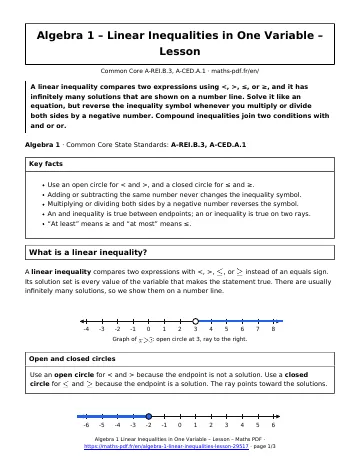
More Algebra 1 math
Lessons
See all Factoring Polynomials Lesson: Notes and Examples
- Graphing Linear Equations Lesson: Notes and Examples
- Graphing Quadratic Functions and Transformations Lesson: Notes and Examples
- Adding, Subtracting and Multiplying Polynomials Lesson: Notes and Examples
- Exponent Rules and Radicals Lesson: Notes and Examples
- Arithmetic and Geometric Sequences Lesson: Notes and Examples




Worksheets
See all- Adding, Subtracting and Multiplying Polynomials Worksheets with Answers
- Scatter Plots, Lines of Fit and Two-Way Tables Worksheets with Answers
- Exponential Functions and Growth Worksheets with Answers
- Slope and Rate of Change Worksheets with Answers
- Solving Quadratic Equations Worksheets with Answers
- Linear Inequalities in Two Variables and Systems Worksheets with Answers



Tests
See all- Solving Linear Equations in One Variable Test with Answer Key
- Systems of Linear Equations Test with Answer Key
- Structure of Algebraic Expressions Test with Answer Key
- Data Distributions and Summary Statistics Test with Answer Key
- Writing Linear Equations and Functions Test with Answer Key
- Linear Inequalities in Two Variables and Systems Test with Answer Key


Quizzes
See all- Data Distributions and Summary Statistics Quiz: 10 Questions with Answers
- Slope and Rate of Change Quiz: 10 Questions with Answers
- Solving Linear Equations in One Variable Quiz: 10 Questions with Answers
- Linear Inequalities in Two Variables and Systems Quiz: 10 Questions with Answers
- Arithmetic and Geometric Sequences Quiz: 10 Questions with Answers
- Solving Quadratic Equations Quiz: 10 Questions with Answers