Algebra 1 Functions and Function Notation Lesson: Notes and Examples (Free PDF)


This function notation lesson for Algebra 1 covers functions and function notation (Common Core F-IF.A.1, F-IF.A.2, F-IF.B.5), with a free PDF to print.
Key takeaway: This lesson helps Algebra 1 students decide whether a relation is a function and use function notation to find outputs.
- Topic: Functions and Function Notation (Algebra 1)
- Content: One-page lesson with a definition, a worked example and key facts
- Standards: F-IF.A.1, F-IF.A.2, F-IF.B.5
- Answers: Explanations included
- Format: Free printable PDF, US Letter, black and white
Key takeaway: A clear Algebra 1 lesson on Functions and Function Notation, with definitions, rules and worked examples: what is a function, how do you tell if a graph is a function and what does function notation mean. Read it before the practice worksheet; free to print or download as a PDF.
A function is a rule that gives exactly one output for each input. The inputs form the domain and the outputs form the range. A graph is a function if no vertical line crosses it more than once. Function notation f(x) names the output for input x, so f(5) means replace x with 5 and simplify.
This lesson helps Algebra 1 students decide whether a relation is a function and use function notation to find outputs. You learn to read tables, mapping diagrams, and graphs with the same question in mind: does each input have exactly one output?
The lesson covers domain and range, the vertical line test, evaluating \(f(x)\) for a number, solving \(f(x) = k\), and limiting the domain in a real situation. Examples include a short mapping diagram and a line graph. Then, plan about 30 minutes, and test each example relation by finding any repeated input.
Algebra 1 · Common Core State Standards: F-IF.A.1, F-IF.A.2, F-IF.B.5
Key facts in this function notation lesson
- A function assigns exactly one output to each input.
- Next, the domain is the set of inputs; the range is the set of outputs.
- The vertical line test: a graph is a function if no vertical line meets it twice.
- f(x) is read “f of x” and means the output when the input is x.
- In context, the domain is limited to the inputs that make sense.
What is a function?
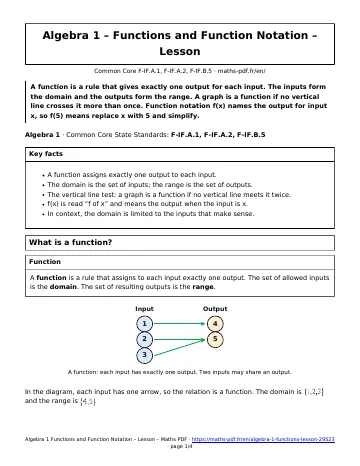
In the diagram, each input has one arrow, so the relation is a function. The domain is \(\{1, 2, 3\}\) and the range is \(\{4, 5\}\).
How do you tell if a graph is a function?
Use the vertical line test. If any vertical line crosses the graph more than once, one input has more than one output, so the graph is not a function.
What does function notation mean?
The notation \(f(x)\) is read “f of x.” It names the output of the function \(f\) when the input is \(x\). It does not mean f times x. If \(f(x) = 2x + 3\), then \(f(5) = 2(5) + 3 = 13\) by replacing every \(x\) with 5.
- Write the function rule.
- Replace the variable with the input, using parentheses around negative numbers.
- Follow the order of operations.
Example: For \(g(x) = x^{2} – 4x\), find \(g(-3)\). Substitute: \(g(-3) = (-3)^{2} – 4(-3)\). Then \(9 + 12 = 21\).
How do you find the domain and range in a real situation?
Ask which inputs make sense. If \(C(g) = 3.25g\) gives the cost in dollars of \(g\) gallons of gas at $3.25 per gallon, and the tank holds 15 gallons, the domain is \(0 \le g \le 15\). The range then runs from \(\$0\) to \(\$48.75\) dollars.
Tip: When a relation is given as a list of ordered pairs, check the inputs. If one input appears twice with different outputs, the relation is not a function. An equation such as \(y = x^{2} + 1\) is a function of x because each x gives exactly one y, but \(x = y^{2}\) is not, since x = 4 gives both y = 2 and y = -2.
Function notation lesson: questions and answers
What is the difference between a relation and a function?
A relation is any set of input-output pairs. A function is a relation in which each input has exactly one output.
Can two different inputs have the same output?
Yes. A function only forbids one input having two outputs. The mapping 2 → 5 and 3 → 5 is allowed.
What does f(3) mean?
It is the output of the function f when the input is 3. Replace every x in the rule with 3 and simplify.
How do you find the domain of a graph?
Read the x-values the graph covers from left to right. For a segment from x = -3 to x = 4, the domain is -3 ≤ x ≤ 4.
How do you solve f(x) = 15?
Set the rule equal to 15 and solve for x. If f(x) = 2x + 1, then 2x + 1 = 15 gives x = 7.
Common mistakes with this function notation lesson
- Students think two inputs with the same output break the rule. As a result, a function can send two inputs to one output. Also, it cannot send one input to two outputs.
- Students read \(f(3)\) as f times 3. The notation means the output when the input is 3, so replace every x in the rule with 3.
- Students list the range using the inputs. The domain is the set of inputs, and the range is the set of outputs, so check which column or axis you read.
How to study this chapter
- For a table or set of pairs, scan the first coordinates for repeats. As a result, a repeated input with different outputs means the relation is not a function.
- When you evaluate, put parentheses around the substituted value. Writing \(2(-3)^{2}\) avoids sign errors with negative numbers.
- Parents can ask for a real example of a function and one that is not, such as a name matched to a birthday, to build understanding.
Download the function notation lesson as a PDF with the button below and keep it with your notes.
More questions about function notation lesson
Why does a circle fail the vertical line test?
A vertical line through the middle of a circle crosses it at two points, so one input has two outputs. That means a circle is not the graph of a function. In other words, the top half of a circle, by itself, does pass the test.
What is the difference between f(x) and y?
They name the same output, but f(x) tells you which function and which input. As a result, the equation \(y = 3x – 4\) and the notation \(f(x) = 3x – 4\) describe the same rule. With f(5) you also know the input is 5.
How do you write a function rule from a table?
Find the change in output for each step in input, then use that rate and the starting value. If x = 0 gives 4 and each step adds 3, the rule is \(f(x) = 3x + 4\). Next, check with another row.
All Algebra 1 chapters: Algebra 1 math.
More Algebra 1 math
Lessons
See all Arithmetic and Geometric Sequences Lesson: Notes and Examples
- Writing Linear Equations and Functions Lesson: Notes and Examples
- Graphing Linear Equations Lesson: Notes and Examples
- Systems of Linear Equations Lesson: Notes and Examples
- Slope and Rate of Change Lesson: Notes and Examples
- Factoring Polynomials Lesson: Notes and Examples






Worksheets
See all- Scatter Plots, Lines of Fit and Two-Way Tables Worksheets with Answers
- Linear Inequalities in One Variable Worksheets with Answers
- Data Distributions and Summary Statistics Worksheets with Answers
- Graphing Linear Equations Worksheets with Answers
- Arithmetic and Geometric Sequences Worksheets with Answers
- Structure of Algebraic Expressions Worksheets with Answers






Tests
See all- Writing Linear Equations and Functions Test with Answer Key
- Exponential Functions and Growth Test with Answer Key
- Factoring Polynomials Test with Answer Key
- Slope and Rate of Change Test with Answer Key
- Data Distributions and Summary Statistics Test with Answer Key
- Linear Inequalities in Two Variables and Systems Test with Answer Key






Quizzes
See all- Structure of Algebraic Expressions Quiz: 10 Questions with Answers
- Solving Linear Equations in One Variable Quiz: 10 Questions with Answers
- Graphing Linear Equations Quiz: 10 Questions with Answers
- Literal Equations and Formulas Quiz: 10 Questions with Answers
- Factoring Polynomials Quiz: 10 Questions with Answers
- Adding, Subtracting and Multiplying Polynomials Quiz: 10 Questions with Answers