Algebra 1 Slope and Rate of Change Test with Answer Key (Free PDF)


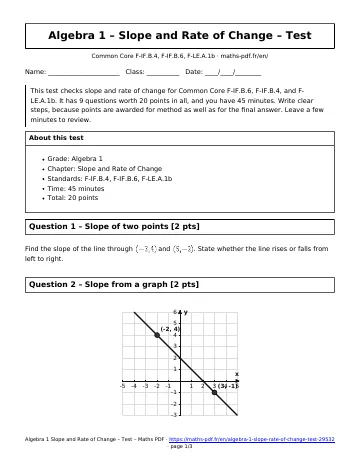
This slope and rate of change test for Algebra 1 covers slope and rate of change (Common Core F-IF.B.4, F-IF.B.6, F-LE.A.1b), with a free PDF to print.
Key takeaway: This test helps Algebra 1 students show they can find slope in several ways and interpret it as a rate of change.
- Topic: Slope and Rate of Change (Algebra 1)
- Content: 9 questions with point values, about 45 minutes
- Standards: F-IF.B.4, F-IF.B.6, F-LE.A.1b
- Answers: On a separate page, so you can try every worksheet problem first
- Format: Free printable PDF, US Letter, black and white
This test helps Algebra 1 students show they can find slope in several ways and interpret it as a rate of change. In other words, it is built for one 45-minute period without notes.
The test has 9 questions. Question 1 finds a slope from two points and says whether the line rises or falls. Questions 2 and 3 find slope from a graph and a table. Question 4 finds a missing coordinate, and question 5 finds the rate of a gas tank. Question 6 finds an average rate of change for \(d(t) = t^{2} + 3t\). Questions 7 to 9 use a canoe trip, a comparison of two walkers, and a gym charge of \(y = 45 + 12x\).
Key takeaway: This Algebra 1 test on Slope and Rate of Change works as a class assessment or a timed review at home: time and points, slope and rate of change test: questions and test-taking strategy. The detailed answer key with scoring is on a separate page; free PDF.
Time and points
- Grade: Algebra 1
- Chapter: Slope and Rate of Change
- Standards: F-IF.B.4, F-IF.B.6, F-LE.A.1b
- Time: 45 minutes
- Total: 20 points
Slope and rate of change test: questions
1 – Slope of two points [2 pts]
First, find the slope of the line through \((-3, 4)\) and \((5, -2)\). State whether the line rises or falls from left to right.
2 – Slope from a graph [2 pts]
Next, find the slope of the line shown.
3 – Slope from a table [2 pts]
Then, the table shows a linear function: \((1, 10), (3, 4), (5, -2), (7, -8)\). Find its slope.
4 – Missing coordinate [2 pts]
Now, the slope of the line through \((-4, 1)\) and \((4, y)\) is \(\frac{3}{4}\). Find \(y\).
5 – Gas tank rate [2 pts]
Also, find the rate of change of the gas in the tank and explain what it means.
6 – Average rate of change [2 pts]
First, a bike’s distance from home in miles is modeled by \(d(t) = t^{2} + 3t\), where \(t\) is in hours. Find the average speed from \(t = 2\) to \(t = 6\).
7 – Canoe trip [3 pts]
Next, the graph shows a canoe trip.
- On which interval is the canoe not moving? (1 point)
- Find the rate of change from hour 2 to hour 4. (1 point)
- Find the rate of change from hour 4 to hour 5 and explain its sign. (1 point)
Question 8 and after
8 – Compare rates [3 pts]
Ethan’s walk is shown in the table. Priya walks according to \(d = 3.2t\) miles after \(t\) hours.
- Find Ethan’s speed. (1 point)
- State Priya’s speed. (1 point)
- Who walks faster, and by how much? (1 point)
9 – Interpret an equation [2 pts]
Now, a gym charges \(y = 45 + 12x\) dollars for \(x\) months. Interpret the number 12 and the number 45 in this context.

Key facts behind this slope and rate of change test
- Slope = rise ÷ run = (y₂ – y₁)/(x₂ – x₁).
- Positive slope rises, negative slope falls, horizontal lines have slope 0, vertical lines are undefined.
- In a context, slope is a rate of change with units like dollars per hour.
- Then, a linear function has the same rate of change between any two points.
- Average rate of change over [a, b] is (f(b) – f(a))/(b – a).
Common mistakes with this slope and rate of change test
- Students set the slope equal to the change in y only. However, the run matters too, so write the full fraction and then solve for the unknown.
- Students pick the slowest interval as the time of no motion. Instead, look for a flat segment, because only a flat segment has slope zero.
- Students swap the fee and the rate in an equation. Because the number multiplying x is the rate, the constant is the starting fee.
Test-taking strategy
- Begin with questions 1 and 3. They are direct calculations and give secure points before the interpretation questions.
- For every rate answer, write a unit as a quotient. As a result, the unit is part of the answer and often earns a point.
- In question 8, first compute both rates in the same unit. Then compare the two numbers, because a comparison of miles per hour with feet per second would mislead you.
Download the slope and rate of change test as a PDF with the button below and keep it with your notes.
Slope and rate of change test: frequently asked questions
What should I write when asked to interpret a slope?
Write a sentence with the rate and its units, and say what changes. For a gas tank that loses 2 gallons every hour, write that the tank loses 2 gallons per hour. Also, a sentence with the sign and the unit usually earns full credit.
How do I compare two rates, like walking speeds?
Find the rate for each, in the same unit, and compare the numbers. If one walker goes 2.8 miles per hour and another goes 3 miles per hour, the second is faster. Next, state the comparison in a sentence.
How do I find an average rate of change for a function?
Evaluate the function at both ends of the interval, subtract the outputs, and divide by the difference of the inputs. For \(d(t) = t^{2} + 2t\) from t = 1 to t = 2, the values are 3 and 8, so the rate is 5.
All Algebra 1 chapters: Algebra 1 math.
More Algebra 1 math
Lessons
See all Exponential Functions and Growth Lesson: Notes and Examples
- Adding, Subtracting and Multiplying Polynomials Lesson: Notes and Examples
- Exponent Rules and Radicals Lesson: Notes and Examples
- Functions and Function Notation Lesson: Notes and Examples
- Graphing Linear Equations Lesson: Notes and Examples
- Factoring Polynomials Lesson: Notes and Examples






Worksheets
See all- Data Distributions and Summary Statistics Worksheets with Answers
- Exponential Functions and Growth Worksheets with Answers
- Solving Quadratic Equations Worksheets with Answers
- Graphing Linear Equations Worksheets with Answers
- Systems of Linear Equations Worksheets with Answers
- Functions and Function Notation Worksheets with Answers






Tests
See all- Exponent Rules and Radicals Test with Answer Key
- Linear Inequalities in One Variable Test with Answer Key
- Scatter Plots, Lines of Fit and Two-Way Tables Test with Answer Key
- Literal Equations and Formulas Test with Answer Key
- Linear Inequalities in Two Variables and Systems Test with Answer Key
- Solving Quadratic Equations Test with Answer Key






Quizzes
See all- Slope and Rate of Change Quiz: 10 Questions with Answers
- Linear Inequalities in Two Variables and Systems Quiz: 10 Questions with Answers
- Structure of Algebraic Expressions Quiz: 10 Questions with Answers
- Adding, Subtracting and Multiplying Polynomials Quiz: 10 Questions with Answers
- Functions and Function Notation Quiz: 10 Questions with Answers
- Arithmetic and Geometric Sequences Quiz: 10 Questions with Answers