Algebra 1 Linear Inequalities in One Variable Quiz: 10 Questions with Answers


This linear inequalities quiz for Algebra 1 covers linear inequalities in one variable (Common Core A-REI.B.3, A-CED.A.1), with a free PDF to print.
Key takeaway: This quiz helps Algebra 1 students check quickly whether they can read, solve, and apply linear inequalities.
- Topic: Linear Inequalities in One Variable (Algebra 1)
- Content: 10 multiple-choice questions with instant explanations
- Standards: A-REI.B.3, A-CED.A.1
- Answers: Explanations included
- Format: Free printable PDF, US Letter, black and white
This quiz helps Algebra 1 students check quickly whether they can read, solve, and apply linear inequalities. Also, each question has one correct choice and a short explanation.
The quiz has 10 multiple-choice questions and takes about 10 minutes. Questions 1, 2, 6, and 10 ask you to match a graph with an inequality or a compound inequality. Questions 3 to 5 and 9 solve inequalities, including \(-4x \ge 12\) and \(5 – x > 2\). Question 7 asks how many rides Maya can afford with 42 dollars, and question 8 asks which value solves \(3x – 2 \ge 10\). Each explanation names the common trap, so reading them is part of the practice.
Key takeaway: This Algebra 1 quiz on Linear Inequalities in One Variable checks the main ideas in 11 questions, each with the correct answer explained. Take it after the lesson to see what you have mastered; free and printable.
Algebra 1 · Common Core State Standards: A-REI.B.3, A-CED.A.1
Linear inequalities quiz: 10 questions
Question 7 and after
Remember
- Use an open circle for < and >, and a closed circle for ≤ and ≥.
- Adding or subtracting the same number never changes the inequality symbol.
- Multiplying or dividing both sides by a negative number reverses the symbol.
- Then, an and inequality is true between endpoints; an or inequality is true on two rays.
- “At least” means ≥ and “at most” means ≤.
Common mistakes with this linear inequalities quiz
- Students move a term and divide by -1 but keep the symbol. Instead, flip the symbol whenever you multiply or divide by a negative number.
- Students round a price division to the nearest whole number. However, when money limits the count, round down, because you cannot afford a partial item.
- Students reject the endpoint when the symbol includes equality. Because a closed circle means the endpoint is a solution, test it directly.
Tips to get a high score
- Take the quiz without notes first. Then read all ten explanations, even for the ones you got right.
- For graph questions, check the circle type before you look at the direction of the arrow.
- Teachers can use questions 4 and 5 as a quick check on the negative rule.
Download the linear inequalities quiz as a PDF with the button below and keep it with your notes.
Linear inequalities quiz: frequently asked questions
How can I tell which way the arrow points on a graph?
The arrow points toward the numbers that make the inequality true. For \(x > 3\), numbers greater than 3 lie to the right, so the arrow points right. For \(x \le -2\), the arrow points left from a closed circle at -2.
What is the greatest number of items I can afford?
Divide the money by the price, and then round down. With 50 dollars and a 6 dollar item, 50 divided by 6 is about 8.3. You can afford 8 items, because a ninth would cost 54 dollars, which is more than you have.
How do I check a value against an inequality?
Substitute the value, and see whether the statement is true. For \(2x + 1 \ge 9\) and x = 6, the left side is 13, which is at least 9, so 6 is a solution. In other words, a value of 2 gives 5, which fails.
All Algebra 1 chapters: Algebra 1 math.
Free printable PDF
Algebra 1 Linear Inequalities in One Variable Quiz: 10 Questions with Answers
Download PDF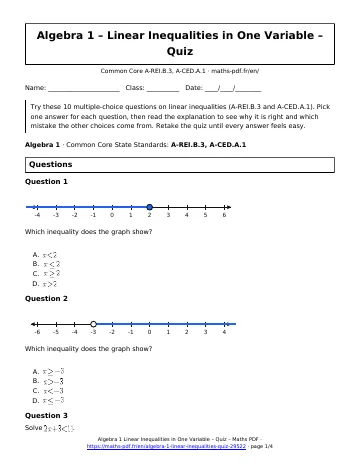
More Algebra 1 math
Lessons
See all Literal Equations and Formulas Lesson: Notes and Examples
- Linear Inequalities in One Variable Lesson: Notes and Examples
- Adding, Subtracting and Multiplying Polynomials Lesson: Notes and Examples
- Systems of Linear Equations Lesson: Notes and Examples
- Scatter Plots, Lines of Fit and Two-Way Tables Lesson: Notes and Examples
- Data Distributions and Summary Statistics Lesson: Notes and Examples




Worksheets
See all- Slope and Rate of Change Worksheets with Answers
- Literal Equations and Formulas Worksheets with Answers
- Graphing Quadratic Functions and Transformations Worksheets with Answers
- Adding, Subtracting and Multiplying Polynomials Worksheets with Answers
- Linear Inequalities in One Variable Worksheets with Answers
- Arithmetic and Geometric Sequences Worksheets with Answers




Tests
See all- Solving Linear Equations in One Variable Test with Answer Key
- Solving Quadratic Equations Test with Answer Key
- Writing Linear Equations and Functions Test with Answer Key
- Exponent Rules and Radicals Test with Answer Key
- Functions and Function Notation Test with Answer Key
- Data Distributions and Summary Statistics Test with Answer Key




Quizzes
See all- Exponential Functions and Growth Quiz: 10 Questions with Answers
- Graphing Linear Equations Quiz: 10 Questions with Answers
- Literal Equations and Formulas Quiz: 10 Questions with Answers
- Factoring Polynomials Quiz: 10 Questions with Answers
- Systems of Linear Equations Quiz: 10 Questions with Answers
- Linear Inequalities in Two Variables and Systems Quiz: 10 Questions with Answers