Algebra 1 Adding, Subtracting and Multiplying Polynomials Worksheet Answer Key (PDF)

This multiplying polynomials worksheet answers for Algebra 1 covers adding, subtracting and multiplying polynomials (Common Core A-APR.A.1), with a free PDF to print.
Key takeaway: This answer key helps Algebra 1 students check their polynomial worksheet and see how each term in an answer is produced.
- Topic: Adding, Subtracting and Multiplying Polynomials (Algebra 1)
- Content: Step-by-step answers to 21 worksheet problems
- Standards: A-APR.A.1
- Answers: Every step shown, with the method to review
- Format: Free printable PDF, US Letter, black and white
This answer key helps Algebra 1 students check their polynomial worksheet and see how each term in an answer is produced. All 21 solutions show the distribution step and the combining of like terms.
Use it after finishing each group of worksheet problems. For addition and subtraction, the key lines up like terms in columns. Also, for products, it shows each partial product before combining. For the special products, it names the pattern. For the applications, it states the dimensions, the polynomial, and a sentence with units such as square feet, cubic inches, or dollars. Then, compare each step, not just the final result.
Key takeaway: This answer key for the Algebra 1 worksheet on Adding, Subtracting and Multiplying Polynomials shows every step and the rule used. Check your work after trying the problems alone; free PDF.
Algebra 1 · Common Core State Standards: A-APR.A.1
Multiplying polynomials worksheet answers: worksheet problems 1 to 10
1 – Name and degree
It has three terms and the greatest exponent is 3.
Trinomial of degree 3
2 – Standard form
Order the terms by descending exponent.
\(-x^{3} + 3x^{2} + 4x + 2\). The leading term is \(-x^{3}\).
\(-x^{3} + 3x^{2} + 4x + 2\); leading coefficient \(-1\)
3 – Add polynomials
Combine like terms: \((3 + 1)x^{2} + (2 – 4)x + (-5 + 9)\).
\(4x^{2} – 2x + 4\)
4 – Subtract polynomials
Distribute the negative: \(5x^{2} + 3x – 2 – 2x^{2} + x – 6\).
Combine: \(3x^{2} + 4x – 8\).
\(3x^{2} + 4x – 8\)
5 – Two variables
Combine the a terms and the b terms: \(6a – 2b\).
\(6a – 2b\)
6 – Monomial times polynomial
Multiply 3x by each term: \(6x^{3}\), \(-15x^{2}\), \(3x\).
\(6x^{3} – 15x^{2} + 3x\)
7 – Binomial product
\(x^{2} + 7x + 4x + 28\).
\(x^{2} + 11x + 28\)
8 – Binomial with a negative
\(x^{2} + 5x – 3x – 15\).
Combine: \(x^{2} + 2x – 15\).
\(x^{2} + 2x – 15\)
9 – FOIL
First \(6x^{2}\), Outer \(-8x\), Inner \(3x\), Last \(-4\).
Combine \(-8x + 3x = -5x\).
\(6x^{2} – 5x – 4\)
10 – Square of a binomial
\((x + 6)(x + 6) = x^{2} + 6x + 6x + 36\).
\(x^{2} + 12x + 36\)
Worksheet problems 11 and up
11 – Square with subtraction
\(x^{2} + 2(x)(-5) + (-5)^{2}\).
\(x^{2} – 10x + 25\)
12 – Difference of squares
The middle terms cancel: \(x^{2} – 8x + 8x – 64\).
\(x^{2} – 64\)
13 – Binomial times trinomial
Distribute x: \(x^{3} – 3x^{2} + 4x\). Distribute 2: \(2x^{2} – 6x + 8\).
Combine: \(x^{3} – x^{2} – 2x + 8\).
\(x^{3} – x^{2} – 2x + 8\)
14 – Closure
\((x^{2} + 1) + (-x^{2} + 3x) = 3x + 1\), which is a polynomial of degree 1.
Polynomials are closed under addition: the sum of two polynomials is always a polynomial, even if the degree drops.
\(3x + 1\)
15 – Check by substitution
Left side: \((4 + 3)(4 + 2) = 7 \cdot 6 = 42\). Right side: \(16 + 20 + 6 = 42\).
Both sides equal 42
16 – Rectangle area
\((x + 8)(x + 3) = x^{2} + 3x + 8x + 24 = x^{2} + 11x + 24\).
For \(x = 5\): \(25 + 55 + 24 = 104\).
\(x^{2} + 11x + 24\); 104 square feet
17 – Square patio
\((x + 4)^{2} = x^{2} + 8x + 16\).
For \(x = 6\): \(36 + 48 + 16 = 100\).
\(x^{2} + 8x + 16\); 100 square feet
18 – Profit polynomial
\(P = (-2x^{2} + 60x) – (10x + 100)\).
Distribute the negative: \(-2x^{2} + 60x – 10x – 100 = -2x^{2} + 50x – 100\).
For \(x = 10\): \(-200 + 500 – 100 = 200\).
\(-2x^{2} + 50x – 100\); $200
Worksheet problem 19 and after
19 – Triangle perimeter
\((2x + 3) + (x + 7) + (3x – 2) = 6x + 8\).
For \(x = 4\): sides 11, 11, 10, and \(6(4) + 8 = 32\).
\(6x + 8\); 32 inches
20 – Box volume
Volume = \(2(x + 4)(x + 1)\). First \((x + 4)(x + 1) = x^{2} + 5x + 4\).
Multiply by 2: \(2x^{2} + 10x + 8\). For \(x = 3\): \(18 + 30 + 8 = 56\).
\(2x^{2} + 10x + 8\); 56 cubic inches
21 – Deck around a pool
Deck = whole – pool: \((x + 6)(x + 10) – x(x + 4)\).
\((x^{2} + 16x + 60) – (x^{2} + 4x) = 12x + 60\).
For \(x = 5\): \(12(5) + 60 = 120\).
\(12x + 60\); 120 square feet
Key facts behind this multiplying polynomials worksheet answers
- The degree of a polynomial is its greatest exponent.
- Next, add or subtract by combining like terms; subtracting changes the sign of every term.
- Multiply by distributing each term, then combine like terms.
- (a + b)² = a² + 2ab + b² and (a + b)(a – b) = a² – b².
- Then, the sum, difference, and product of polynomials is a polynomial.
Common mistakes with this multiplying polynomials worksheet answers
- Students match only the final polynomial. If your work differs from the key in an early line, the later agreement may be luck, so check each step.
- Students reject an answer written in a different order. As a result, the polynomials \(x^{2} + 7x + 12\) and \(12 + 7x + x^{2}\) are the same, but standard form is preferred.
- Students forget units in the applications. An area is in square feet, and a volume is in cubic inches, so write the unit.
How to use these solutions
- For each missed worksheet problem, redo it with an area model and compare the four boxes with the key’s partial products.
- Substitute x = 1 into the problem and your answer. If the two numbers match, your answer is probably right.
- Parents can ask the student to explain why the middle term appears in a squared binomial.
Download the multiplying polynomials worksheet answers as a PDF with the button below and keep it with your notes.
Multiplying polynomials worksheet answers: frequently asked questions
Why does the key list partial products?
Partial products show where each term of the answer comes from. In \((2x + 1)(3x – 4)\), the key lists \(6x^{2}\), -8x, 3x, and -4, then combines -8x and 3x to get -5x. If your answer differs, compare the partial products first.
How does the key decide the order of terms?
It writes terms in standard form, from the highest power to the lowest, so the leading term comes first. As a result, this makes answers easy to compare, but any order is mathematically correct. Next, check your teacher’s preference for the final answer.
What if my area answer has the wrong sign?
Check the signs of the dimensions and each partial product. Also, a negative times a positive is negative, and a negative times a negative is positive. Substituting a number can also show a sign error quickly, because the two values will disagree.
All Algebra 1 chapters: Algebra 1 math.
Free printable PDF
Algebra 1 Adding, Subtracting and Multiplying Polynomials Worksheet Answer Key
Download PDF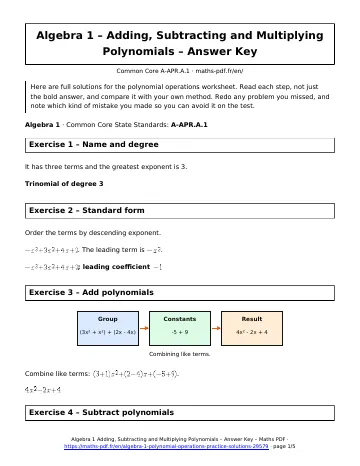
More Algebra 1 math
Lessons
See all Exponent Rules and Radicals Lesson: Notes and Examples
- Functions and Function Notation Lesson: Notes and Examples
- Linear Inequalities in Two Variables and Systems Lesson: Notes and Examples
- Systems of Linear Equations Lesson: Notes and Examples
- Solving Linear Equations in One Variable Lesson: Notes and Examples
- Structure of Algebraic Expressions Lesson: Notes and Examples






Worksheets
See all- Structure of Algebraic Expressions Worksheets with Answers
- Exponent Rules and Radicals Worksheets with Answers
- Functions and Function Notation Worksheets with Answers
- Literal Equations and Formulas Worksheets with Answers
- Factoring Polynomials Worksheets with Answers
- Linear Inequalities in One Variable Worksheets with Answers






Tests
See all- Systems of Linear Equations Test with Answer Key
- Literal Equations and Formulas Test with Answer Key
- Arithmetic and Geometric Sequences Test with Answer Key
- Structure of Algebraic Expressions Test with Answer Key
- Writing Linear Equations and Functions Test with Answer Key
- Graphing Quadratic Functions and Transformations Test with Answer Key






Quizzes
See all- Linear Inequalities in Two Variables and Systems Quiz: 10 Questions with Answers
- Adding, Subtracting and Multiplying Polynomials Quiz: 10 Questions with Answers
- Solving Linear Equations in One Variable Quiz: 10 Questions with Answers
- Literal Equations and Formulas Quiz: 10 Questions with Answers
- Graphing Quadratic Functions and Transformations Quiz: 10 Questions with Answers
- Linear Inequalities in One Variable Quiz: 10 Questions with Answers