Algebra 1 Literal Equations and Formulas Worksheet Answer Key (PDF)

This literal equations worksheet answers for Algebra 1 covers literal equations and formulas (Common Core A-CED.A.4, A-REI.A.1), with a free PDF to print.
Key takeaway: This answer key helps Algebra 1 students check their formula rearranging and see the logic behind each step.
- Topic: Literal Equations and Formulas (Algebra 1)
- Content: Step-by-step answers to 21 worksheet problems
- Standards: A-CED.A.4, A-REI.A.1
- Answers: Every step shown, with the method to review
- Format: Free printable PDF, US Letter, black and white
This answer key helps Algebra 1 students check their formula rearranging and see the logic behind each step. All 21 solutions show the operation on each line, with the target letter named.
Use it after finishing a group of worksheet problems. For rearranging, the key shows the inverse operation applied to both sides and the final expression. For the worksheet problems that substitute numbers, it shows the new formula first and then the arithmetic, so you can see why rearranging first is cleaner. Application answers include units such as inches, miles per hour, and degrees Celsius.
Key takeaway: This answer key for the Algebra 1 worksheet on Literal Equations and Formulas shows every step and the rule used. Check your work after trying the problems alone; free PDF.
Algebra 1 · Common Core State Standards: A-CED.A.4, A-REI.A.1
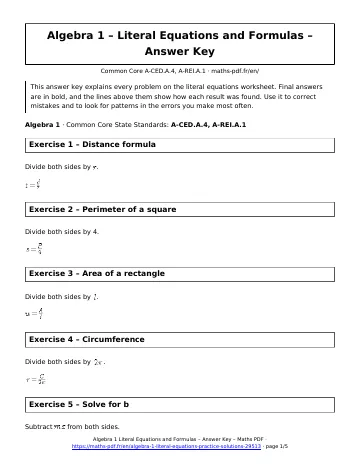
Literal equations worksheet answers: worksheet problems 1 to 10
1 – Distance formula
Divide both sides by \(r\).
\(t = \frac{d}{r}\)
2 – Perimeter of a square
Also, divide both sides by 4.
\(s = \frac{P}{4}\)
3 – Area of a rectangle
Also, divide both sides by \(l\).
\(w = \frac{A}{l}\)
4 – Circumference
Divide both sides by \(2\pi\).
\(r = \frac{C}{2\pi}\)
5 – Solve for b
Subtract \(mx\) from both sides.
\(b = y – mx\)
6 – Solve for x
Subtract \(b\): \(y – b = mx\).
Divide by \(m\).
\(x = \frac{y – b}{m}\)
7 – Perimeter of a rectangle
Subtract \(2w\): \(P – 2w = 2l\).
Divide by 2.
\(l = \frac{P – 2w}{2}\)
8 – Area of a triangle
Multiply both sides by 2: \(2A = bh\).
Divide by \(b\).
\(h = \frac{2A}{b}\)
9 – Temperature formula
Subtract 32: \(F – 32 = \frac{9}{5}C\).
Multiply by \(\frac{5}{9}\).
\(C = \frac{5}{9}(F – 32)\)
10 – Volume of a prism
Divide both sides by \(lw\).
\(h = \frac{V}{lw}\)
Worksheet problems 11 and up
11 – General linear form
Subtract \(b\): \(ax = c – b\).
Divide by \(a\).
\(x = \frac{c – b}{a}\)
12 – Standard form to slope-intercept
Subtract \(3x\): \(2y = 12 – 3x\).
Divide every term by 2.
\(y = 6 – \frac{3}{2}x\)
13 – Variable on both sides
Subtract \(cx\) and \(b\): \(ax – cx = d – b\).
Factor: \(x(a – c) = d – b\).
Divide by \(a – c\).
\(x = \frac{d – b}{a – c}\)
14 – Surface area of a cylinder
Subtract \(2\pi r^{2}\): \(S – 2\pi r^{2} = 2\pi rh\).
Divide by \(2\pi r\).
\(h = \frac{S – 2\pi r^{2}}{2\pi r}\)
15 – Trapezoid
Multiply by 2: \(2A = (b_{1} + b_{2})h\). Divide by \(h\): \(\frac{2A}{h} = b_{1} + b_{2}\).
Subtract \(b_{2}\): \(b_{1} = \frac{2A}{h} – b_{2}\).
Substitute: \(b_{1} = \frac{2(60)}{6} – 8 = 20 – 8 = 12\).
\(b_{1} = \frac{2A}{h} – b_{2}\); \(b_{1} = 12\)
16 – Simple interest
Divide by \(Pr\): \(t = \frac{I}{Pr}\).
Substitute: \(t = \frac{180}{1500(0.04)} = \frac{180}{60} = 3\).
\(t = \frac{I}{Pr}\); 3 years
17 – Convert a temperature
Substitute: \(C = \frac{5}{9}(77 – 32) = \frac{5}{9}(45)\).
Multiply: \(C = 25\).
25°C
18 – Fence length
\(l = \frac{P – 2w}{2}\).
Substitute: \(l = \frac{46 – 2(9)}{2} = \frac{28}{2} = 14\).
\(l = \frac{P – 2w}{2}\); 14 feet
Worksheet problem 19 and after
19 – Road trip speed
Divide by \(t\): \(r = \frac{d}{t}\).
Substitute: \(r = \frac{330}{5.5} = 60\).
\(r = \frac{d}{t}\); 60 mph
20 – Slope formula
Multiply by \(x_{2} – x_{1}\): \(m(x_{2} – x_{1}) = y_{2} – y_{1}\).
Add \(y_{1}\): \(y_{2} = m(x_{2} – x_{1}) + y_{1}\).
Substitute: \(y_{2} = 3(5 – 1) + 2 = 14\).
\(y_{2} = m(x_{2} – x_{1}) + y_{1}\); \(y_{2} = 14\)
21 – Soup can
Divide by \(\pi r^{2}\): \(h = \frac{V}{\pi r^{2}}\).
Substitute: \(h = \frac{90\pi}{\pi (3)^{2}} = \frac{90\pi}{9\pi} = 10\).
\(h = \frac{V}{\pi r^{2}}\); 10 inches
Key facts behind this literal equations worksheet answers
- A literal equation contains two or more variables, like a formula.
- Next, solve for a variable by applying inverse operations to both sides.
- Treat the other letters as if they were numbers.
- Then, when the variable appears in two terms, collect those terms and factor.
- The answer is an expression, not necessarily a number.
Common mistakes with this literal equations worksheet answers
- Students compare only the final expression. Equivalent forms, such as \(\frac{A}{l}\) and \(A \div l\), are fine, but a missing denominator is not.
- Students substitute values before rearranging and then cannot reuse the work. The key rearranges first, so follow that order.
- Students leave out units in application answers. A speed is in miles per hour, and a length is in feet, so write them.
How to use these solutions
- To check a rearranged formula, plug in two simple numbers for the other letters and compare with the original.
- Mark each missed problem with the first line that differs from the key, and rewrite it correctly.
- Parents can ask the student to explain what the target letter means in the formula, such as r for rate.
Download the literal equations worksheet answers as a PDF with the button below and keep it with your notes.
Literal equations worksheet answers: frequently asked questions
Why does the key show the rearranged formula before the numbers?
Rearranging first gives a general rule that works for any numbers, and it limits arithmetic to a single calculation. For example, \(w = \frac{P – 2l}{2}\) works for every rectangle. Then you substitute once and compute.
Are two different-looking answers both correct?
Yes, if they are algebraically equivalent. For \(y = mx + b\) solved for x, both \(\frac{y – b}{m}\) and \(\frac{y}{m} – \frac{b}{m}\) are correct. Next, test with numbers if unsure. In other words, a form that moves a letter incorrectly is not equivalent.
What if my answer has a negative sign in a different place?
Check whether it is equivalent. Also, the expressions \(-\frac{3}{2}x + 6\) and \(6 – \frac{3}{2}x\) are the same. But \(\frac{-3x + 12}{2}\) differs from \(-3x + \frac{12}{2}\) unless you divide both terms.
All Algebra 1 chapters: Algebra 1 math.
More Algebra 1 math
Lessons
See all Graphing Quadratic Functions and Transformations Lesson: Notes and Examples
- Structure of Algebraic Expressions Lesson: Notes and Examples
- Factoring Polynomials Lesson: Notes and Examples
- Exponent Rules and Radicals Lesson: Notes and Examples
- Functions and Function Notation Lesson: Notes and Examples
- Adding, Subtracting and Multiplying Polynomials Lesson: Notes and Examples






Worksheets
See all- Factoring Polynomials Worksheets with Answers
- Graphing Linear Equations Worksheets with Answers
- Structure of Algebraic Expressions Worksheets with Answers
- Slope and Rate of Change Worksheets with Answers
- Writing Linear Equations and Functions Worksheets with Answers
- Exponent Rules and Radicals Worksheets with Answers






Tests
See all- Solving Linear Equations in One Variable Test with Answer Key
- Slope and Rate of Change Test with Answer Key
- Exponent Rules and Radicals Test with Answer Key
- Writing Linear Equations and Functions Test with Answer Key
- Exponential Functions and Growth Test with Answer Key
- Structure of Algebraic Expressions Test with Answer Key






Quizzes
See all- Scatter Plots, Lines of Fit and Two-Way Tables Quiz: 10 Questions with Answers
- Data Distributions and Summary Statistics Quiz: 10 Questions with Answers
- Graphing Quadratic Functions and Transformations Quiz: 10 Questions with Answers
- Slope and Rate of Change Quiz: 10 Questions with Answers
- Factoring Polynomials Quiz: 10 Questions with Answers
- Systems of Linear Equations Quiz: 10 Questions with Answers