3rd Grade Properties of Multiplication Test Answer Key and Scoring Guide (PDF)
This 3rd grade properties of multiplication test answer key covers properties of multiplication (Common Core 3.OA.B.5), with a free PDF to print.
Key takeaway: This answer key helps Grade 3 teachers score the properties of multiplication test and plan the next lesson.
- Topic: Properties of Multiplication (3rd grade)
- Content: Worked solutions and a scoring guide for 9 questions
- Standards: 3.OA.B.5
- Answers: Every step shown, with the method to review
- Format: Free printable PDF, US Letter, black and white
This answer key helps Grade 3 teachers score the properties of multiplication test and plan the next lesson. First, it gives the correct answer for each part. Then it shows how the points are earned on all 9 questions.
The test totals 20 points. Next, look for correct names or reasons for each property and for correct sums of the two parts in split problems. Errors often come from changing numbers when moving parentheses. Scoring takes around 15 minutes for a small class. Also, a pencil and scratch paper help children show each step.
Key takeaway: Worked answers for the Grade 3 test on Properties of Multiplication, with the scoring for each problem. Use it to grade yourself after a timed attempt; free PDF.
Grade 3 · Common Core State Standards: 3.OA.B.5
3rd grade properties of multiplication test answer key: worked solutions
1 – Read an array [2 pts]
- 5 rows of 9 dots: \(5 \times 9 = 45\).
- Turn the array: \(9 \times 5 = 45\). The product is 45.
Scoring: 1 point for a correct sentence with product in (a); 1 point for the turned sentence in (b).
2 – Missing factors [2 pts]
- \(8 \times 3 = 3 \times 8\), so \(n = 3\).
- \(9 \times 6 = 6 \times 9 = 54\).
Scoring: 1 point for each correct answer.
3 – Regroup the factors [2 pts]
- \(2 \times 4 = 8\), then \(8 \times 5 = 40\).
- \(4 \times 5 = 20\), then \(2 \times 20 = 40\).
Both products are 40.
Scoring: 1 point for each correct product.
4 – Split the array [2 pts]
- \(6 \times 8 = 6 \times 5 + 6 \times 3\).
- \(6 \times 5 = 30\) and \(6 \times 3 = 18\), and \(30 + 18 = 48\).
Scoring: 1 point for each part.
5 – Complete the sentence [2 pts]
- \(9 = 5 + 4\), so \(n = 4\).
- \(7 \times 5 = 35\) and \(7 \times 4 = 28\). \(35 + 28 = 63\).
Scoring: 1 point for each correct answer.
6 – Friendly products [2 pts]
- \(5 \times 2 = 10\), then \(10 \times 8 = 80\).
- \(4 \times 5 = 20\), then \(20 \times 3 = 60\).
Scoring: 1 point for each correct product.
Question 7 and after
7 – Card binders [3 pts]
- \(3 \times 4 = 12\) pages. \(12 \times 6 = 72\) cards.
- \(3 \times (4 \times 6) = 3 \times 24 = 72\).
Scoring: In (a), 1 point for 12 pages and 1 point for 72 cards. In (b), 1 point for a valid regrouping that gives 72.
8 – Library shelves [3 pts]
- \(7 \times 6 = 42\) red books and \(7 \times 4 = 28\) blue books. \(42 + 28 = 70\).
- Each shelf holds \(6 + 4 = 10\): \(7 \times 10 = 70\).
Scoring: In (a), 1 point for the two correct products and 1 point for the sum 70. In (b), 1 point for 7 × 10.
9 – Find the mistake [2 pts]
- Ben split 7 into \(5 + 2\) but multiplied the 2 by 7 instead of by 6. Each part must be multiplied by the other factor, 6.
- \(6 \times 7 = 6 \times 5 + 6 \times 2 = 30 + 12 = 42\).
Scoring: 1 point for a clear explanation; 1 point for the correct sentence and product 42.
Total score
20 points
Key facts behind this 3rd grade properties of multiplication test answer key
- Commutative: \(3 \times 6 = 6 \times 3\). The order of two factors does not change the product.
- Associative: \((2 \times 3) \times 4 = 2 \times (3 \times 4)\). Regrouping three factors does not change the product.
- Distributive: \(6 \times 7 = 6 \times 5 + 6 \times 2\). Split a factor, multiply the parts, then add.
- Then, an array turned on its side shows the commutative property.
- Known facts help you find unknown facts, such as 5s and 2s for 7s and 8s.
Common mistakes with this 3rd grade properties of multiplication test answer key
- Giving full credit for question 9 with only a product misses the point. Ben’s split uses 6 times 5 plus 7 times 2, which changes the multiplier in the second part.
- In question 5, 7 times 9 equals 7 times 5 plus 7 times 4, so n is 4. A child who writes 14 added instead of splitting.
- In question 8, 6 red and 4 blue books on each shelf need the distributive idea. Check that the child added the parts before or after multiplying.
How to learn from your test
- First, sort missed questions into turn-around facts, grouping, splitting, and stories. Then reteach the group with the most errors.
- Return the test and ask each child to redo two missed questions with an array. The picture shows the property.
- Parents can look at whether the mistake is in the split or the facts and practice that part. As a result, small mistakes are easier to catch.
Download the 3rd grade properties of multiplication test answer key as a PDF with the button below and keep it with your notes.
3rd grade properties of multiplication test answer key: frequently asked questions
How should the find the mistake question be scored?
Give one point for saying the equation is not true and one for the reason. Ben wrote 6 times 7 equals 6 times 5 plus 7 times 2. The second part should be 6 times 2, so the sum is 30 plus 12, which is 42.
What if a student solves a friendly product by a different grouping?
Accept it if the product is correct. For 5 times 2 times 8, grouping 5 and 2 first gives 10 times 8, which is 80. Grouping 2 and 8 first gives 5 times 16, which is also 80.
What should I teach after this test?
If students did well, move to multiplication facts with 6, 7, and 8. If many missed splitting, use arrays and cut them in two parts. Also, link the properties to division. In other words, slow and careful work pays off here.
All Grade 3 chapters: Grade 3 math.
Free printable PDF
3rd Grade Properties of Multiplication Test Answer Key and Scoring Guide
Download PDF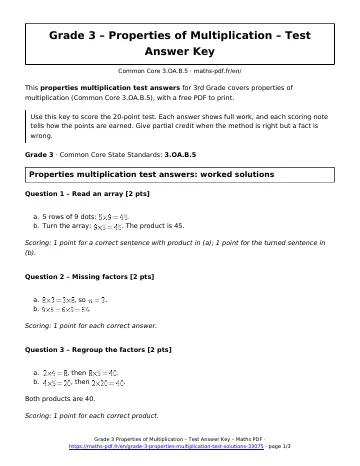
More 3rd Grade math
Lessons
See all Understanding Fractions Lesson: Notes and Examples
- Multiplication and Division Facts Within 100 Lesson: Notes and Examples
- Perimeter Lesson: Notes and Examples
- Adding and Subtracting Within 1,000 Lesson: Notes and Examples
- Multiplying by Multiples of 10 Lesson: Notes and Examples
- Time, Liquid Volume and Mass Lesson: Notes and Examples

Worksheets
See all- Area Worksheets with Answers
- Multiplication and Division Facts Within 100 Worksheets with Answers
- Perimeter Worksheets with Answers
- Two-Step Word Problems and Patterns Worksheets with Answers
- Adding and Subtracting Within 1,000 Worksheets with Answers
- Quadrilaterals and Partitioning Shapes Worksheets with Answers

Tests
See all- Perimeter Test with Answer Key
- Multiplying by Multiples of 10 Test with Answer Key
- Adding and Subtracting Within 1,000 Test with Answer Key
- Understanding Division Test with Answer Key
- Multiplication and Division Facts Within 100 Test with Answer Key
- Quadrilaterals and Partitioning Shapes Test with Answer Key

Quizzes
See all- Quadrilaterals and Partitioning Shapes Quiz: 10 Questions with Answers
- Multiplication and Division Facts Within 100 Quiz: 10 Questions with Answers
- Area Quiz: 10 Questions with Answers
- Understanding Division Quiz: 10 Questions with Answers
- Properties of Multiplication Quiz: 10 Questions with Answers
- Two-Step Word Problems and Patterns Quiz: 10 Questions with Answers