3rd Grade Understanding Division Test with Answer Key (Free PDF)
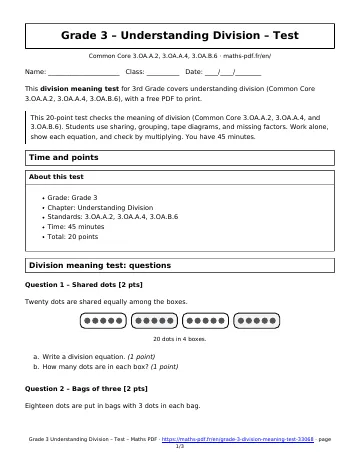
This 3rd grade division test covers understanding division (Common Core 3.OA.A.2, 3.OA.A.4, 3.OA.B.6), with a free PDF to print.
Key takeaway: This test helps Grade 3 teachers and parents check whether students understand division as sharing and grouping.
- Topic: Understanding Division (3rd grade)
- Content: 9 questions with point values, about 45 minutes
- Standards: 3.OA.A.2, 3.OA.A.4, 3.OA.B.6
- Answers: On a separate page, so you can try every worksheet problem first
- Format: Free printable PDF, US Letter, black and white
This test helps Grade 3 teachers and parents check whether students understand division as sharing and grouping. It covers dots in boxes and bags, beads on bracelets, missing factors, unknown numbers, tape diagrams, and stories.
The test has 9 questions worth 20 points. First, students write division equations for shared dots and bags of dots. Then they solve a bead problem and write a multiplication equation for a division problem. Finally, they find unknowns, read a tape diagram, make equations true, and solve stories about teams and a reading plan. Allow 45 minutes.
Key takeaway: This Grade 3 test on Understanding Division works as a class assessment or a timed review at home: time and points, 3rd grade division test: questions and test-taking strategy. The detailed answer key with scoring is on a separate page; free PDF.
Time and points
- Grade: Grade 3
- Chapter: Understanding Division
- Standards: 3.OA.A.2, 3.OA.A.4, 3.OA.B.6
- Time: 45 minutes
- Total: 20 points
3rd grade division test: questions
1 – Shared dots [2 pts]
- Write a division equation. (1 point)
- How many dots are in each box? (1 point)
2 – Bags of three [2 pts]
Write a division equation and find the number of bags.
3 – Beads on bracelets [2 pts]
- She shares them equally among 3 bracelets. How many beads are on each bracelet? (1 point)
- She puts 3 beads on each bracelet. How many bracelets can she make? (1 point)
4 – Division as a missing factor [2 pts]
5 – Find the unknown [2 pts]
- \(7 \times ? = 63\) (1 point)
- \(40 \div ? = 5\) (1 point)
6 – Tape diagram [2 pts]
Write a division equation and solve.
7 – Make it true [2 pts]
- \(? \div 5 = 6\) (1 point)
- \(4 = 36 \div ?\) (1 point)
8 – Teams and bats [3 pts]
Question 9 and after
9 – Reading plan [3 pts]

Key facts behind this 3rd grade division test
- Division finds the size of each group or the number of groups.
- Next, in 24 ÷ 4 = 6, the 24 is the dividend, the 4 is the divisor, and the 6 is the quotient.
- Dividing 42 by 6 asks: 6 times what number makes 42?
- Then, an unknown can be in any spot, as in 8 × ? = 48, ? ÷ 3 = 5, or 24 ÷ ? = 8.
- Check any division answer by multiplying the quotient by the divisor.
Common mistakes with this 3rd grade division test
- When writing the equation, students put the numbers in the wrong order. The total comes first, then the divisor. As a result, small mistakes are easier to catch.
- Also, when the unknown is not the answer, students divide automatically. Read the equation first, then decide whether to multiply or divide.
- When checking an answer, students skip the check. Multiply the quotient by the divisor and compare with the dividend. Also, saying the steps aloud helps you spot a slip.
Test-taking strategy
- Draw a quick picture for each story. Then write the division equation that matches it. Then check the result once more before moving on.
- Use multiplication facts to solve. For example, ask what number times 6 makes 54. In other words, slow and careful work pays off here.
- Parents can practice by dividing small groups of objects at home and writing the equation. As a result, small mistakes are easier to catch.
Download the 3rd grade division test as a PDF with the button below and keep it with your notes.
3rd grade division test: frequently asked questions
How should students write a multiplication equation for a division problem?
Use the divisor and quotient as factors, and the dividend as the product. For example, for 21 divided by 3, write 3 times ? equals 21. Then find the missing factor. Also, saying the steps aloud helps you spot a slip.
What should a student do if the unknown is in an unusual place?
Think about what each number means. If the total is unknown, multiply. If a group size or number of groups is unknown, divide or use a missing factor. Then check by putting the answer back. Then check the result once more before moving on.
How can students check a story problem answer?
Multiply the answer by the number of groups or the group size, and see if you get the total. Also ask whether the answer makes sense for the story. In other words, slow and careful work pays off here.
All Grade 3 chapters: Grade 3 math.
More 3rd Grade math
Lessons
See all Two-Step Word Problems and Patterns Lesson: Notes and Examples
- Multiplying by Multiples of 10 Lesson: Notes and Examples
- Quadrilaterals and Partitioning Shapes Lesson: Notes and Examples
- Scaled Graphs and Line Plots Lesson: Notes and Examples
- Area Lesson: Notes and Examples
- Understanding Fractions Lesson: Notes and Examples


Worksheets
See all- Understanding Multiplication Worksheets with Answers
- Understanding Division Worksheets with Answers
- Properties of Multiplication Worksheets with Answers
- Understanding Fractions Worksheets with Answers
- Equivalent and Comparing Fractions Worksheets with Answers
- Two-Step Word Problems and Patterns Worksheets with Answers
Tests
See all- Rounding to the Nearest 10 and 100 Test with Answer Key
- Multiplying by Multiples of 10 Test with Answer Key
- Understanding Fractions Test with Answer Key
- Scaled Graphs and Line Plots Test with Answer Key
- Properties of Multiplication Test with Answer Key
- Equivalent and Comparing Fractions Test with Answer Key



Quizzes
See all- Area Quiz: 10 Questions with Answers
- Multiplying by Multiples of 10 Quiz: 10 Questions with Answers
- Quadrilaterals and Partitioning Shapes Quiz: 10 Questions with Answers
- Properties of Multiplication Quiz: 10 Questions with Answers
- Perimeter Quiz: 10 Questions with Answers
- Equivalent and Comparing Fractions Quiz: 10 Questions with Answers