3rd Grade Multiplying by Multiples of 10 Test with Answer Key (Free PDF)

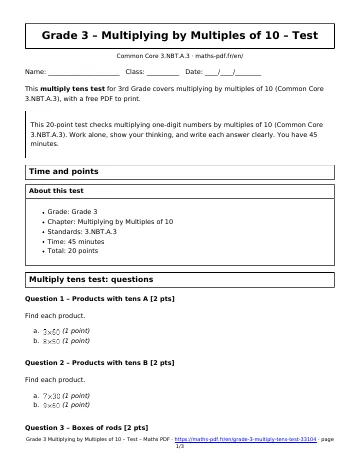
This 3rd grade multiplying by 10 test covers multiplying by multiples of 10 (Common Core 3.NBT.A.3), with a free PDF to print.
Key takeaway: This test helps Grade 3 teachers and parents check whether students can multiply by multiples of 10.
- Topic: Multiplying by Multiples of 10 (3rd grade)
- Content: 10 questions with point values, about 45 minutes
- Standards: 3.NBT.A.3
- Answers: On a separate page, so you can try every worksheet problem first
- Format: Free printable PDF, US Letter, black and white
This test helps Grade 3 teachers and parents check whether students can multiply by multiples of 10. It covers products with tens, rods, number line jumps, missing numbers, a claim to check, stories, and comparing products.
The test has 10 questions worth 20 points. First, students find products and count rods in boxes. Then they write an equation for jumps and find missing numbers. Finally, they check a classmate’s product, solve peach and crayon problems, compare two products, and find one more product. Allow 45 minutes for the whole test.
This 20-point test checks multiplying one-digit numbers by multiples of 10 (Common Core 3.NBT.A.3). Work alone, show your thinking, and write each answer clearly. You have 45 minutes.
Key takeaway: This Grade 3 test on Multiplying by Multiples of 10 works as a class assessment or a timed review at home: time and points, 3rd grade multiplying by 10 test: questions and test-taking strategy. The detailed answer key with scoring is on a separate page; free PDF.
Time and points
- Grade: Grade 3
- Chapter: Multiplying by Multiples of 10
- Standards: 3.NBT.A.3
- Time: 45 minutes
- Total: 20 points
3rd grade multiplying by 10 test: questions
1 – Products with tens A [2 pts]
- \(3 \times 60\) (1 point)
- \(8 \times 50\) (1 point)
2 – Products with tens B [2 pts]
- \(7 \times 30\) (1 point)
- \(9 \times 60\) (1 point)
3 – Boxes of rods [2 pts]
Then, each rod is worth 10. Five boxes each hold the same number of rods.
- Write a multiplication equation for the total value of the rods. (1 point)
- Find the total value. (1 point)
4 – Jumps on a number line [2 pts]
- Write a multiplication equation for the jumps. (1 point)
- Where does the last jump land? (1 point)
5 – Missing numbers [2 pts]
- \(6 \times ? = 480\) (1 point)
- \(? \times 30 = 240\) (1 point)
6 – Mia's product [2 pts]
- Is Mia correct? (1 point)
- Find the correct product. (1 point)
7 – Peach baskets [2 pts]
Next, a farmers market stand packs 8 baskets. Each basket holds 60 peaches. Let p be the number of peaches in all the baskets.
- Write an equation for p. (1 point)
- Solve the equation. (1 point)
Question 8 and after
8 – Crayon boxes [3 pts]
- How many crayons are in the 6 boxes? (1 point)
- Also, how many crayons are in the 4 boxes? (1 point)
- How many crayons does Ms. Lee order in all? (1 point)
9 – Which is greater? [2 pts]
- Find both products. (1 point)
- Tell which expression is greater. (1 point)
10 – One more product [1 pt]

Key facts behind this 3rd grade multiplying by 10 test
- A multiple of 10 is a whole number of tens, such as 30 (3 tens) or 80 (8 tens).
- Next, multiply the basic fact first: 9 x 8 = 72, so 9 x 80 = 720.
- The answer is that many tens, so the product ends in 0.
- Then, if the basic fact ends in 0, the product ends in two zeros: 5 x 60 = 300.
- Skip counting by the multiple of 10 gives the same answer.
Common mistakes with this 3rd grade multiplying by 10 test
- When the basic fact ends in zero, students write one zero too few. For example, 5 times 40 needs two zeros because 5 times 4 is 20.
- Also, when checking a classmate’s product, students agree if the digits look right. Multiply the basic fact and then read the answer in tens.
- When comparing products, students compare the multiples of ten. Find both products first. As a result, small mistakes are easier to catch.
Test-taking strategy
- Write the basic fact beside each problem. Then add the tens and write the product. Also, saying the steps aloud helps you spot a slip.
- Use the inverse operation to check missing numbers. For example, divide the product by the known factor. Then check the result once more before moving on.
- Parents can practice with a basic fact and its tens fact. Pairs like 3 times 4 and 3 times 40 show the pattern.
Download the 3rd grade multiplying by 10 test as a PDF with the button below and keep it with your notes.
3rd grade multiplying by 10 test: frequently asked questions
How should a student check a classmate’s product?
Multiply the basic fact, then write the answer in tens. If the classmate’s product is a different size, say that it is too small or too large. A sentence with the basic fact earns full credit.
What should a student do for a missing number with tens?
Divide the product by the known factor. For example, if 7 times a number is 420, divide 420 by 7. You can think in tens: 42 tens divided by 7 is 6 tens, or 60. Then check the result once more before moving on.
How can students avoid forgetting a zero?
Say the answer in tens first and then write it. For example, 12 tens is 120. Also check that the product has the right number of digits by estimating. In other words, slow and careful work pays off here.
All Grade 3 chapters: Grade 3 math.
More 3rd Grade math
Lessons
See all Understanding Multiplication Lesson: Notes and Examples
- Scaled Graphs and Line Plots Lesson: Notes and Examples
- Perimeter Lesson: Notes and Examples
- Properties of Multiplication Lesson: Notes and Examples
- Multiplication and Division Facts Within 100 Lesson: Notes and Examples
- Adding and Subtracting Within 1,000 Lesson: Notes and Examples





Worksheets
See all




Tests
See all





Quizzes
See all- Area Quiz: 10 Questions with Answers
- Time, Liquid Volume and Mass Quiz: 10 Questions with Answers
- Quadrilaterals and Partitioning Shapes Quiz: 10 Questions with Answers
- Multiplication and Division Facts Within 100 Quiz: 10 Questions with Answers
- Understanding Multiplication Quiz: 10 Questions with Answers
- Understanding Fractions Quiz: 10 Questions with Answers