3rd Grade Perimeter Lesson: Notes and Examples (Free PDF)

This 3rd grade perimeter lesson covers perimeter (Common Core 3.MD.D.8), with a free PDF to print.
Key takeaway: This lesson helps Grade 3 students find the perimeter of polygons and solve problems with unknown sides.
- Topic: Perimeter (3rd grade)
- Content: One-page lesson with a definition, a worked example and key facts
- Standards: 3.MD.D.8
- Answers: Explanations included
- Format: Free printable PDF, US Letter, black and white
Key takeaway: A clear Grade 3 lesson on Perimeter, with definitions, rules and worked examples: what is perimeter, how do you find the perimeter of a polygon and how do you find a missing side length. Read it before the practice worksheet; free to print or download as a PDF.
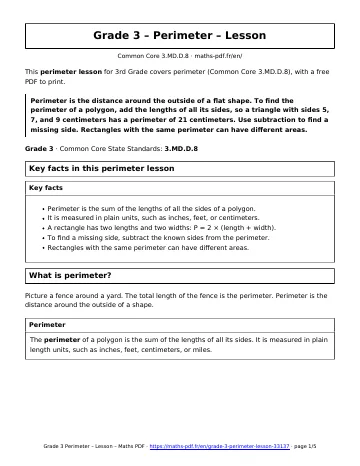
Perimeter is the distance around the outside of a flat shape. To find the perimeter of a polygon, add the lengths of all its sides, so a triangle with sides 5, 7, and 9 centimeters has a perimeter of 21 centimeters. Use subtraction to find a missing side. Rectangles with the same perimeter can have different areas.
This lesson helps Grade 3 students find the perimeter of polygons and solve problems with unknown sides. First, children learn that perimeter is the distance around a shape. Then they add all the side lengths and write the answer in plain units.
Next, the lesson shows shortcuts for rectangles, squares, and regular polygons. Also, it teaches how to find a missing side when the perimeter is known. Finally, it compares rectangles with the same perimeter but different areas. Plan about 20 minutes, with string and a ruler to trace around shapes.
Grade 3 · Common Core State Standards: 3.MD.D.8
Key facts in this 3rd grade perimeter lesson
- Perimeter is the sum of the lengths of all the sides of a polygon.
- Next, it is measured in plain units, such as inches, feet, or centimeters.
- A rectangle has two lengths and two widths: P = 2 × (length + width).
- Then, to find a missing side, subtract the known sides from the perimeter.
- Rectangles with the same perimeter can have different areas.
What is perimeter?
Picture a fence around a yard. The total length of the fence is the perimeter. Perimeter is the distance around the outside of a shape.
Add the sides of the triangle: \(5 + 7 + 9 = 21\). Its perimeter is 21 centimeters.
How do you find the perimeter of a polygon?
- Write the length of every side. Use the same unit for all of them.
- Add all the side lengths.
- Write the unit with the answer.
Example. A rectangle is 8 feet long and 3 feet wide. It has two sides of 8 feet and two sides of 3 feet.
\(8 + 3 + 8 + 3 = 22\), so the perimeter is 22 feet. A shortcut is to add one length and one width, then double: \(2 \times (8 + 3) = 22\).
In a regular polygon, all the sides are equal. Multiply one side by the number of sides.
\(6 \times 4 = 24\), so the perimeter of the hexagon is 24 centimeters.
How do you find a missing side length?
If you know the perimeter and all but one side, add the sides you know. Then subtract that sum from the perimeter.
The known sides add to \(9 + 3 + 4 + 3 + 6 = 25\). The missing side is \(30 – 25 = 5\) feet.
Can different rectangles have the same perimeter?
Yes. These three rectangles all have a perimeter of 14 units, but they cover different amounts of space.
The perimeters match, yet the areas are 6, 10, and 12 square units. Rectangles with the same perimeter can have different areas, and rectangles with the same area can have different perimeters.
3rd grade perimeter lesson: questions and answers
What is the difference between perimeter and area?
Perimeter is the distance around the outside of a shape, measured in units like feet. Area is the amount of flat space inside, measured in square units like square feet.
Do I always add all the sides to find perimeter?
Yes, the perimeter is the sum of all the sides. For a rectangle you can add the length and width and double it. For a regular polygon you can multiply one side by the number of sides.
How do I find a missing side when I know the perimeter?
Add the side lengths you know. Subtract that sum from the perimeter. The difference is the missing side.
Why do some sides have no label in a figure?
In shapes with right angles, opposite lengths can be found from the labeled ones. Find them before you add, so you do not skip any side.
Can two rectangles have the same perimeter but different areas?
Yes. A 2 by 5 rectangle and a 3 by 4 rectangle both have a perimeter of 14, but their areas are 10 and 12.
Common mistakes with this 3rd grade perimeter lesson
- Students write perimeter in square units. Perimeter measures a distance, so write inches or feet, not square inches. In other words, slow and careful work pays off here.
- Children add only the labeled sides of a figure. For a figure with right angles, find the unlabeled sides from the labeled ones first, then add all sides.
- When finding a missing side, students add the known sides and stop. Instead, subtract the known sides from the perimeter.
How to study this chapter
- First, trace around a shape with a finger and mark each side you add. Then you will not skip or repeat a side.
- For a rectangle, add the length and width, then double. Also check by adding all four sides. As a result, small mistakes are easier to catch.
- Parents can measure a table or a book cover and add the sides. Then ask how much string would go around it.
Download the 3rd grade perimeter lesson as a PDF with the button below and keep it with your notes.
More questions about 3rd grade perimeter lesson
Why is perimeter written in plain units?
Perimeter measures length along the edge of a shape, not the space inside. Length uses plain units such as inches, feet, or centimeters. Area counts squares inside the shape, so it uses square units. Also, saying the steps aloud helps you spot a slip.
How do you find the perimeter of a regular polygon?
All sides of a regular polygon have the same length. Multiply the side length by the number of sides. For example, a regular pentagon with sides of 5 inches has perimeter 5 times 5, which is 25 inches.
How do you find the perimeter of a figure with right angles and some unlabeled sides?
Use the labeled sides to find the missing lengths. Opposite sides that line up add to the same total. Then add all the sides around the figure. Then check the result once more before moving on.
All Grade 3 chapters: Grade 3 math.
More 3rd Grade math
Lessons
See all Properties of Multiplication Lesson: Notes and Examples
- Time, Liquid Volume and Mass Lesson: Notes and Examples
- Quadrilaterals and Partitioning Shapes Lesson: Notes and Examples
- Multiplication and Division Facts Within 100 Lesson: Notes and Examples
- Understanding Multiplication Lesson: Notes and Examples
- Multiplying by Multiples of 10 Lesson: Notes and Examples





Worksheets
See all- Rounding to the Nearest 10 and 100 Worksheets with Answers
- Two-Step Word Problems and Patterns Worksheets with Answers
- Perimeter Worksheets with Answers
- Adding and Subtracting Within 1,000 Worksheets with Answers
- Time, Liquid Volume and Mass Worksheets with Answers
- Quadrilaterals and Partitioning Shapes Worksheets with Answers



Tests
See all





Quizzes
See all- Two-Step Word Problems and Patterns Quiz: 10 Questions with Answers
- Scaled Graphs and Line Plots Quiz: 10 Questions with Answers
- Quadrilaterals and Partitioning Shapes Quiz: 10 Questions with Answers
- Multiplication and Division Facts Within 100 Quiz: 10 Questions with Answers
- Area Quiz: 10 Questions with Answers
- Properties of Multiplication Quiz: 10 Questions with Answers