3rd Grade Quadrilaterals and Partitioning Shapes Test with Answer Key (Free PDF)
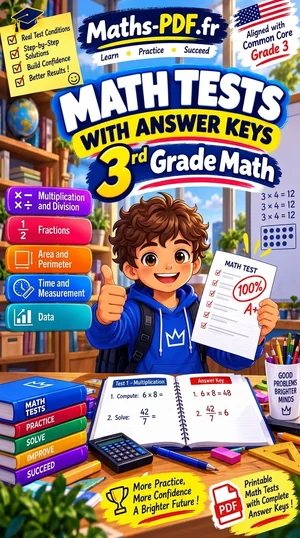
This 3rd grade quadrilaterals test covers quadrilaterals and partitioning shapes (Common Core 3.G.A.1, 3.G.A.2), with a free PDF to print.
Key takeaway: This test helps Grade 3 teachers and parents check whether students can classify quadrilaterals and partition shapes.
- Topic: Quadrilaterals and Partitioning Shapes (3rd grade)
- Content: 9 questions with point values, about 45 minutes
- Standards: 3.G.A.1, 3.G.A.2
- Answers: On a separate page, so you can try every worksheet problem first
- Format: Free printable PDF, US Letter, black and white
This test helps Grade 3 teachers and parents check whether students can classify quadrilaterals and partition shapes. It covers finding quadrilaterals, true or false statements, mystery shapes, sorting, drawing a new quadrilateral, equal parts on a grid, a cut square, a corn bread tray, and two cuts.
The test has 9 questions worth 20 points. First, students find quadrilaterals and decide true or false. Then they name two mystery shapes, sort shapes in a table, and draw a quadrilateral. Finally, they partition a rectangle and a square and name the parts. Allow 45 minutes for the whole test, and give each student a ruler and grid paper.
This test has 9 questions worth 20 points in all. Show your thinking when a question asks you to explain. Use a pencil and a ruler. You have 45 minutes.
Key takeaway: This Grade 3 test on Quadrilaterals and Partitioning Shapes works as a class assessment or a timed review at home: time and points, 3rd grade quadrilaterals test: questions and test-taking strategy. The detailed answer key with scoring is on a separate page; free PDF.
Time and points
- Grade: Grade 3
- Chapter: Quadrilaterals and Partitioning Shapes
- Standards: 3.G.A.1, 3.G.A.2
- Time: 45 minutes
- Total: 20 points
3rd grade quadrilaterals test: questions
1 – Which are quadrilaterals [2 pts]
First, write the letters of all the quadrilaterals.
2 – True or false [2 pts]
- Every square is a rhombus. (1 point)
- Every rectangle has 4 equal sides. (1 point)
3 – Two mystery shapes [2 pts]
- I have 4 equal sides and no right angles. Name me. (1 point)
- I have 4 right angles and 2 pairs of equal sides, but my sides are not all equal. Name me. (1 point)
4 – Sort the shapes [3 pts]
| Shape | Is it a rectangle? | Is it a rhombus? |
|---|---|---|
| Square | ? | ? |
| A 7 by 3 rectangle | ? | ? |
| Rhombus with no right angles | ? | ? |
Now, write yes or no for each question mark. Then explain why a trapezoid is neither. (1 point for the explanation)
5 – Draw a new quadrilateral [2 pts]
Also, draw a quadrilateral that is not a rhombus, not a rectangle, and not a square. Label the sides with lengths that show why.
6 – Equal parts on a grid [2 pts]
First, the rectangle is made of 18 equal squares. Draw lines to cut it into 3 parts with equal area. What fraction of the rectangle is one part?
Question 7 and after
7 – The cut square [2 pts]
Next, a square napkin with sides of \(8 ext{ in}\) is cut by a straight line from one corner to the middle of the opposite side. Aisha says the shaded triangle is \(\frac{1}{2}\) of the square because there are 2 parts. Is she right? Explain.
8 – Corn bread tray [3 pts]
Ethan bakes a rectangular tray of corn bread and cuts it into 8 pieces with equal area.
- What fraction of the tray is one piece? (1 point)
- Ethan cuts a second tray of the same size into 4 pieces with equal area. Are those pieces bigger or smaller than the first ones? (1 point)
- Explain your answer to part b. (1 point)
9 – Two cuts [2 pts]
Now, a square is cut into 4 parts with equal area. Maya cuts hers into 4 small squares. Jamal cuts his into 4 triangles. Do both children have fourths? Explain.

Key facts behind this 3rd grade quadrilaterals test
- A quadrilateral has exactly 4 straight sides and 4 corners.
- Also, a rhombus has 4 equal sides; a rectangle has 4 right angles.
- A square is a rhombus and a rectangle at the same time.
- Then, some quadrilaterals are not rhombuses, rectangles, or squares.
- Equal parts have equal area, and each of n equal parts is 1/n of the whole.
Common mistakes with this 3rd grade quadrilaterals test
- When sorting a shape in a table, students mark rectangle for a shape with only 4 sides. A rectangle needs 4 right angles.
- Also, when drawing a new quadrilateral, students draw a shape that fits a named group. Also, check that the sides and angles break the rules.
- When partitioning, students make unequal parts. Then, count the squares on the grid to check that each part has the same area.
Test-taking strategy
- Use the two key questions: does it have 4 equal sides, and does it have 4 right angles? Then name the shape.
- When partitioning, draw lines with a ruler and count squares for each part. Then name each part as a unit fraction.
- Also, parents can practice with a sheet of grid paper. Next, draw shapes and ask a child to name them by their attributes.
Download the 3rd grade quadrilaterals test as a PDF with the button below and keep it with your notes.
3rd grade quadrilaterals test: frequently asked questions
How should students explain that a shape is a quadrilateral?
Say that it has exactly 4 straight sides and 4 corners. For example, a kite is a quadrilateral even though it is not a rectangle or rhombus. A short sentence naming both attributes earns full credit.
What should a student do on a mystery shape question?
List the clues, then match them to the attributes of each shape. For example, 4 equal sides and no right angles describe a rhombus that is not a square. Also, check that every clue fits. As a result, small mistakes are easier to catch.
How do you name parts when a shape is cut into equal parts?
Count the equal parts to find the denominator. Each part is one over that number. For example, 8 equal parts mean each part is 1/8 of the whole. Also, saying the steps aloud helps you spot a slip.
All Grade 3 chapters: Grade 3 math.
More 3rd Grade math
Lessons
See all Rounding to the Nearest 10 and 100 Lesson: Notes and Examples
- Time, Liquid Volume and Mass Lesson: Notes and Examples
- Understanding Fractions Lesson: Notes and Examples
- Multiplying by Multiples of 10 Lesson: Notes and Examples
- Equivalent and Comparing Fractions Lesson: Notes and Examples
- Area Lesson: Notes and Examples



Worksheets
See all- Two-Step Word Problems and Patterns Worksheets with Answers
- Quadrilaterals and Partitioning Shapes Worksheets with Answers
- Time, Liquid Volume and Mass Worksheets with Answers
- Understanding Division Worksheets with Answers
- Properties of Multiplication Worksheets with Answers
- Understanding Multiplication Worksheets with Answers

Tests
See all




Quizzes
See all- Multiplying by Multiples of 10 Quiz: 10 Questions with Answers
- Area Quiz: 10 Questions with Answers
- Understanding Division Quiz: 10 Questions with Answers
- Quadrilaterals and Partitioning Shapes Quiz: 10 Questions with Answers
- Equivalent and Comparing Fractions Quiz: 10 Questions with Answers
- Properties of Multiplication Quiz: 10 Questions with Answers