3rd Grade Time, Liquid Volume and Mass Worksheets with Answers (Free PDF)
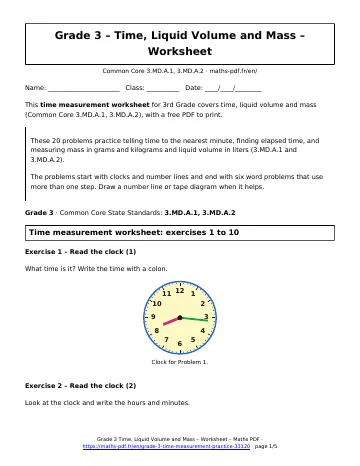
This 3rd grade elapsed time worksheet covers time, liquid volume and mass (Common Core 3.MD.A.1, 3.MD.A.2), with a free PDF to print.
Key takeaway: This worksheet helps Grade 3 students practice time, mass, and liquid volume.
- Topic: Time, Liquid Volume and Mass (3rd grade)
- Content: 20 worksheet problems, from easy to challenging
- Standards: 3.MD.A.1, 3.MD.A.2
- Answers: On a separate page, so you can try every worksheet problem first
- Format: Free printable PDF, US Letter, black and white
This worksheet helps Grade 3 students practice time, mass, and liquid volume. First, children read clocks to the nearest minute and find minutes left until the hour. Then they find elapsed time, end time, and start time with number lines.
The 12 problems also choose grams or kilograms, choose reasonable liters, add masses, and find how many more liters fill a beaker. Next, children solve word problems with the same unit. Finally, they check their answers with a number line or a quick estimate. Plan about 25 minutes, with a clock and a ruler for number lines.
These 20 problems practice telling time to the nearest minute, finding elapsed time, and measuring mass in grams and kilograms and liquid volume in liters (3.MD.A.1 and 3.MD.A.2).
The problems start with clocks and number lines and end with six word problems that use more than one step. Draw a number line or tape diagram when it helps.
Key takeaway: This Grade 3 worksheet on Time, Liquid Volume and Mass gives 20 problems, from warm-up questions to harder applications. The answer key is on a separate page; free printable PDF.
Grade 3 · Common Core State Standards: 3.MD.A.1, 3.MD.A.2
3rd grade elapsed time worksheet: worksheet problems 1 to 10
1 – Read the clock (1)
2 – Read the clock (2)
3 – Write the time
4 – Minutes until the hour
5 – Elapsed time in one hour
6 – Find the end time
7 – Number line jumps
8 – Find the start time
9 – Gram or kilogram
- A strawberry
- A bag of cat litter
Worksheet problem 10 and after
10 – Reasonable liters
Worksheet problems 11 and up
11 – Add masses
12 – Fill the beaker
13 – Compare masses
14 – Read the scale
15 – Equal groups of liters
16 – Share kilograms
17 – Homework time
18 – Two trips
Worksheet problem 19 and after
19 – Jug of water
20 – Crates of oranges

Key facts behind this 3rd grade elapsed time worksheet
- There are 60 minutes in 1 hour; count by 5s, then by 1s.
- Elapsed time = the jumps from start to end, added together.
- 1 kilogram = 1,000 grams.
- Liquid volume is measured in liters (L).
- Then, add, subtract, multiply, or divide measurements that use the same unit.
Common mistakes with this 3rd grade elapsed time worksheet
- When finding minutes until the next hour, students subtract the minutes from 100. An hour has 60 minutes, so subtract from 60.
- Also, when finding an end time, students add minutes to the hour only. Jump to the next hour first, then add the rest.
- When choosing g or kg, students pick g for heavy objects. A paper clip is a few grams, and a watermelon is a few kilograms.
Tips before you start the worksheet problems
- Draw a number line for every elapsed time problem. Then label the jump to the next hour first. In other words, slow and careful work pays off here.
- Use benchmark objects to choose units. For example, a paper clip is about 1 gram, and a loaf of bread is about 1 kilogram.
- Teachers can ask students to bring a measuring cup and compare a liter to other containers. As a result, small mistakes are easier to catch.
Download the 3rd grade elapsed time worksheet as a PDF with the button below and keep it with your notes.
3rd grade elapsed time worksheet: frequently asked questions
How do you find elapsed time across the hour?
Jump to the next hour, then add the rest. For example, from 3:40 to 4:15 is 20 minutes to 4:00, then 15 more, which is 35 minutes. A number line with two jumps makes this clear.
How do you choose a reasonable amount of water?
Compare it to a known container. A liter is about the size of a large water bottle. A bathtub holds many liters, and a cup holds a small fraction of a liter. Pick the amount that fits the object.
How do you add masses in different problems?
Make sure both masses use the same unit. Then add the numbers. For example, 150 g plus 220 g is 370 g. If the units differ, convert before adding. Then check the result once more before moving on.
All Grade 3 chapters: Grade 3 math.
More 3rd Grade math
Lessons
See all Equivalent and Comparing Fractions Lesson: Notes and Examples
- Multiplication and Division Facts Within 100 Lesson: Notes and Examples
- Quadrilaterals and Partitioning Shapes Lesson: Notes and Examples
- Properties of Multiplication Lesson: Notes and Examples
- Understanding Fractions Lesson: Notes and Examples
- Area Lesson: Notes and Examples






Worksheets
See all- Quadrilaterals and Partitioning Shapes Worksheets with Answers
- Two-Step Word Problems and Patterns Worksheets with Answers
- Understanding Fractions Worksheets with Answers
- Understanding Multiplication Worksheets with Answers
- Rounding to the Nearest 10 and 100 Worksheets with Answers
- Scaled Graphs and Line Plots Worksheets with Answers





Tests
See all





Quizzes
See all- Equivalent and Comparing Fractions Quiz: 10 Questions with Answers
- Multiplication and Division Facts Within 100 Quiz: 10 Questions with Answers
- Adding and Subtracting Within 1,000 Quiz: 10 Questions with Answers
- Quadrilaterals and Partitioning Shapes Quiz: 10 Questions with Answers
- Area Quiz: 10 Questions with Answers
- Rounding to the Nearest 10 and 100 Quiz: 10 Questions with Answers