3rd Grade Quadrilaterals and Partitioning Shapes Lesson: Notes and Examples (Free PDF)
This 3rd grade quadrilaterals lesson covers quadrilaterals and partitioning shapes (Common Core 3.G.A.1, 3.G.A.2), with a free PDF to print.
Key takeaway: This lesson helps Grade 3 students classify quadrilaterals and split shapes into equal parts.
- Topic: Quadrilaterals and Partitioning Shapes (3rd grade)
- Content: One-page lesson with a definition, a worked example and key facts
- Standards: 3.G.A.1, 3.G.A.2
- Answers: Explanations included
- Format: Free printable PDF, US Letter, black and white
Key takeaway: A clear Grade 3 lesson on Quadrilaterals and Partitioning Shapes, with definitions, rules and worked examples: what is a quadrilateral, how do you sort quadrilaterals by their attributes and can one shape belong to more than one group. Read it before the practice worksheet; free to print or download as a PDF.
A quadrilateral is a closed shape with exactly 4 straight sides and 4 corners. Squares, rectangles, rhombuses, and trapezoids are quadrilaterals, and shapes can be sorted by attributes such as equal sides and right angles. A shape cut into equal areas has parts named by unit fractions, like one fourth.
This lesson helps Grade 3 students classify quadrilaterals and split shapes into equal parts. First, children learn that a quadrilateral has exactly 4 straight sides and 4 corners. Then they learn the attributes that define rhombuses, rectangles, and squares.
Next, the lesson shows how shapes belong to groups, such as a square being both a rectangle and a rhombus. Also, it explains that some quadrilaterals fit none of these groups. Finally, it teaches partitioning shapes into equal areas and naming each part as a unit fraction. Plan about 20 minutes, with grid paper and shape cutouts.
Grade 3 · Common Core State Standards: 3.G.A.1, 3.G.A.2
Key facts in this 3rd grade quadrilaterals lesson
- A quadrilateral has exactly 4 straight sides and 4 corners.
- Also, a rhombus has 4 equal sides; a rectangle has 4 right angles.
- A square is a rhombus and a rectangle at the same time.
- Then, some quadrilaterals are not rhombuses, rectangles, or squares.
- Equal parts have equal area, and each of n equal parts is 1/n of the whole.
What is a quadrilateral?
A quadrilateral is a closed shape with exactly 4 straight sides and 4 corners. The word comes from “quad,” which means four, and “lateral,” which means side. Squares, rectangles, rhombuses, and trapezoids are all quadrilaterals. So are many shapes that have no special name.
How do you sort quadrilaterals by their attributes?
An attribute is something you can notice about a shape, like how many sides are equal, how many right angles it has, or whether sides are parallel. Parallel sides always stay the same distance apart and never meet. Shapes that share an attribute can go in the same group.
| Shape | Equal sides | Right angles | Parallel pairs |
|---|---|---|---|
| Square | all 4 | 4 | 2 |
| Rectangle | opposite sides | 4 | 2 |
| Rhombus | all 4 | not needed | 2 |
| Trapezoid | not needed | not needed | 1 |
Can one shape belong to more than one group?
Some quadrilaterals are not rhombuses, rectangles, or squares. A kite and a four-sided shape with sides of 4 different lengths are two examples. You can draw one by joining 4 points with straight sides.
How do you cut a shape into equal parts?
Equal parts have the same area, which is the amount of flat space a part covers. The parts do not have to look alike. If a shape is cut into 4 parts with equal area, each part is one fourth of the whole, written \(\frac{1}{4}\).
- Count how many equal parts the shape must make.
- Draw lines that make parts with the same area.
- Name one part with a unit fraction: 1 over the number of parts.
Example. Priya has a mat of 12 tiles. She wants 3 equal parts. Each part gets \(12 \div 3 = 4\) tiles, so each part is \(\frac{1}{3}\) of the mat.
3rd grade quadrilaterals lesson: questions and answers
How many sides does a quadrilateral have?
A quadrilateral has exactly 4 straight sides and 4 corners. If a closed shape has 3, 5, or 6 sides, it is not a quadrilateral.
Is a square a rectangle?
Yes. A rectangle is a quadrilateral with 4 right angles, and every square has 4 right angles. A square is a special rectangle whose sides are all equal.
What is the difference between a rhombus and a square?
Both have 4 equal sides. A square must also have 4 right angles, but a rhombus does not need any. So every square is a rhombus, but most rhombuses are not squares.
Do equal parts have to look the same?
No. Equal parts must have the same area, but they can have different shapes. A rectangle can be cut into 2 equal halves with a straight line down the middle or with a slanted line through the center.
How do you name one part of a shape cut into equal parts?
Write 1 over the number of equal parts. If a shape is cut into 6 parts with the same area, each part is one sixth of the whole.
Common mistakes with this 3rd grade quadrilaterals lesson
- Students think a square is not a rectangle. A rectangle has 4 right angles, and a square has them too. So a square is a special rectangle.
- Children call every shape with 4 equal sides a square. A rhombus also has 4 equal sides but may have no right angles. Then, check the angles too.
- When partitioning, students make parts that look equal but are not. Equal parts must cover the same area, so count squares on a grid to check.
How to study this chapter
- First, sort shape cutouts into groups by sides and angles. Then name each group and check that every shape fits.
- Fold a paper rectangle into equal parts and check by laying parts over each other. Also name one part, such as one fourth.
- Also, parents can find quadrilaterals at home, like a window, a book, or a kite. Next, ask what makes each one special.
Download the 3rd grade quadrilaterals lesson as a PDF with the button below and keep it with your notes.
More questions about 3rd grade quadrilaterals lesson
What is a trapezoid in third grade?
A trapezoid is a quadrilateral that is not a rectangle, rhombus, or square. Some trapezoids have one pair of parallel sides. In Grade 3, the focus is on the fact that quadrilaterals have many types, and each type has its own attributes.
How can shapes in different groups share attributes?
Many quadrilaterals share the attribute of having four sides. A rhombus and a rectangle share parallel opposite sides. A square has all the attributes of both a rhombus and a rectangle. Also, saying the steps aloud helps you spot a slip.
How do you split a rectangle into equal areas on a grid?
Count the squares in the whole rectangle and divide by the number of parts. For example, a rectangle of 12 squares cut into 4 parts has 3 squares in each part. Also, draw lines to make parts with the same number of squares.
All Grade 3 chapters: Grade 3 math.
Free printable PDF
3rd Grade Quadrilaterals and Partitioning Shapes Lesson: Notes and Examples
Download PDF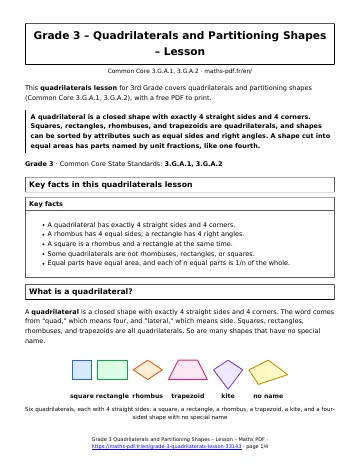
More 3rd Grade math
Lessons
See all Time, Liquid Volume and Mass Lesson: Notes and Examples
- Scaled Graphs and Line Plots Lesson: Notes and Examples
- Understanding Division Lesson: Notes and Examples
- Equivalent and Comparing Fractions Lesson: Notes and Examples
- Adding and Subtracting Within 1,000 Lesson: Notes and Examples
- Multiplying by Multiples of 10 Lesson: Notes and Examples


Worksheets
See all



Tests
See all- Multiplying by Multiples of 10 Test with Answer Key
- Adding and Subtracting Within 1,000 Test with Answer Key
- Scaled Graphs and Line Plots Test with Answer Key
- Rounding to the Nearest 10 and 100 Test with Answer Key
- Two-Step Word Problems and Patterns Test with Answer Key
- Time, Liquid Volume and Mass Test with Answer Key




Quizzes
See all- Multiplication and Division Facts Within 100 Quiz: 10 Questions with Answers
- Quadrilaterals and Partitioning Shapes Quiz: 10 Questions with Answers
- Equivalent and Comparing Fractions Quiz: 10 Questions with Answers
- Perimeter Quiz: 10 Questions with Answers
- Understanding Division Quiz: 10 Questions with Answers
- Understanding Fractions Quiz: 10 Questions with Answers