3rd Grade Equivalent and Comparing Fractions Lesson: Notes and Examples (Free PDF)
This 3rd grade equivalent fractions lesson covers equivalent and comparing fractions (Common Core 3.NF.A.3), with a free PDF to print.
Key takeaway: This lesson helps Grade 3 students find equivalent fractions and compare fractions.
- Topic: Equivalent and Comparing Fractions (3rd grade)
- Content: One-page lesson with a definition, a worked example and key facts
- Standards: 3.NF.A.3
- Answers: Explanations included
- Format: Free printable PDF, US Letter, black and white
Key takeaway: A clear Grade 3 lesson on Equivalent and Comparing Fractions, with definitions, rules and worked examples: what are equivalent fractions, how does a number line show equivalent fractions and can a whole number be written as a fraction. Read it before the practice worksheet; free to print or download as a PDF.
Equivalent fractions name the same amount, such as 1/2, 2/4 and 4/8. They are the same size on a model and at the same point on a number line. A whole number is also a fraction: 4/4 = 1 and 6/2 = 3. To compare fractions with the same denominator, compare numerators; with the same numerator, compare denominators.
This lesson helps Grade 3 students find equivalent fractions and compare fractions. First, children see that different fractions can name the same amount and sit at the same point on a number line. Then they write whole numbers as fractions.
Next, the lesson shows how to compare fractions with the same denominator and with the same numerator. Also, it uses bars and number lines with halves, thirds, fourths, sixths, and eighths. Finally, it teaches how to order fractions. Plan about 20 minutes, with fraction bars or strips of paper. Also, a pencil and scratch paper help children show each step.
Grade 3 · Common Core State Standards: 3.NF.A.3
Key facts in this 3rd grade equivalent fractions lesson
- Equivalent fractions name the same amount and sit at the same point on a number line.
- Examples with denominators 2, 3, 4, 6, and 8: 1/2 = 2/4 = 4/8 and 2/3 = 4/6.
- A fraction with the same top and bottom number equals 1, and n/1 equals n.
- Same denominator: the greater numerator makes the greater fraction.
- Same numerator: the smaller denominator makes the greater fraction.
What are equivalent fractions?
Two fractions are equivalent when they name the same amount, even if they look different. Cut a bar into 2 equal parts, then into 4, then into 8. The shaded amount stays the same.
How does a number line show equivalent fractions?
Put two number lines from 0 to 1 above each other. Cut one into fourths and the other into eighths. The point \(\frac{2}{4}\) lines up exactly with \(\frac{4}{8}\). Same point, same number.
Can a whole number be written as a fraction?
Yes. A fraction with the same numerator and denominator is one whole: \(\frac{4}{4}\) = 1. Any whole number is a fraction with denominator 1, so \(\frac{3}{1}\) = 3. Counting halves also works: six halves reach 3, so \(\frac{6}{2}\) = 3.
How do you compare two fractions?
You can only compare fractions when they describe the same whole. Use the symbols <, >, and =.
- Same denominator: the parts are the same size, so the greater numerator is the greater fraction.
- Same numerator: the fraction with the smaller denominator is greater, because its parts are bigger.
Worked example
- Look at the two fractions \(\frac{2}{3}\) and \(\frac{2}{6}\). The numerators match.
- Compare the denominators. Thirds are bigger pieces than sixths.
- Write the answer: \(\frac{2}{3} > \frac{2}{6}\).
3rd grade equivalent fractions lesson: questions and answers
What are equivalent fractions in third grade?
Equivalent fractions are different names for the same amount, like 1/2 and 2/4. You can see it when two models have the same shaded size.
How can you tell two fractions are equivalent on a number line?
Mark both fractions on number lines of the same length. If they land on the same point, the fractions are equivalent.
How do you write a whole number as a fraction?
Use denominator 1, so 5 = 5/1. You can also use equal numerator and denominator for 1, such as 6/6, or count parts like 6/2 = 3.
How do you compare fractions with the same denominator?
The parts are the same size, so compare the numerators. The fraction with the greater numerator is greater, so 5/8 is greater than 3/8.
Why is 1/3 greater than 1/6?
The numerators are the same, so compare part sizes. A whole cut into 3 equal parts has bigger parts than a whole cut into 6, so 1/3 is greater.
Common mistakes with this 3rd grade equivalent fractions lesson
- Students think a bigger denominator means a bigger fraction. For example, 1/8 looks bigger than 1/4 because 8 is bigger. Instead, more parts mean smaller parts, so 1/4 is greater.
- When writing equivalent fractions, students add the same number to the top and bottom. Instead, use bars to see that 2/4 matches 1/2 because both cover the same length.
- Children compare fractions by the numerator only. For example, 3/4 and 3/8 have the same numerator, but the denominators differ. The smaller denominator gives the greater fraction.
How to study this chapter
- First, fold paper strips into halves, fourths, and eighths. Then line them up to see which fractions cover the same length.
- Mark fractions on a number line. Also, notice that equivalent fractions land on the same point. Also, saying the steps aloud helps you spot a slip.
- Parents can compare slices of a pizza or a pie. Ask which slice is bigger when a pizza is cut into thirds or sixths.
Download the 3rd grade equivalent fractions lesson as a PDF with the button below and keep it with your notes.
More questions about 3rd grade equivalent fractions lesson
How can you show 1/2 equals 2/4 with paper strips?
Fold one strip into halves and another into fourths. Shade one half on the first strip and two fourths on the second. When you line them up, the shaded parts have the same length, so 1/2 equals 2/4.
Why does a fraction with the same numerator and denominator equal one?
The numerator tells how many parts you have, and the denominator tells how many parts make a whole. If you have all the parts, you have one whole. For example, 4/4 and 6/6 both equal 1.
How do you order fractions from least to greatest?
First, sort fractions by the same denominator or numerator when you can. Then use a number line or bars to compare the rest. The fraction that is farthest left on the number line is the least.
All Grade 3 chapters: Grade 3 math.
Free printable PDF
3rd Grade Equivalent and Comparing Fractions Lesson: Notes and Examples
Download PDF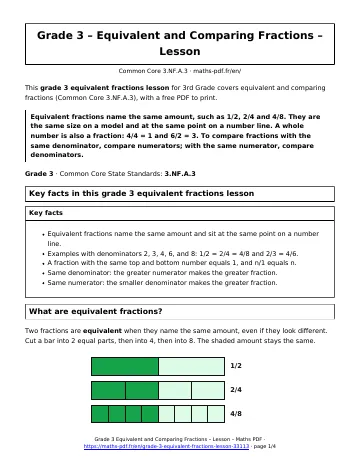
More 3rd Grade math
Lessons
See all Understanding Division Lesson: Notes and Examples
- Rounding to the Nearest 10 and 100 Lesson: Notes and Examples
- Understanding Multiplication Lesson: Notes and Examples
- Scaled Graphs and Line Plots Lesson: Notes and Examples
- Area Lesson: Notes and Examples
- Time, Liquid Volume and Mass Lesson: Notes and Examples



Worksheets
See all- Perimeter Worksheets with Answers
- Understanding Fractions Worksheets with Answers
- Two-Step Word Problems and Patterns Worksheets with Answers
- Scaled Graphs and Line Plots Worksheets with Answers
- Time, Liquid Volume and Mass Worksheets with Answers
- Quadrilaterals and Partitioning Shapes Worksheets with Answers
Tests
See all
Quizzes
See all- Equivalent and Comparing Fractions Quiz: 10 Questions with Answers
- Multiplication and Division Facts Within 100 Quiz: 10 Questions with Answers
- Understanding Fractions Quiz: 10 Questions with Answers
- Understanding Division Quiz: 10 Questions with Answers
- Time, Liquid Volume and Mass Quiz: 10 Questions with Answers
- Two-Step Word Problems and Patterns Quiz: 10 Questions with Answers